
Importance of Social Media Marketing in Business
Your customers are already scrolling. The question is whether your business is meeting them there in a way that actually matters.
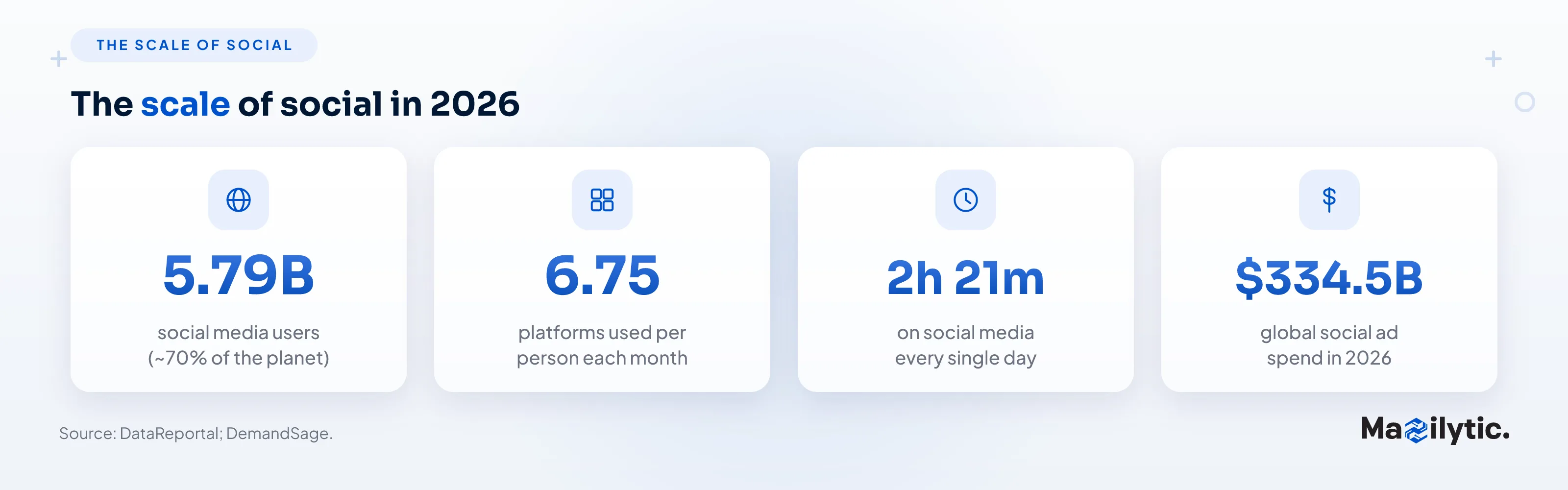
Social media marketing has moved far past posting updates and hoping something sticks. In 2026, it's a full commercial channel. There are now 5.79 billion social media users worldwide, nearly 70% of the entire global population. The average person uses 6.75 different platforms every month and spends roughly 2 hours and 21 minutes on social media daily. And global ad spending on social platforms has hit $334.5 billion this year.
That's not a trend. That's the new reality of where attention lives and where purchasing decisions get made.
Whether you're running a startup, a mid‑size company, or a growing enterprise, social media marketing for business is now one of the most direct lines to your target customer. But the landscape has shifted sharply. AI, short‑form video, in‑app shopping, and hyper‑personalization have changed what works. This guide covers where things stand in 2026 and what digital marketing strategies actually move the needle.
What Is Social Media Marketing?
Social media marketing is the practice of promoting a business, its products, or its services through platforms like Instagram, TikTok, LinkedIn, YouTube, Facebook, X (formerly Twitter), and Threads. It covers content creation, community engagement, paid advertising, influencer partnerships, and, increasingly, in‑app commerce.
What's different in 2026 is the sophistication of the tools and the expectations of the audience. Users don't just want content, they want relevance. They want it fast. And they want to buy without leaving the app.
Why Social Media Marketing Still Matters (More Than Ever)
Social media marketing for business works because it sits at the intersection of attention, trust, and purchasing intent.
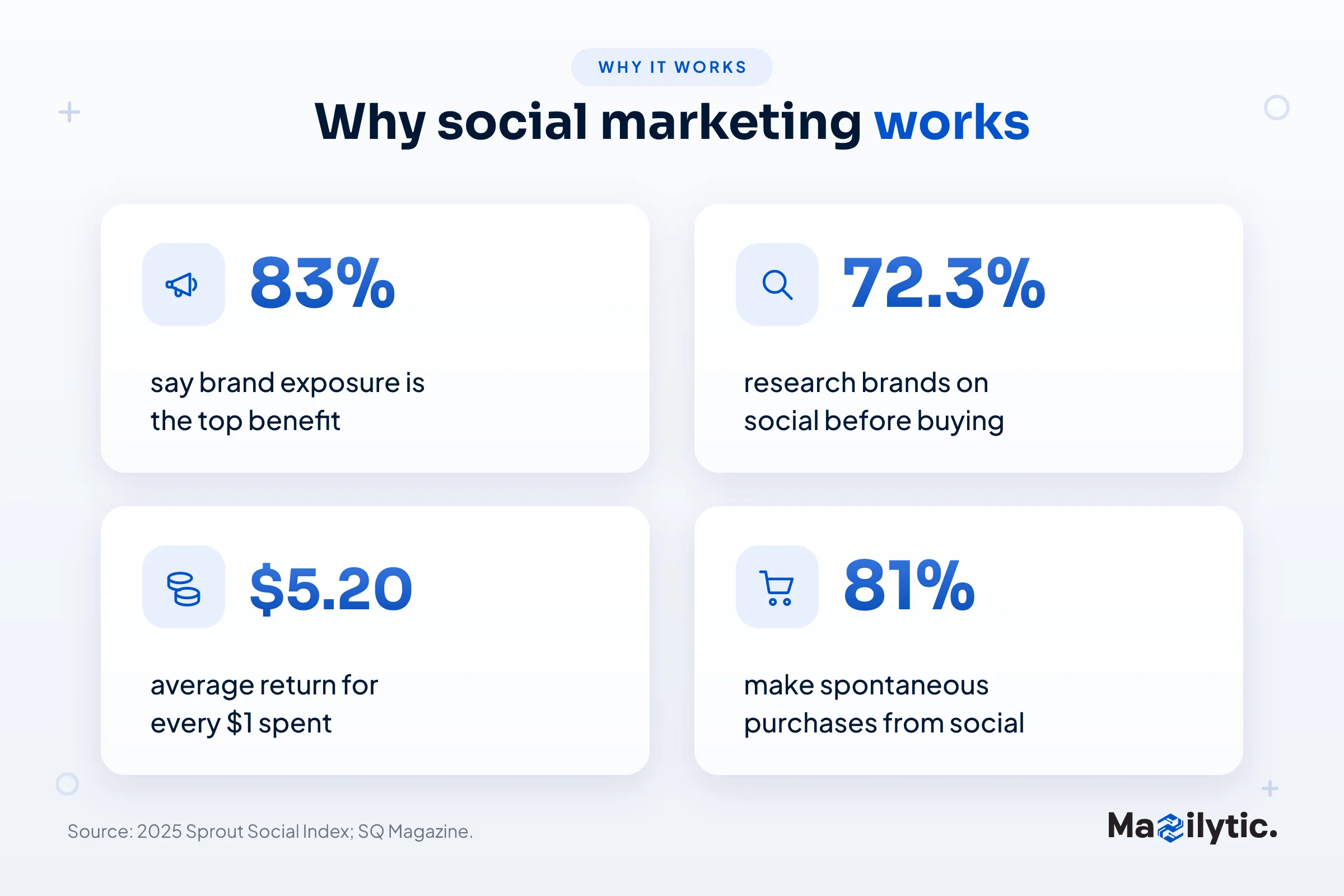
• 83% of marketers worldwide say the primary benefit of social media is increased brand exposure.
• 72.3% of online audiences use social media to research brands before making a purchase.
• 54.9% of social media users follow or research brands and products on networks before buying.
• Social media marketing delivers an average ROI of $5.20 for every $1 spent.
81% of consumers say social media compels them to make spontaneous purchases multiple times per year.
And it's cost‑effective compared to traditional advertising, but only when you have a real strategy behind it. Publishing content without intent is still a waste of time, no matter how big your following gets.
Top Social Media Trends in 2026
The trends that are actually driving results:
Short‑Form Video Is Winning
Short‑form video now delivers the highest ROI of any content format, cited by 41% of marketers. Instagram's algorithm is prioritizing Reels so aggressively that brands posting fewer than 4 Reels per week see overall account reach drop by 23%. TikTok users spend an average of 34 hours and 56 minutes per month on the platform. YouTube Shorts continues to drive serious traffic for brands that treat it as a standalone content type rather than repurposed content.
Social Search Is Replacing Google for Younger Audiences
34% of Gen Z now use social media as their primary search engine (Digital Applied, 2026). They go to TikTok and Instagram instead of Google to find products, read reviews, and compare options. This has direct implications for SEO services and how content is structured: keywords and discoverability now matter inside platform search, not just on the open web.
Authenticity Beats Polish
Human‑generated content is the #1 priority consumers expect from brands in 2026. Overly produced, corporate‑feeling content is losing engagement. Creators who speak naturally and brands that respond like humans are outperforming those chasing aesthetic perfection.
Threads Is a Real Platform Now
Threads has crossed 400 million monthly users with a 6.25% median engagement rate, roughly 73.6% higher than X's 3.6%. If your brand is still ignoring it, that gap is worth paying attention to.
Reference: Digital Applied, 200+ Social Media Statistics 2026; SQ Magazine; Sprout Social.
AI in Social Media Marketing
AI SEO optimization and AI‑powered content tools have moved from novelty to necessity. The AI in social media market is valued at $4.8 billion in 2026 and is projected to reach $42.5 billion by 2033, a 36.6% CAGR.
The practical impact is already measurable: AI‑optimized campaigns deliver up to 40 to 41% higher efficiency and conversion rates compared to manual campaigns.
References: Persistence Market Research, AI in Social Media Market 2026; SQ Magazine, 2026.
What AI is actually doing in social media marketing services right now:
• Content generation at scale: AI tools write captions, generate visuals, and suggest posting schedules. Around 82% of marketers already use AI for content generation, saving several hours per week.
• Smarter audience targeting: instead of broad demographic buckets, AI analyzes behavioral signals and purchase intent in real time, reducing wasted ad spend.
• Personalization: AI‑driven personalization in influencer campaigns can boost conversion rates by up to 20% and improve campaign efficiency by up to 30%.
• Sentiment analysis: modern tools monitor comments and community signals, letting brands adjust messaging in real time rather than quarterly.
Worth saying clearly: 46% of consumers aren't comfortable with AI influencers. The brands winning in 2026 use AI to work smarter behind the scenes while keeping their public‑facing content human and credible.
Reference: Sprout Social, 120+ Social Media Marketing Statistics 2026.
Social Commerce and In‑App Shopping
This is the biggest structural shift in social media marketing for business in the past two years.
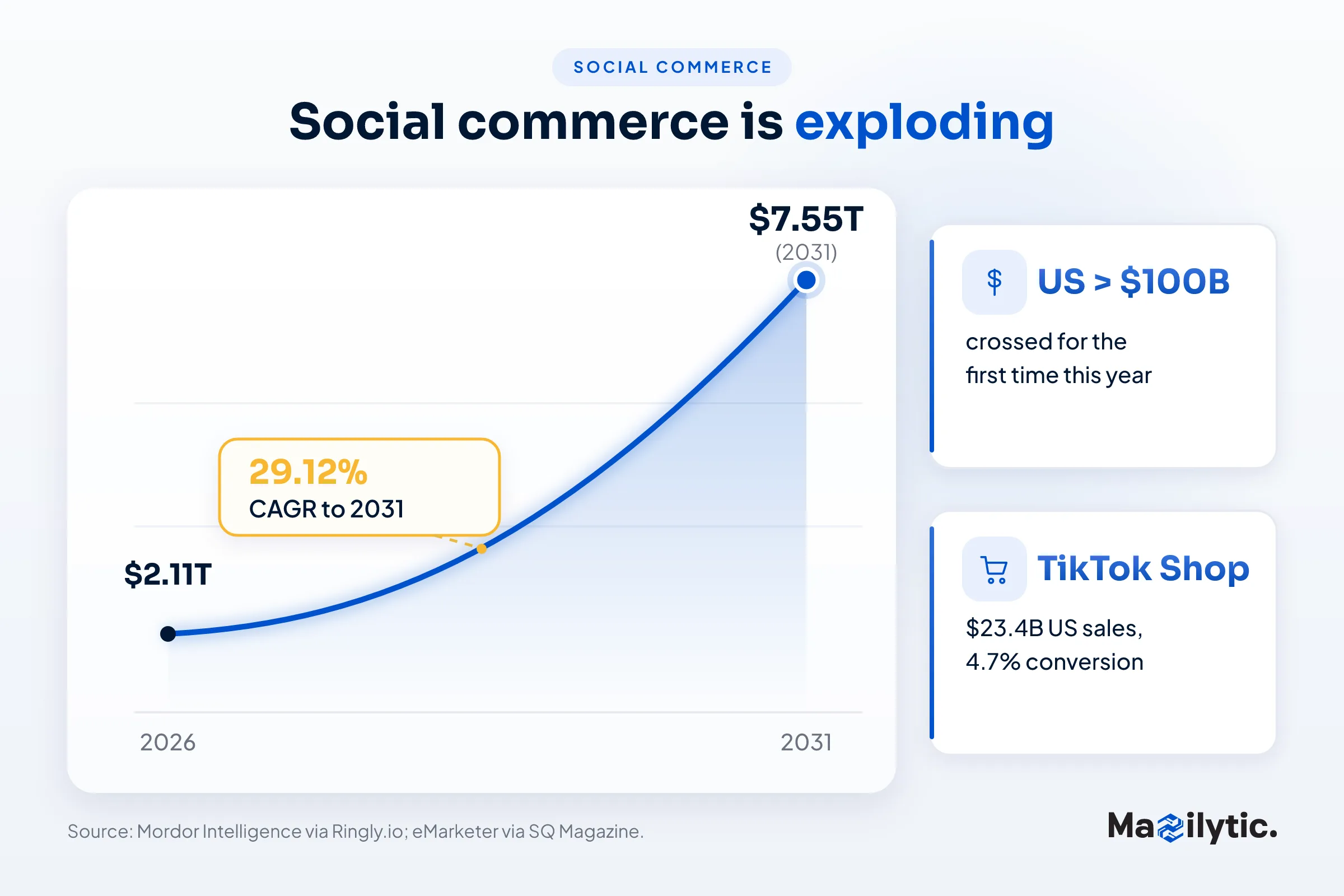
The global social commerce market hit $2.11 trillion in 2026, growing at a compound annual rate of 29.12% toward a projected $7.55 trillion by 2031. In the US alone, social commerce surpassed $100 billion for the first time this year.
What the platform data shows:
• TikTok Shop is projected to hit $23.4 billion in US ecommerce sales in 2026, bigger than Target or Costco online, with a 4.7% conversion rate.
• Instagram Shopping: 61% of users open the app specifically to find products. Instagram Reels delivers 30% higher ROI than other formats on the platform.
• Facebook Shops has 250 million monthly US users, with an add‑to‑cart conversion rate of 34.10%.
• Pinterest: 85% of weekly users have purchased a product they discovered through a Pin.
Reference: AutoFaceless, Social Commerce Statistics 2026; Synup.
The data on in‑app purchasing is clear: brands that redirect users to external product pages see 3.4x higher abandonment rates than those using native in‑app checkout. If your strategy still relies on “click the link in bio,” that's worth revisiting.
Reference: Digital Applied, 2026.
Choosing the Right Platform for Your Business
Not every platform is right for every business. Here's the honest breakdown:
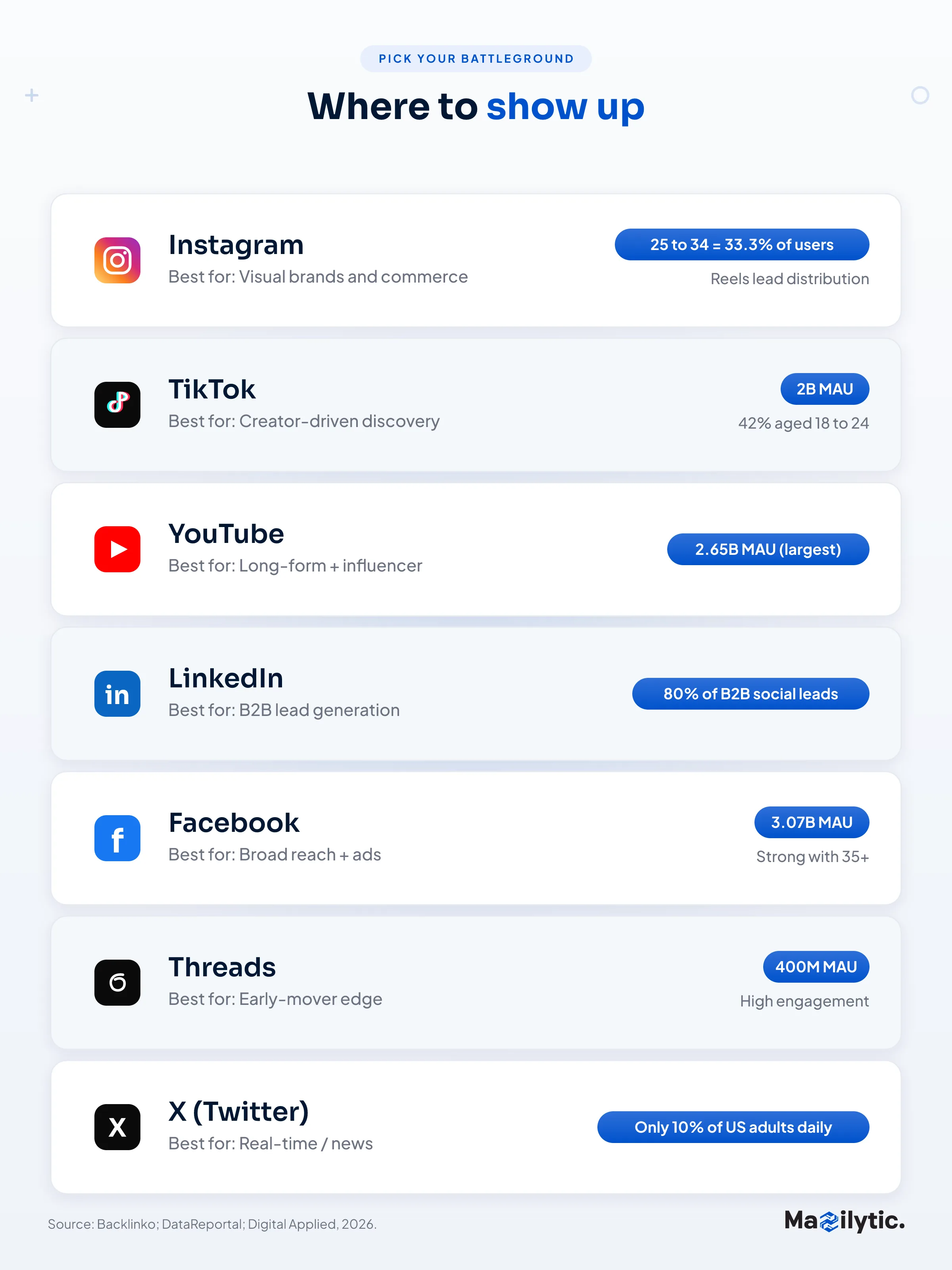
Best for visual brands, product discovery, and commerce. The 25 to 34 age group makes up 33.3% of global users. Reels are the algorithm's primary distribution lever right now.
TikTok
2 billion monthly active users (Backlinko, 2026). Fastest‑growing for commerce. 42% of users are 18 to 24. The go‑to platform for creator‑driven discovery and short‑form video.
YouTube
2.65 billion monthly active users, the largest by that metric (Backlinko, 2026). Highest engagement for influencer content. Essential for long‑form brand education, tutorials, and product walkthroughs.
The primary channel for B2B lead generation. 80% of social B2B leads originate on LinkedIn (Digital Applied, 2026). If you sell to businesses, this isn't optional.
Still the largest platform by monthly active users at 3.07 billion (DataReportal, 2026). Dominant for 35+ demographics. Best‑in‑class advertising tools, particularly for local targeting and retargeting.
Threads
Early advantage for brands willing to invest now. High engagement rate, fast‑growing user base, and currently less competitive than established platforms.
X (Twitter)
Declining daily usage (only 10% of US adults visit daily), but still relevant for real‑time commentary, brand news, and certain B2B niches.
Common Social Media Marketing Mistakes to Avoid
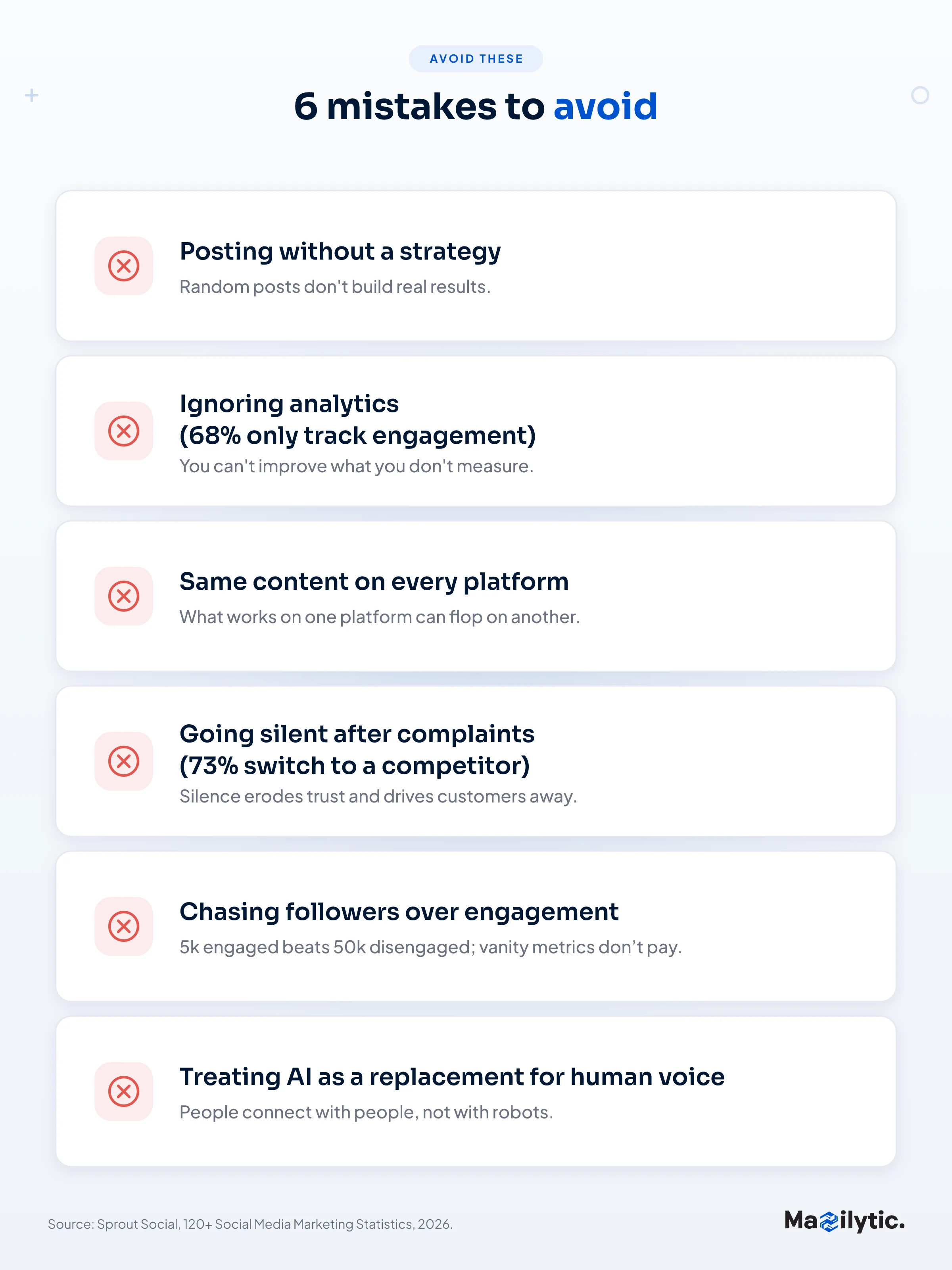
1. Posting without a strategy: content published without clear goals is noise. Every post should serve brand awareness, lead generation, community building, or conversion. Pick one per piece.
2. Ignoring analytics: 68% of marketing leaders measure social ROI primarily through engagement. That's not wrong, but it's incomplete. Revenue, conversion, and efficiency metrics tell a fuller story.
3. Using the same content across all platforms: a LinkedIn post and a TikTok video serve different audiences in different mindsets. Reposting without adapting format and tone almost always underperforms.
4. Going silent after complaints: 73% of consumers say they'll switch to a competitor if a brand doesn't respond on social media. Response time is now a brand‑trust signal.
5. Chasing follower count over engagement: a highly engaged audience of 5,000 consistently outperforms a disengaged following of 50,000 in conversion and revenue.
6. Treating AI as a replacement for human voice: AI tools should improve efficiency, not strip out personality. Audiences can tell the difference, and in 2026 they're more sensitive to it than ever.
How to Measure ROI and KPIs
Proving the value of social media marketing services requires tracking the right metrics, not just the easy ones.
Metrics worth tracking:
• Conversion rate: what percentage of social traffic takes the desired action?
• Cost per lead / cost per acquisition: what does each new lead or customer actually cost through social?
• Revenue attributed to social: social networks now generate 15.2% of total online sales.
• Engagement rate by reach: more meaningful than raw likes.
• Share of voice: how your brand's presence compares to competitors.
Tools commonly used: Sprout Social, Hootsuite, Meta Business Suite, TikTok Analytics, and Google Analytics 4 for cross‑channel attribution.
For paid campaigns, a 5:1 return is the standard expectation. Organic results build more slowly but compound over time, particularly for brand trust, community depth, and search discoverability.
Future of Social Media Marketing Beyond 2026
A few directions worth tracking:
AI agents managing campaigns end‑to‑end. The shift from AI‑assisted to AI‑autonomous campaign management is already underway, and early adopters are gaining meaningful efficiency advantages.
Live shopping maturing in Western markets. Live commerce converts at up to 30%, roughly ten times the rate of traditional product pages. The US is behind Asian markets but catching up fast.
Social platforms as search engines. The behavior is already there; the monetization and optimization infrastructure is being built around it now. Digital marketing strategies that don't account for platform‑native SEO will start to lag.
Community over broadcast. Niche communities, private groups, and subscriber‑only content are growing faster than public broadcast content. The brands building genuine communities now will have durable advantages within two to three years.
Conclusion
The platforms have changed. The tools have changed. Consumer behavior has changed. But the core of social media marketing for business hasn't: show up consistently, create content people actually want, and make it easy for them to take the next step.
The numbers in this article aren't hypothetical. They're what businesses achieving real growth through social media are generating right now.
CTA: Ready to build a social media strategy that drives real revenue? Mazilytic's Social Media Marketing Services help businesses develop and execute data‑driven strategies across every major platform. Get in touch to find out what's possible for your business.
FAQ
Q1: Why is social media marketing important for businesses in 2026?
A: Because 5.79 billion people use social media globally, spending an average of 2 hours and 21 minutes on platforms daily. It's where brand discovery happens, where purchase decisions are influenced, and where transactions get completed, all in one session, without leaving the app.
Q2: How does social media marketing help small businesses grow in 2026?
A: It levels the reach gap between small and large businesses. Organic content, creator partnerships, and highly targeted paid ads give small businesses access to specific audiences at a fraction of traditional advertising costs. Social commerce features on TikTok, Instagram, and Facebook let them sell directly through content without separate e‑commerce infrastructure.
Q3: What is the ROI of social media marketing?
A: For paid campaigns, a 5:1 return is considered standard. Influencer marketing can generate up to 18x ROI in top campaigns. Organic social builds more slowly but compounds as brand trust, community loyalty, and recurring revenue. Overall, social media delivers an average of $5.20 for every $1 spent.
Q4: How do you measure social media marketing success?
A: Beyond likes and follower counts, track conversion rate, cost per acquisition, revenue attributed to social, and engagement rate by reach. Strong teams tie social metrics directly to revenue and efficiency outcomes, not just engagement.