
A Step-by-Step Guide to Becoming a Programmer in 2026
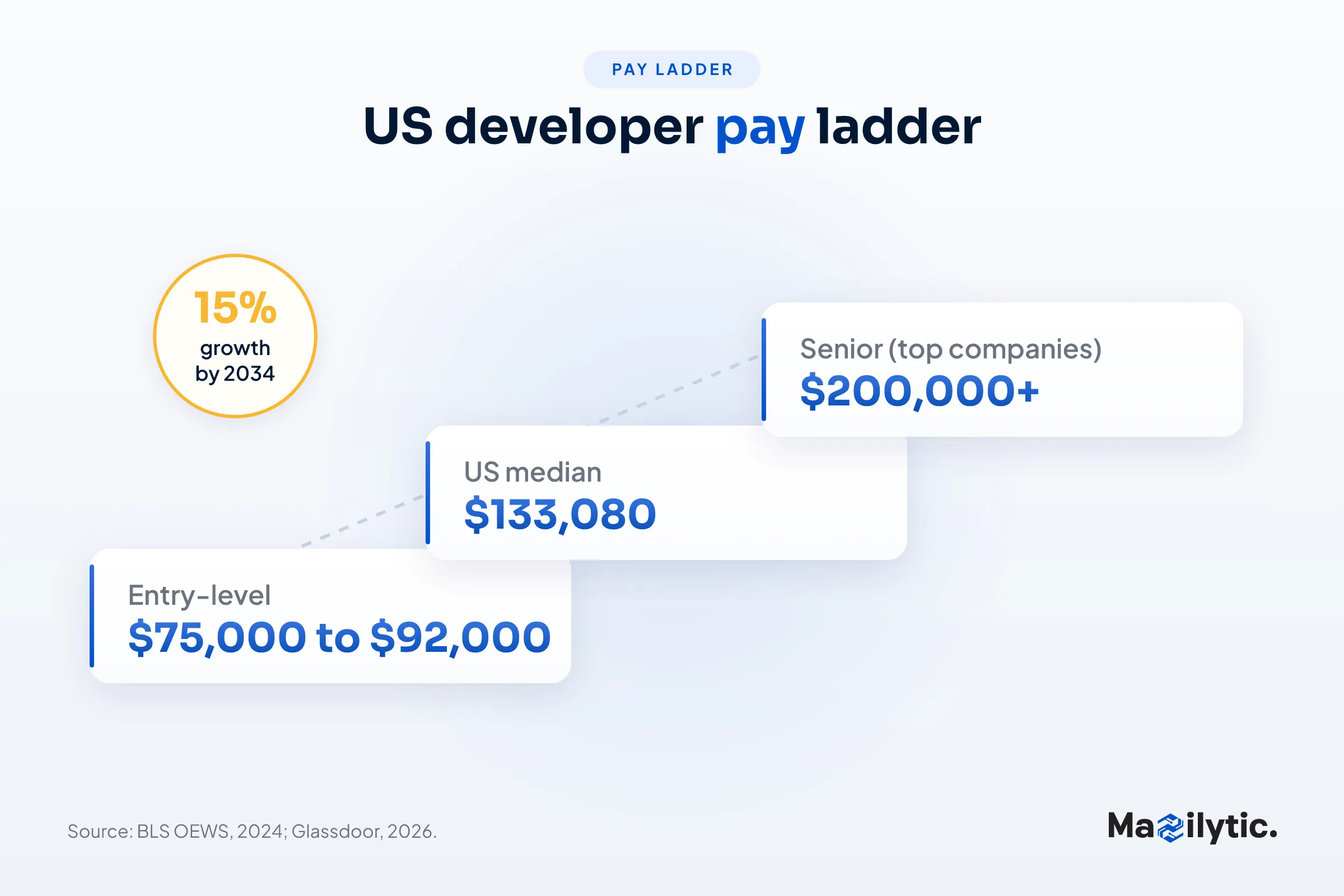
Software development is one of the strongest career bets available right now. The U.S. Bureau of Labor Statistics projects 15% employment growth for software developers from 2024 to 2034, more than four times the average growth rate across all occupations.
The median annual salary for a software developer in the US sits at $133,080, with entry‑level roles starting around $75,000 to $92,000 and senior engineers at top companies pulling in $200,000 or more in total compensation.
So the opportunity is real. But the path to getting there isn't always obvious, particularly for someone starting from scratch.
This programming career guide is built around what actually works: picking the right language, choosing the right learning format, building a portfolio that gets noticed, and preparing for the technical interview. Whether you want to become a programmer to land a full‑time job, switch careers, or start freelancing, the steps are largely the same. Here's how to do it.
Step 1: Understand the Programming Landscape
Before writing a single line of code, it's worth understanding what kind of programmer you want to be. The field covers a wide range of specializations, and each has a different day‑to‑day reality and a different set of in‑demand tools.
The main paths most developers land on are:
• Web development: building websites and web applications, split into frontend (what users see), backend (server‑side logic), and full‑stack (both). The most accessible entry point for most beginners and the area with the largest volume of jobs.
• Mobile app development: building for iOS or Android. Typically Swift or Kotlin, though cross‑platform tools like React Native and Flutter are increasingly common.
• Data science and machine learning: analyzing data, building predictive models, and working with AI systems. Python dominates here.
• Cybersecurity: protecting systems from attacks and vulnerabilities. One of the fastest‑growing specializations, with CompTIA projecting 367% growth for cybersecurity analysts from 2025 to 2035 (CompTIA State of the Tech Workforce, 2025).
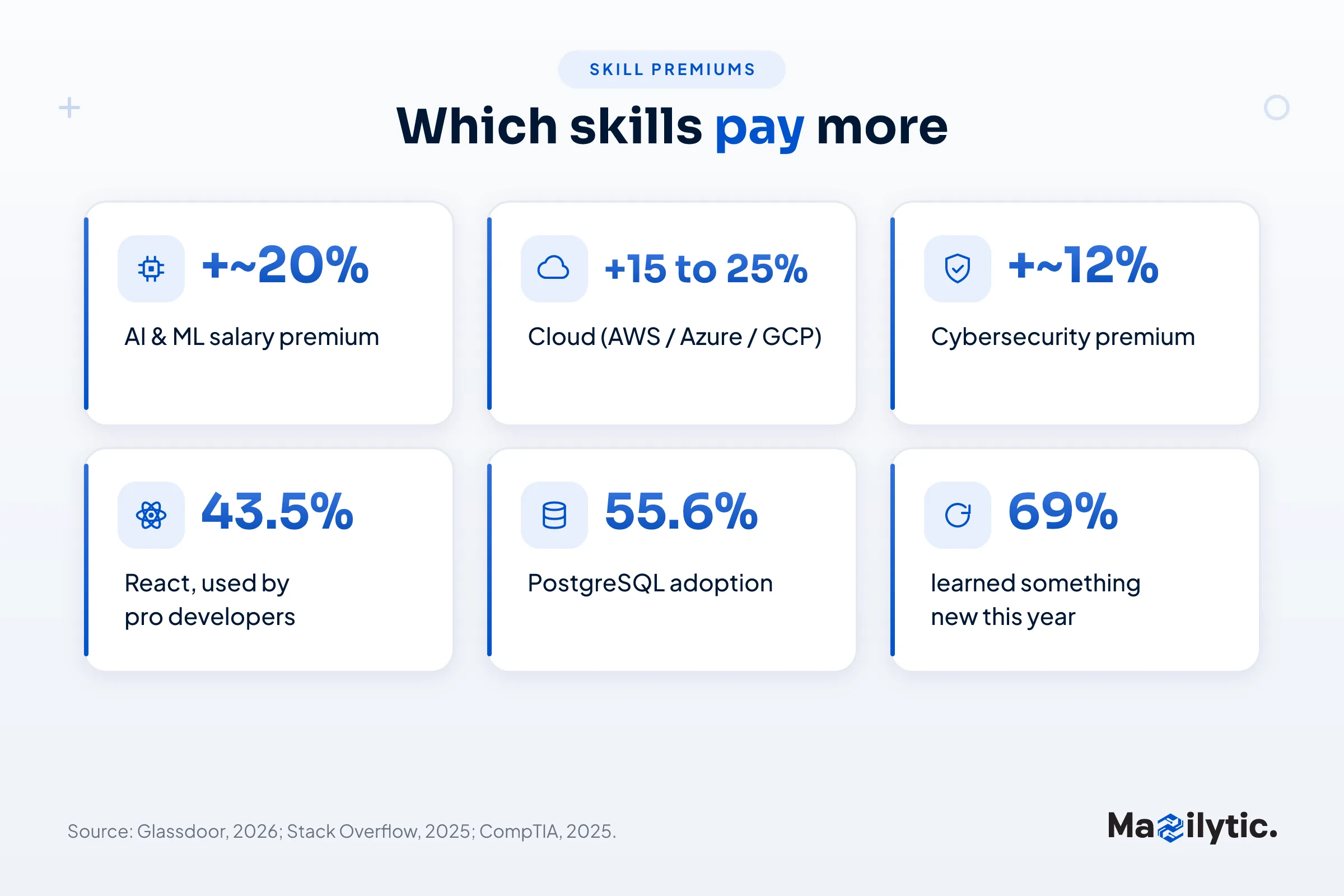
• DevOps and cloud engineering: managing infrastructure, deployment pipelines, and cloud platforms. AWS, Azure, and GCP certifications add a 15 to 25% salary premium (Glassdoor, 2026).
None of these paths is inherently harder or easier. They're different. The goal at this stage is to figure out which type of work is most interesting to you, because that shapes every learning decision that follows.
Step 2: Choose the Right Programming Languages for Beginners
The question “which programming language should I learn first?” gets debated constantly. The data gives a clear answer for most people.
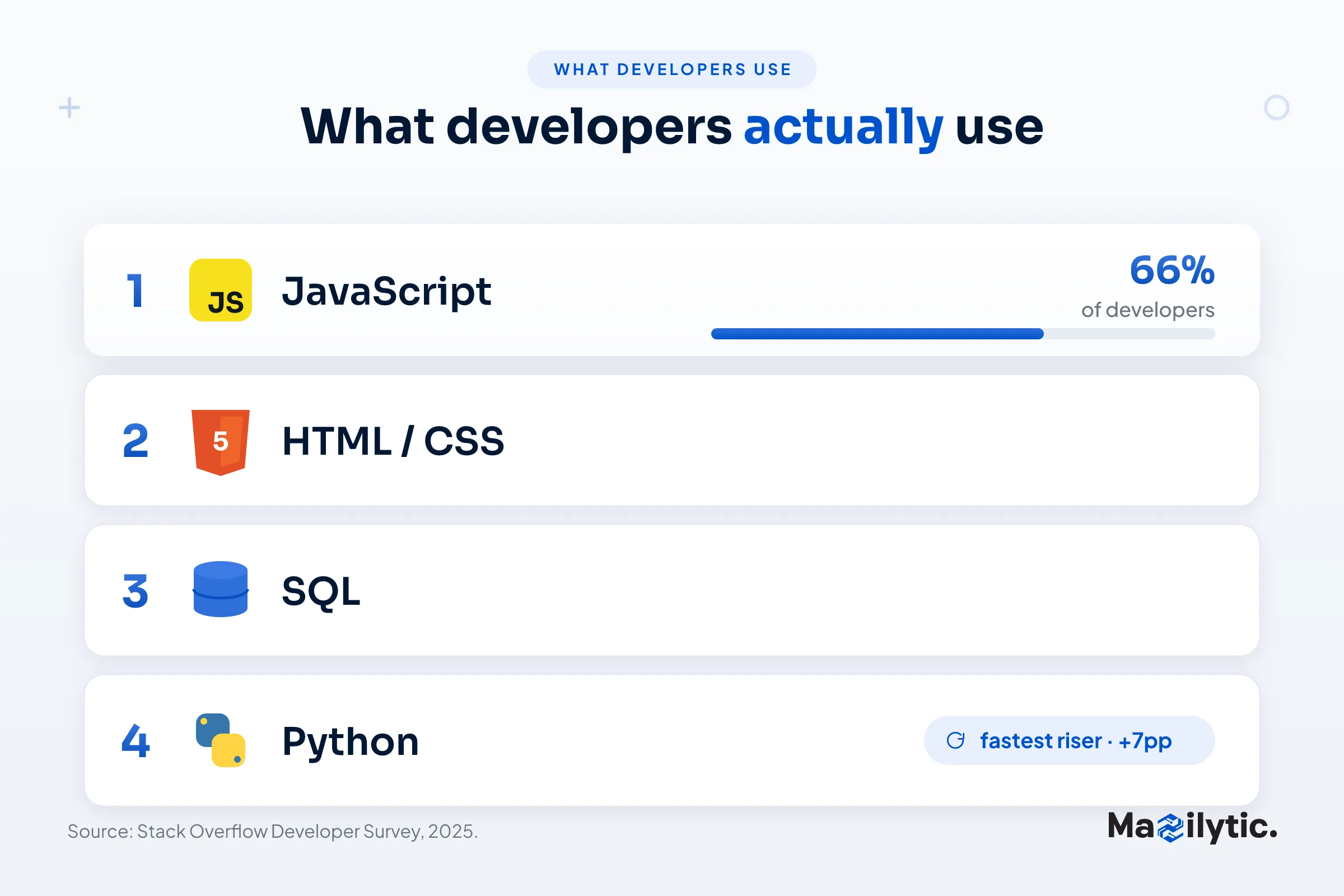
According to the 2025 Stack Overflow Developer Survey, conducted with over 49,000 developers across 177 countries, the most widely used languages were:
1. JavaScript, used by 66% of developers surveyed. The dominant language for web development, used in virtually every website and web application.
2. HTML/CSS, foundational to all web development. Not a full programming language, but essential for anything web‑based.
3. SQL, essential for working with databases. Used across almost every industry and backend system.
4. Python, which saw a 7 percentage point increase in usage year‑over‑year, the largest jump of any language in the survey. Now the go‑to for AI, machine learning, data science, and backend development.
For most beginners, the honest recommendation in 2026: start with Python if you're interested in data, AI, or backend work. Start with JavaScript if you want to build websites or web applications. Both are beginner‑friendly, widely used, and have enormous learning communities.
Python for beginners is particularly strong because the syntax is readable and close to plain English, which lets you focus on logic and problem‑solving rather than fighting the language. It's also the most in‑demand language for the fastest‑growing part of the industry, AI and machine learning.
JavaScript matters because it runs in every browser. It's the language of the web, which means every website you've ever used involves JavaScript in some way.
Secondary languages worth exploring once the fundamentals are solid include TypeScript (the typed version of JavaScript, growing fast in enterprise use), Java (dominant in enterprise software and Android), and SQL for database work.
Step 3: Choose Your Learning Format, Coding Bootcamp vs Degree
One of the most practical decisions in a software developer's career path is how to learn. There are three main options:
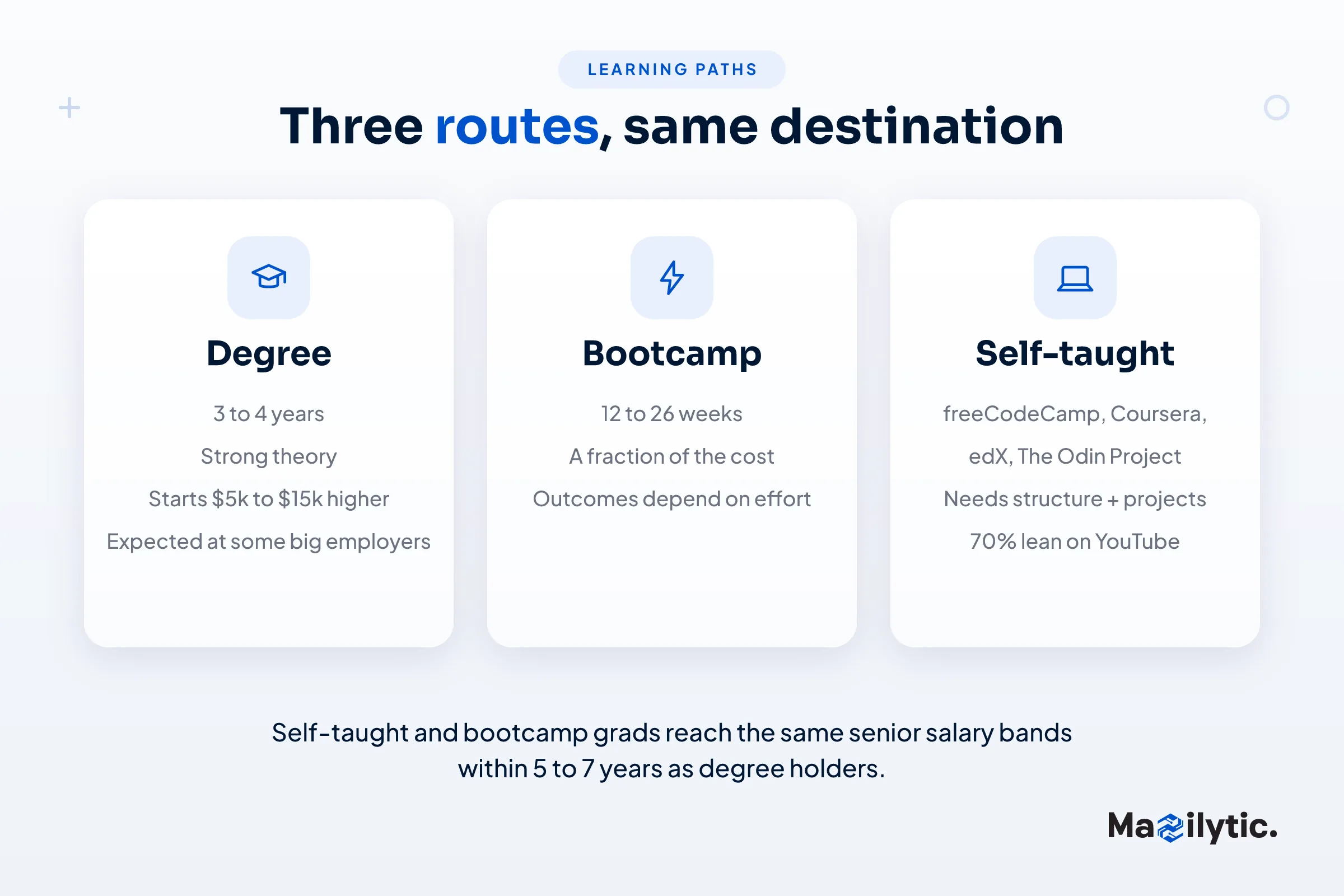
1. A computer science degree gives a strong foundation in theory (algorithms, data structures, computer architecture) and is still the expected credential at some large employers. Degree holders typically start $5,000 to $15,000 higher than bootcamp graduates in their first role.
2. A coding bootcamp compresses core skills into 12 to 26 weeks, typically at a fraction of the cost of a degree. Outcomes depend heavily on the quality of the bootcamp and how hard students work. Stack Overflow's 2025 survey shows self‑taught and bootcamp graduates reach the same senior‑level salary bands within 5 to 7 years as degree holders. Skills and demonstrable experience matter more than credentials past the first two or three years.
3. Self‑directed learning through platforms like freeCodeCamp, Coursera, edX, The Odin Project, or Codecademy is increasingly viable, particularly when combined with real project work. 68% of developers rely on technical documentation as their primary learning tool, and 70% of those learning to code use YouTube for tutorials.
Learn programming online effectively by combining a structured curriculum (bootcamp or a defined online course path) with consistent practice and real project‑building. Self‑study without structure is where most people stall.
The most honest summary: if you can afford a degree and have the time, it opens certain doors. If you need to move faster or more affordably, a quality bootcamp or structured self‑study path combined with a strong portfolio can get you to the same place.
Step 4: Build the Programming Fundamentals
Once a language and learning format are chosen, solidify the core concepts every programmer needs regardless of specialization:
• Variables and data types: how programs store and label information
• Control structures: conditionals (if/else) and loops (for, while) that control how a program flows
• Functions: reusable blocks of code that perform specific tasks
• Data structures: arrays, lists, dictionaries, and other ways of organizing data
• Object‑oriented programming (OOP): classes and objects, which underpin most modern software design
• Version control with Git: how to track code changes and collaborate. Non‑negotiable for any professional role.
Coding for beginners should focus on these fundamentals before frameworks, libraries, or specialization. A developer who deeply understands variables, functions, and control flow in one language can learn a second language far faster than one who skipped the foundations.
Step 5: Sharpen Programming Skills Through Real Projects
Reading about programming and actually writing code are completely different activities. Practical project work is where real learning happens and where the portfolio that gets people hired gets built.
Start with small, manageable projects: a to‑do list app, a simple calculator, a weather app that pulls from a public API. These build confidence with the full development loop: writing code, debugging it, and getting something that works.
Gradually increase complexity: after the basics, contributing to open‑source projects on GitHub is one of the best ways to learn from experienced developers, see real codebases, and demonstrate initiative. Over 180 million developers are on GitHub, and the platform merged 43.2 million pull requests monthly in 2025, a 23% year‑over‑year increase.
Build a portfolio website: this is where completed projects live. Show at least three to five projects of different complexity, each with a clear explanation of what it does, what technologies it uses, and what problems it solves. Employers use portfolios to assess real capability before interviewing, particularly for early‑career candidates.
Step 6: Understand the Web Development Career Path
For most beginners, the web development career is the most accessible entry point. The skill stack is well‑documented, job volume is high, and the path from beginner to employed developer is reasonably predictable.
A typical frontend developer learns HTML, CSS, JavaScript, and at least one major framework. React is currently used by 43.5% of professional developers. A backend developer works with a server‑side language (Node.js, Python, Java, or PHP), a database (PostgreSQL is now the most popular at 55.6% adoption), and an understanding of how APIs work. A full‑stack developer combines both.
The JavaScript path for aspiring web developers in 2026 covers JavaScript fundamentals, TypeScript for type safety, React or Vue for frontend, Node.js for backend, and SQL for databases. That stack covers the vast majority of web development roles.
Web development starting salaries in the US range from roughly $54,000 to $91,000 for junior roles, with experienced developers earning well above $100,000.
Step 7: Develop the Programming Skills That Get You Hired
Knowing how to code is necessary. But employers also look for surrounding skills that determine how useful a developer is in a real team.
According to CompTIA's 2025 State of the Tech Workforce report, the three skills employers most frequently flag as hard to find are:
1. Problem‑solving and analytical thinking: breaking complex requirements into workable solutions
2. Communication: explaining technical decisions to non‑technical stakeholders, writing clear documentation
3. Collaboration: working effectively in a team, using version control properly, reviewing others' code constructively
Beyond soft skills, the programming skills that command the highest market premium right now are AI and machine learning expertise (adds roughly 20% to baseline salary), cloud certification in AWS, Azure, or GCP (adds 15 to 25%), and cybersecurity knowledge (adds roughly 12%), according to cross‑platform salary analysis.
69% of working developers spent time in the past year learning new coding techniques or a new language; the field expects continuous learning, not just an initial credential.
Step 8: Land Your First Programming Job
Craft a targeted resume. Focus on projects, technologies used, and measurable outcomes. Tailor it to each role using the language from the job description. Many companies use automated screening that filters for keywords before a human reads the application.
Prepare for technical interviews. Interviews typically include coding challenges, algorithm questions, and sometimes system design for senior roles. LeetCode, HackerRank, and Codewars offer practice problems by difficulty and topic. Data structures and algorithms (arrays, linked lists, trees, sorting, searching) are the consistent core of what gets assessed.
Build a GitHub profile that speaks for itself. A recruiter who sees an active GitHub profile with real projects, consistent commits, and readable code has evidence of capability before the interview starts.
Network deliberately. Attend meetups, join developer communities on Discord and Reddit, connect with engineers on LinkedIn, and contribute to open‑source. The tech industry hires extensively through referrals.
FAQs
Q1: How long does it take to become a programmer?
A: Most bootcamp graduates are job‑ready in 4 to 6 months of intensive study. Self‑taught developers typically take 12 to 24 months. A computer science degree takes 3 to 4 years. The fastest path to employment is a focused bootcamp or structured self‑study combined with a strong project portfolio.
Q2: What is the best programming language to learn first?
A: Python for data science, AI, or backend work. JavaScript for web development. Both are beginner‑friendly, widely used, and have strong job markets. Learn SQL alongside either, since database skills are required in almost every role.
Q3: Is it too late to become a programmer with AI taking over?
A: The BLS still projects 15% job growth for software developers through 2034. AI is automating some routine coding tasks, which makes entry‑level hiring more competitive in places. But it's also creating new roles: 7 of the 10 fastest‑growing tech roles in 2025 were AI‑related. Developers who learn to work with AI tools are more in demand, not less.
Q4: How much can a programmer earn?
A: The US median software developer salary is $133,080. Entry‑level roles start around $75,000 to $92,000. Senior engineers at large tech companies earn $200,000 or more in total compensation. AI and ML specialization adds roughly 20% above baseline.
Conclusion
The path to becoming a programmer is more accessible in 2026 than it has ever been. The learning resources exist. The job demand is documented. The salary ceiling is real. What makes the difference isn't talent, it's consistency, deliberate practice, and a willingness to build things even when they break.
Start with one language. Build something small. Keep going. The programming career guide is useful, but the actual progress happens in the code editor, not by reading about it.
Whether you're aiming for a web development career, exploring Python for beginners, or mapping out a broader software developer career path, the fundamentals here apply across all of them. The next step is simply to begin.
CTA: Looking to build something before you're fully job‑ready? Mazilytic's web development team works with founders, product teams, and businesses to bring technical ideas to life. If you have a product concept and need experienced developers to build it, get in touch.