How to Choose the Right Mobile App Development Company in the UK
Choosing a mobile app development company is rarely just a technical decision. It's a business decision that determines whether your idea reaches customers on time, on budget, and actually works the way you imagined it. With thousands of agencies now competing for attention across London, Manchester, Leeds, and beyond, working out which mobile app development firm is genuinely right for your project, rather than just the one with the flashiest portfolio, takes a bit of a framework.
This guide walks through exactly that: how the UK market works, what things actually cost, which red flags to watch for, and how to shortlist a mobile app development company in the UK with confidence.
The UK Mobile App Market: Why This Decision Matters
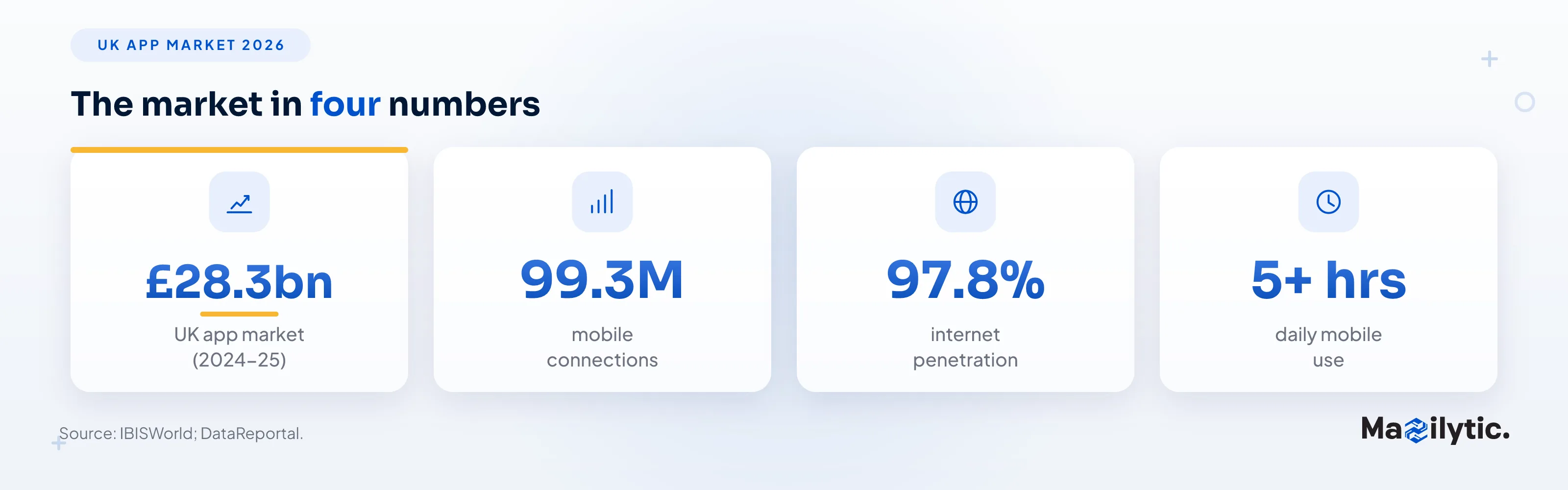
The UK app development industry isn't a niche corner of tech; it's a genuinely large and mature market. According to IBISWorld, the sector was worth an estimated £28.3 billion in the 2024‑25 financial year, employing roughly 73,470 people across 14,527 businesses. On the demand side, DataReportal's Digital 2026 report recorded 99.3 million cellular mobile connections in the UK by late 2025 (equivalent to 143% of the population), with internet penetration at 97.8%. British users now spend over five hours a day on mobile. For most consumer‑facing and operational businesses, a phone app isn't a "nice to have" anymore, but it's core infrastructure.
That scale is exactly why the selection process matters so much. Get it right, and you gain a long‑term technology partner who understands your sector, your users, and your growth plans. Get it wrong, and you're looking at blown budgets, missed launch windows, and an app that needs rebuilding within eighteen months.
What to Look for in a Mobile App Development Company
1. A Genuine Track Record, Not Just a Portfolio
Anyone can post polished mockups on a website. What separates a serious mobile app development firm from a shop that flips projects is a documented history of shipped, maintained products. Ask for named case studies, not anonymised ones. Ask who on the team will actually work on your build, not just who's in the sales pitch. Independent review platforms like Clutch and GoodFirms are useful here because they verify client engagements directly, rather than relying on testimonials a company chooses to publish itself.
2. Native and Cross‑Platform Expertise
A capable IT software development company should be able to explain, clearly, why they're recommending native development (Swift for iOS, Kotlin for Android) versus a cross‑platform framework like React Native or Flutter for your specific project, not just default to whichever they happen to specialise in. Cross‑platform tools can meaningfully cut cost and timeline for many business apps, but performance‑heavy or hardware‑dependent apps (camera‑intensive apps, AR features, high‑frequency trading tools) often still benefit from native builds.
3. Sector and Regulatory Experience
If you're building in a regulated space like fintech, healthcare, or anything that handles personal data under the UK GDPR, sector experience isn't optional. A mobile app development company that has already navigated FCA compliance for a banking app, or NHS‑adjacent data handling for a healthtech product, will save you months of rework compared to a generalist team learning the compliance landscape on your dime.
4. Post‑Launch Support, Not Just Delivery
A phone app is never really "finished" at launch; operating system updates, security patches, and user feedback all demand ongoing attention. Ask exactly what a firm's maintenance package includes, what response times look like, and what's billable versus included. Agencies that treat delivery as a handoff rather than the start of an ongoing relationship are a common source of post‑launch headaches.
5. AI Capability, Used Appropriately
AI has moved from novelty to near‑default expectation in app development, and on‑device AI and edge intelligence via chips like Apple's Neural Engine and Qualcomm's Snapdragon AI Engine are increasingly standard rather than experimental. Developer adoption of AI tooling is now nearly universal: Stack Overflow's 2025 Developer Survey, based on more than 49,000 respondents, found that 84% of developers use or plan to use AI tools in their workflows, up from 76% in 2024. Notably, though, trust in those tools' accuracy has fallen sharply, with only 29% saying they trust the output. The key question to ask any prospective partner isn't "do you use AI?"
Nearly everyone will say yes, but where and why? Is it improving personalisation and workflow automation for your users, or is it just marketing language layered onto a standard build?
How Much Does Mobile App Development Cost in the UK?
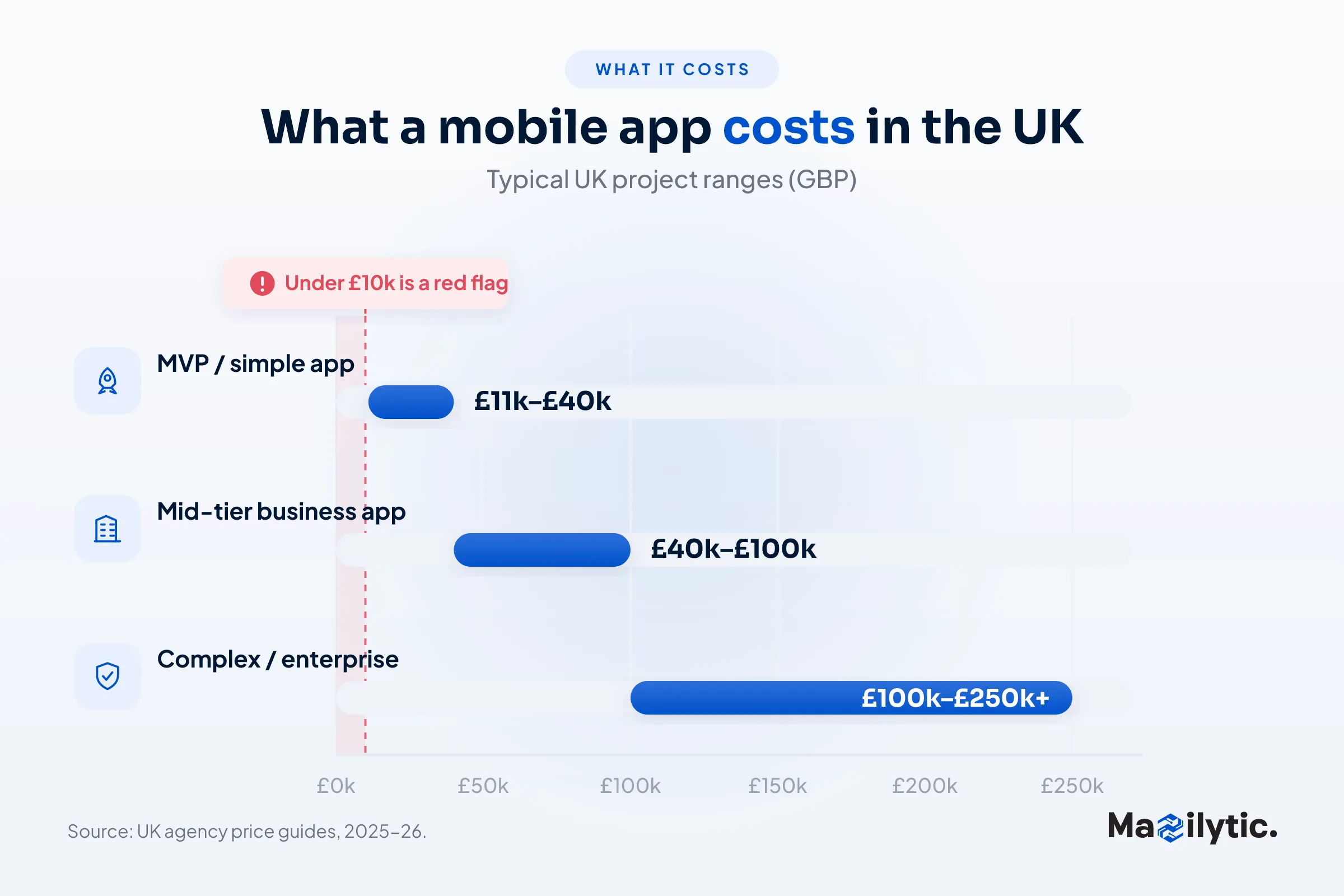
This is usually the first question business owners ask, and the honest answer is: it depends enormously on scope. There is no single authoritative UK price list; the figures below are synthesised from multiple UK agency price guides published in 2025‑26, and should be treated as indicative bands rather than fixed quotes:
- Simple app / MVP: Roughly £11,000-£40,000. Basic builds with limited features, useful for validating an idea before committing to a larger project.
- Mid‑tier business app: Roughly £40,000-£100,000, covering more complex functionality, backend integrations, and polished UI/UX.
- Complex or enterprise app: £100,000-£250,000+, typical for apps with real‑time data, heavy third‑party integrations, AI features, or strict regulatory requirements such as fintech or healthcare.
For a sense of the wider picture, Clutch's global directory data puts the average app development project at around $90,780, with a typical timeline of about 11 months and most projects falling between $10,000 and $50,000. But note that this is a worldwide average, skewed upward by a handful of very large enterprise builds, not a UK‑specific figure. For UK‑specific rate evidence, ITJobsWatch reported a median contractor day rate of £500 for software developers as of April 2026 (£530 in London, £510 outside it).
If a quote comes in dramatically under £10,000 for anything beyond the simplest single‑feature app, treat it as a red flag rather than a bargain. It usually signals corners will be cut on testing, security, or post‑launch support. Offshoring development to regions like India or the Philippines can reduce build costs by roughly 40‑50% according to UK agency estimates. Still, it's worth weighing that saving against time‑zone friction, communication overhead, and the compliance expertise a UK‑based mobile app development firm brings to regulated sectors.
Business Mobile Apps vs. Turning a Website Into an App
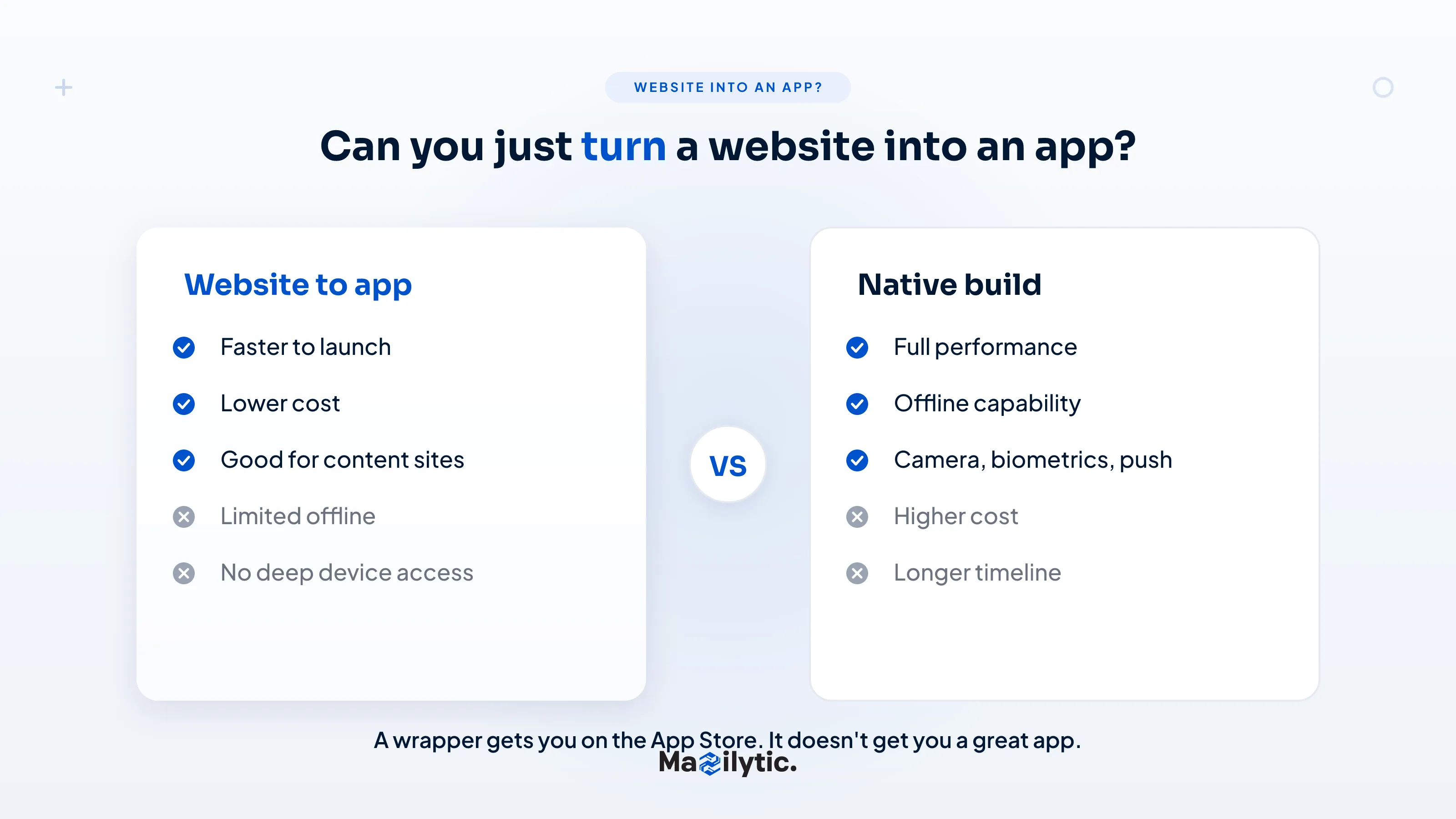
Not every business needs a fully custom build from day one. If you already have a strong website, one increasingly common and cost‑effective starting point is to convert that website into an app using a hybrid or wrapper approach, giving customers a native‑feeling mobile presence without a ground‑up rebuild. This route tends to suit content‑driven businesses, service directories, and companies wanting a faster, lower‑cost route to the App Store and Google Play before committing to a fully bespoke product.
That said, a website‑to‑app conversion has real limits. It won't deliver the performance, offline functionality, or deep device integration (camera, biometrics, push personalisation) that a fully native or cross‑platform build offers. The right mobile app development company should be upfront about which approach actually fits your goals, rather than steering every client toward whichever service is most profitable for them.
The commercial case for going mobile‑first is strong either way. Engagement data long cited across the industry suggests shoppers spend dramatically more time in dedicated shopping apps than on mobile shopping websites, on the order of 200 minutes a month versus around 10. More recent figures point the same way: Capital One Shopping reports that 85% of US mobile shoppers prefer apps to mobile websites, and app users consistently show higher average order values than mobile‑web shoppers. For business mobile apps specifically, that engagement gap is exactly why so many UK companies are prioritising native or near‑native mobile experiences over browser‑only strategies.
Questions to Ask Before You Sign
A short, practical checklist before committing budget to any mobile app development company:
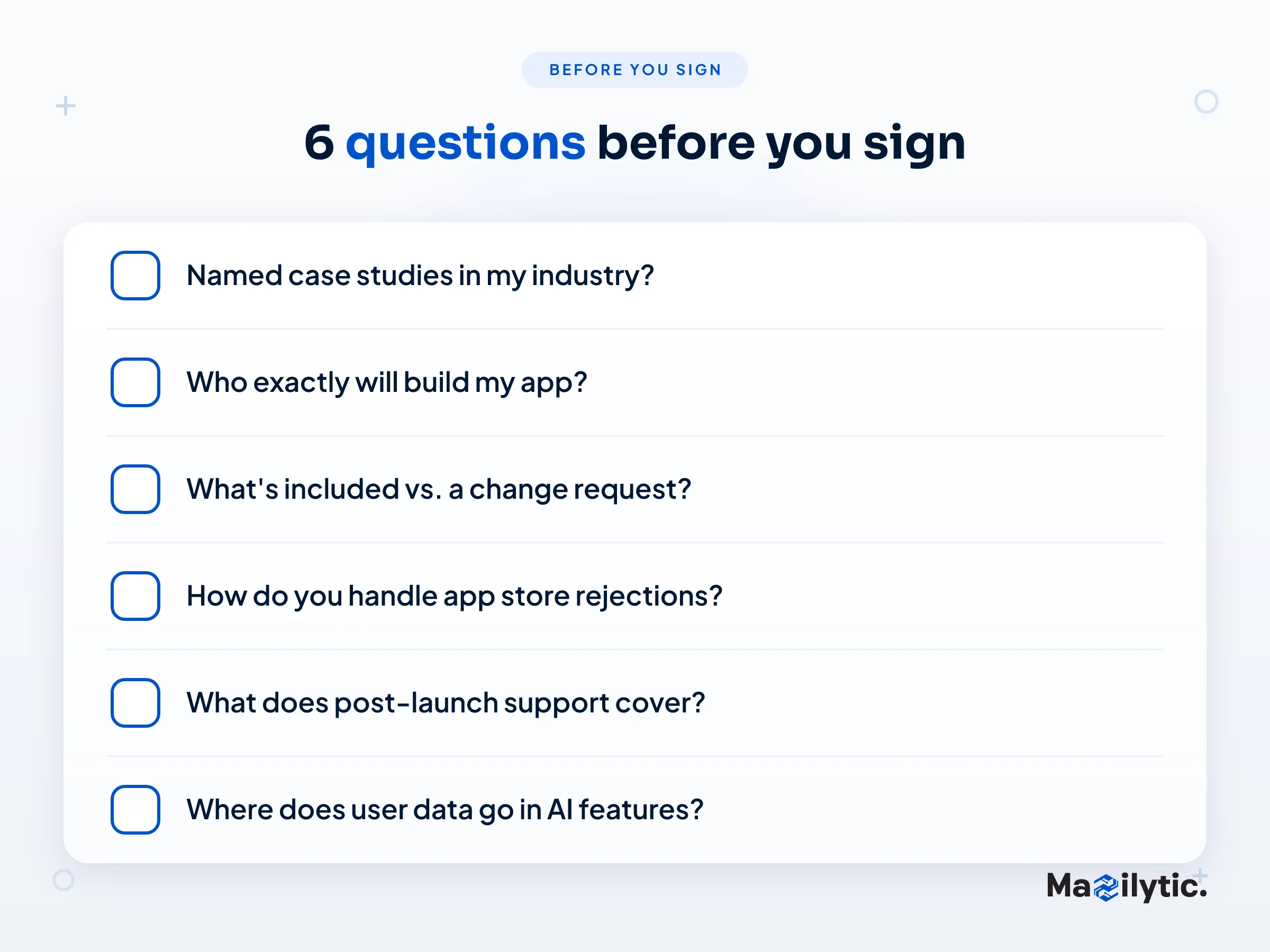
- Can you show me two or three case studies in my industry, with named clients I can contact directly?
- Who specifically will be working on my project, and what's their experience level?
- What's included in your quoted price, and what typically becomes a change request?
- How do you handle App Store and Google Play submission and rejection risk?
- What does your post‑launch support and maintenance agreement actually cover?
- If my project involves AI features, what's the specific use case and what happens to user data?
Vague answers to any of these, or a refusal to provide named references, are the clearest signal to keep shortlisting.
Native, Cross‑Platform, or AI‑Native: Choosing the Right Build
For most UK businesses in 2026, the practical decision tree looks roughly like this:
- Tight budget, need to validate an idea fast: A cross‑platform MVP, or a website‑to‑app conversion if you already have strong web traffic.
- Consumer‑facing app competing on user experience: Native or high‑quality cross‑platform development, with a design‑led firm that treats UI/UX as core, not decorative.
- Regulated industry (fintech, healthcare, public sector): A mobile app development firm with proven compliance experience and, ideally, ISO 27001 certification.
- AI‑driven product (personalisation, automation, on‑device intelligence): A team that can demonstrate real AI implementation experience, not just AI‑assisted code generation, which is now standard practice across the industry regardless of the firm you choose.
Final Thoughts
The right mobile app development company in the UK isn't necessarily the biggest name, the cheapest quote, or the agency with the most impressive‑looking case study slide. It's the partner whose track record, sector expertise, and post‑launch commitment genuinely match what your business needs, at a cost that's transparent from the first conversation.
Take the time to verify claims independently, ask for named references, and get a clear, itemised quote before committing. A well‑chosen mobile app development firm becomes a long‑term technology partner; a poorly chosen one becomes a project you're rebuilding within two years.
Frequently Asked Questions
Q1: How much does it cost to build a mobile app in the UK?
It depends on scope. A simple app or MVP typically runs £11,000 to £40,000, a mid‑tier business app £40,000 to £100,000, and a complex or enterprise app £100,000 to £250,000 or more. Treat these as indicative bands rather than fixed quotes, and be wary of anything under £10,000 for a real build.
Q2: How do I choose a mobile app development company in the UK?
Look for a documented track record of shipped products, named case studies you can verify, clear native versus cross‑platform reasoning, relevant sector and compliance experience, and a real post‑launch support plan. Ask who will actually build your app, not just who is in the sales pitch.
Q3: Is it better to build a native app or turn a website into an app?
A website‑to‑app (wrapper) approach is faster and cheaper and suits content‑driven businesses, but it cannot match native performance, offline capability or deep device features like camera and biometrics. A good partner will be honest about which route fits your goals rather than defaulting to whichever is most profitable for them.
Q4: What is a red flag when hiring an app developer?
A quote dramatically under £10,000 for anything beyond the simplest single‑feature app is the clearest warning sign; it usually means corners will be cut on testing, security or post‑launch support. Vague answers about process, or a refusal to provide named references, are also reasons to keep shortlisting.
CTA: Ready to build your next app?
Mazilytic works with UK businesses to design, build, and support custom mobile apps from early‑stage MVPs to AI‑powered, enterprise‑grade platforms. Get in touch to talk through your project and get a clear, honest cost estimate.