
Custom App vs No-Code App Builders: What's Better in 2026?
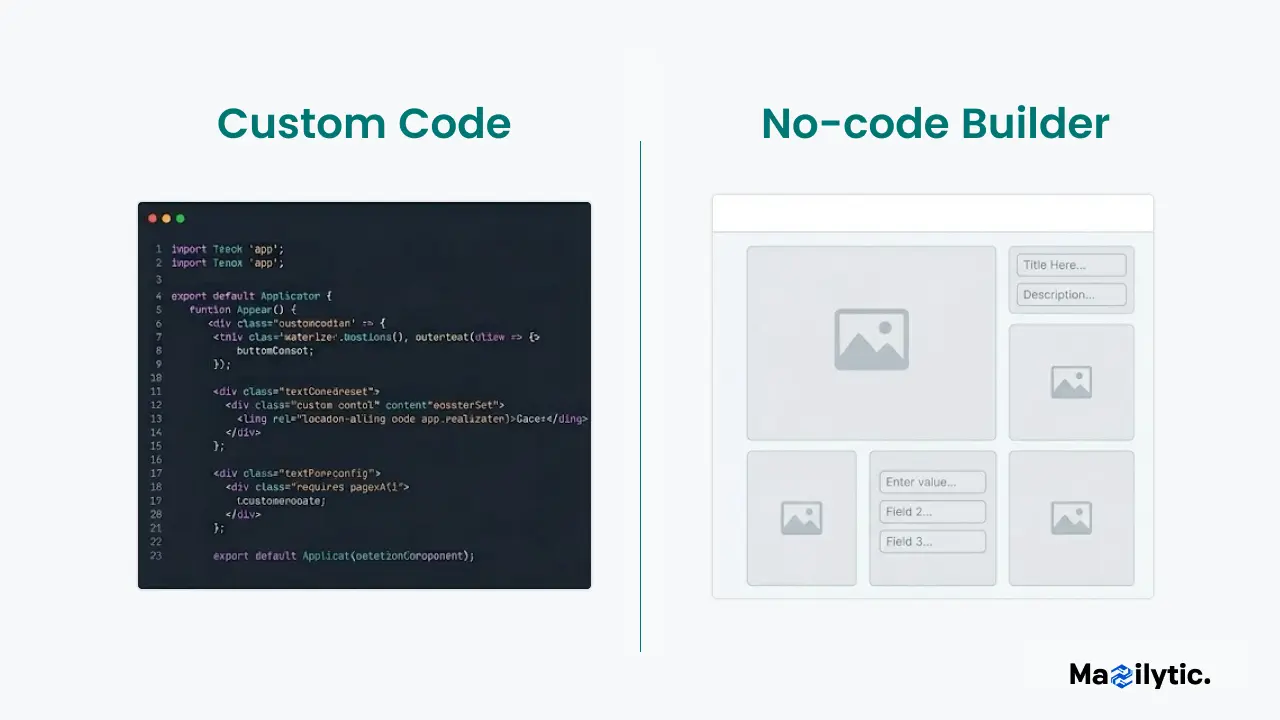
Custom App or no‑code builder, both directions have similar hype, so let's skip it all and take an unbiased view. No‑code evangelists will tell you anyone can build a production‑grade app in a weekend. Custom development agencies will tell you no‑code is a toy that'll collapse the moment your business gets serious. Neither is being entirely honest with you.
The real answer is more useful than both: it depends on what you're building, who you're building it for, and what you need it to do 24 months from now. This is a comprehensive guide that will tell you where each approach genuinely wins, where each one will burn you, and how to make the right call before you've committed six months and a significant budget to the wrong one.
The Landscape in 2026
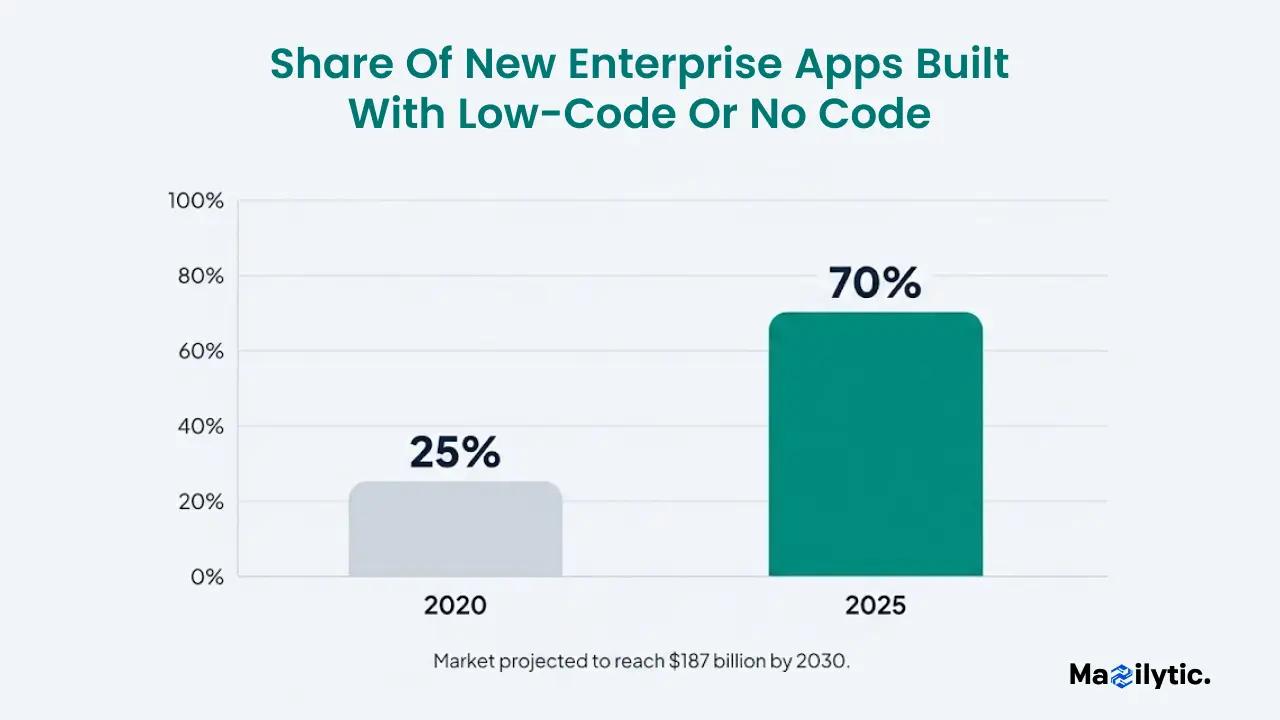
No‑code is not a fringe trend anymore. Gartner projected that 70% of new enterprise applications would be built with no‑code or low‑code platforms by 2025, up from less than 25% in 2020, and the market has largely borne that out. The global low‑code development market is projected to reach $187 billion by 2030. Platforms like Bubble, Webflow, Glide, and AppSheet have matured significantly, and they can handle real workflows, real data, and real users.
At the same time, 31% of enterprises currently using no‑code platforms have not used them to build a single one of their highest‑value applications. That number tells its own story. Accessibility and capability are not the same thing.
Custom development hasn't gone anywhere either. For applications where performance, security, compliance, and long‑term scalability are non‑negotiable, custom‑built software remains the standard. The question for any business is not which approach is universally better, but which approach is right for your project at your stage.
1. What No‑Code Actually Delivers
No‑code platforms offer a genuine value proposition worth taking seriously. Speed is real. 72% of users successfully develop and launch applications in three months or less using low‑code platforms, compared to traditional development cycles of 6 to 12 months. For validation‑stage ideas, that gap is enormous.
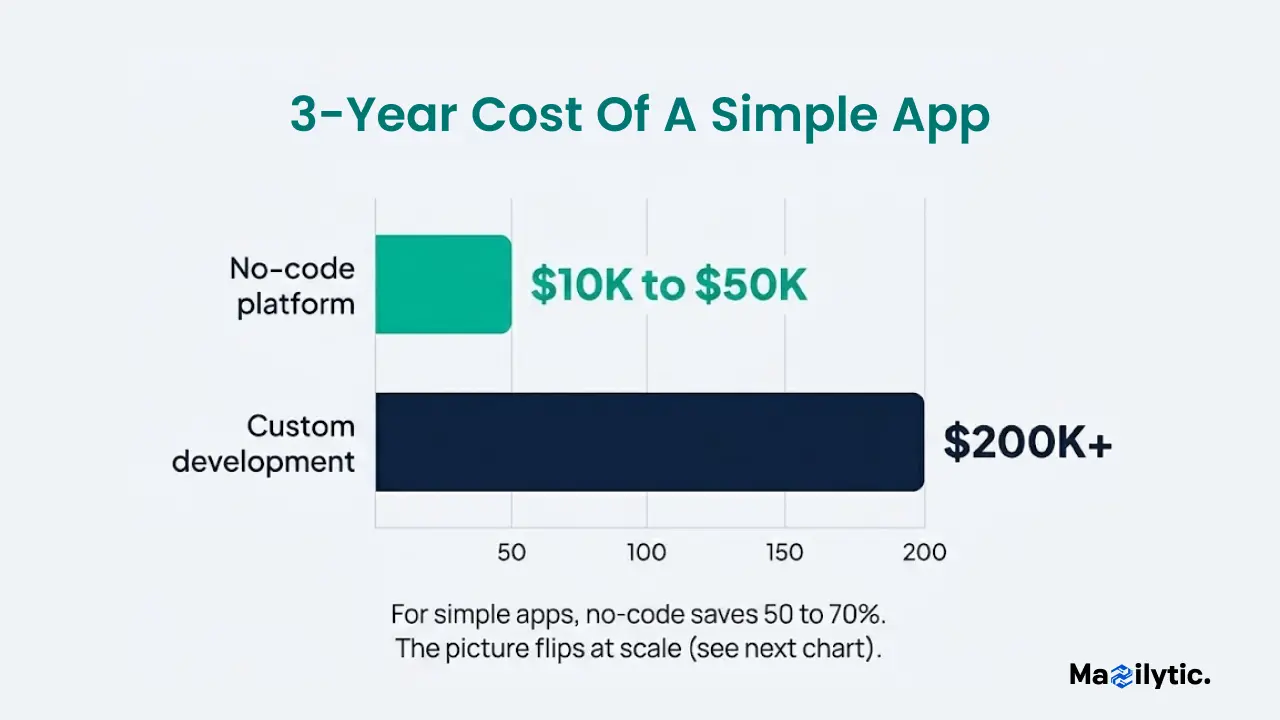
For simple applications, no‑code platforms typically cost $10,000 to $50,000 over three years, compared to $200,000 or more for equivalent custom development, a saving of 50 to 70%. Nearly 60% of all custom business apps are now being built outside the IT department, and no‑code made that possible.
Where No‑Code Makes Sense
- Internal tools and workflow automation with predictable, controlled user volume
- MVPs where speed to market matters more than architecture
- Simple customer‑facing applications: booking systems, directories, membership portals
- Early‑stage startups validating a product before committing a full development budget
Where No‑Code Breaks Down
The "build anything without code" marketing promise is misleading. No‑code platforms have hard ceilings that become real problems as soon as requirements push past standard templates.
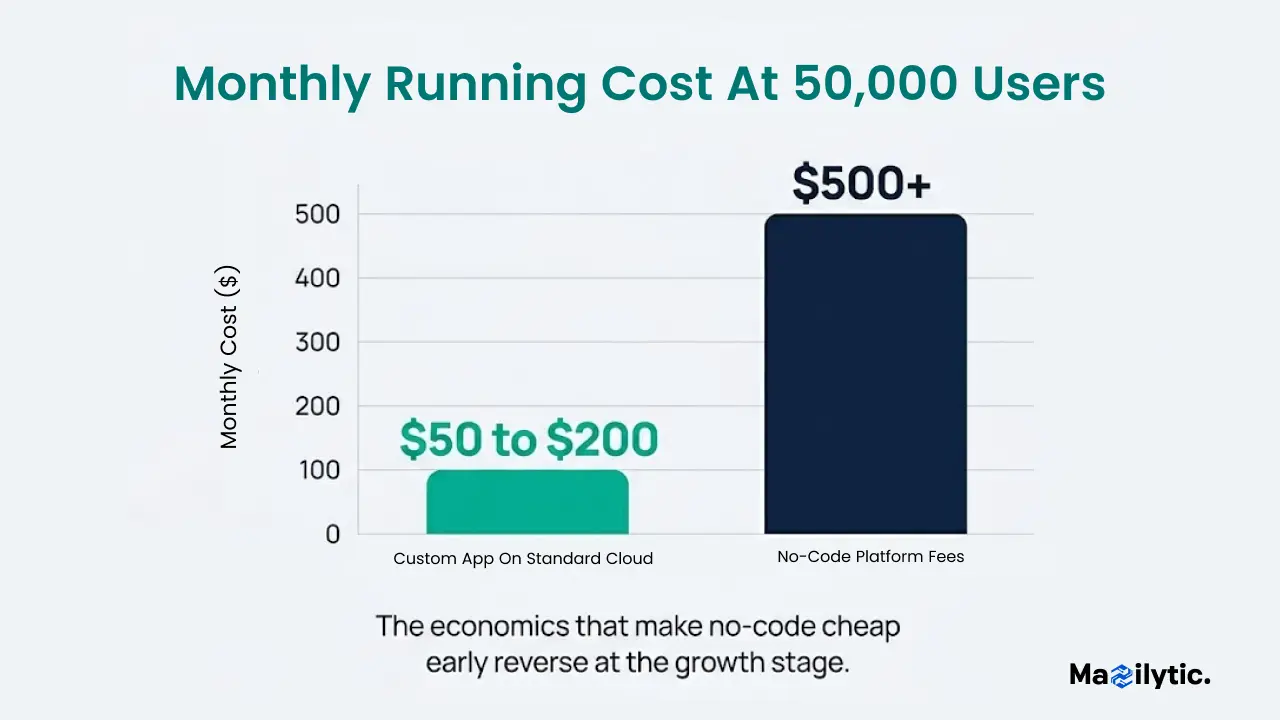
- A no‑code app serving 50,000 users might cost $500 or more per month in platform fees. A custom‑built equivalent on standard cloud infrastructure might cost $50 to $200 per month (DesignRevision, 2026). The economics that make no‑code cheap early can reverse at the growth stage.
- Your entire application lives on someone else's infrastructure, subject to their pricing decisions, their security posture, and their product roadmap. If the platform raises prices, discontinues a feature, or gets acquired, your options are limited.
- When your business logic doesn't fit their model, and eventually, for any differentiated product, it won't, then you're either working around it or rebuilding from scratch.
2. What Custom Development Actually Costs
Custom development is expensive. What's worth understanding is what drives the cost and what you're actually buying.
| Role | Typical US Rate (2026) |
| Junior developer | $75 to $100 per hour |
| Mid‑level developer | $100 to $150 per hour |
| Senior / Lead developer | $150 to $250 per hour |
| UI/UX designer | $100 to $175 per hour |
| Agency blended rate | $150 to $250 per hour |
A medium‑complexity custom application, such as a B2B SaaS platform with standard integrations, authentication, and a dashboard, typically runs $40,000 to $150,000 in initial development. Enterprise‑grade platforms with compliance requirements can reach $500,000 or more.
Those numbers reflect something specific: you own the result, end to end.
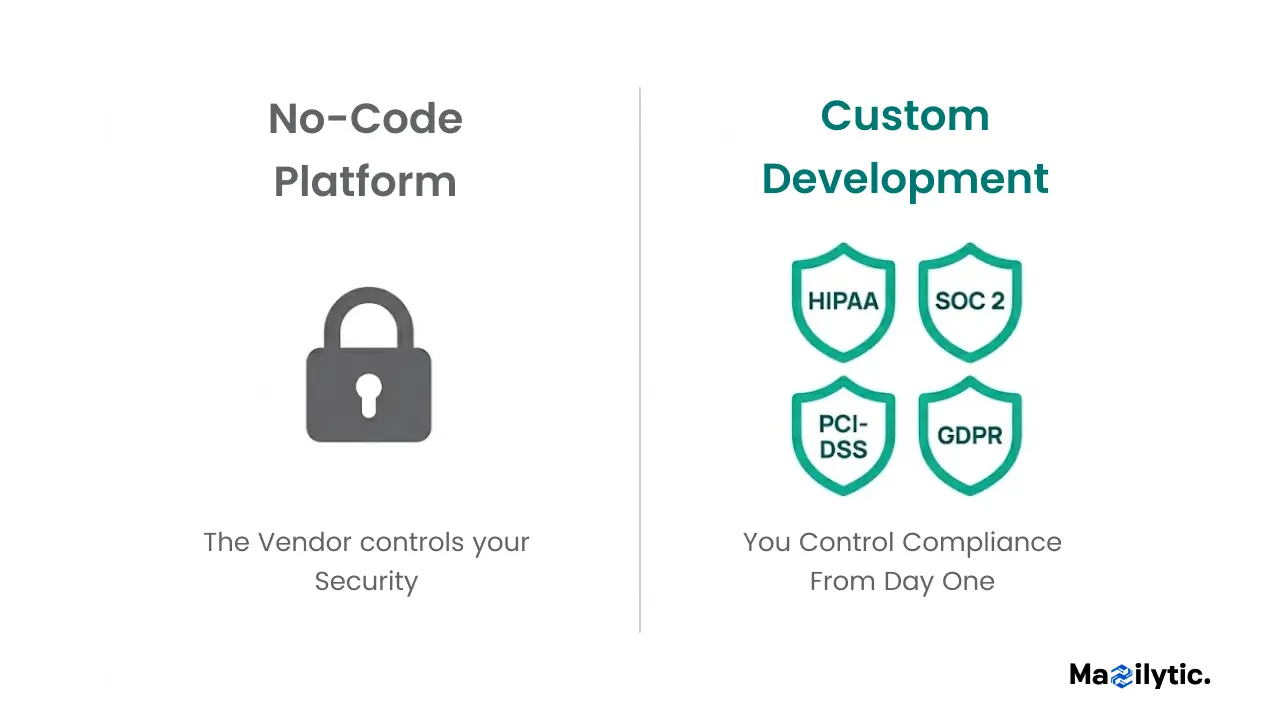
Security you can verify. The vendor dictates security features in no‑code platforms. For businesses in regulated industries such as healthcare, fintech, and legal, that's often not sufficient. Custom development lets you build compliance in from day one. HIPAA, SOC 2, PCI‑DSS, and GDPR aren't afterthoughts; they're architectural decisions made before a line of code is written. As FullStack Labs notes, no‑code platforms present a potential "back door" for bad actors, since a third party entirely controls security.
3. The Real Cost of Getting This Wrong
Both camps tend to be less than honest about this part.
The no‑code rebuild problem: Businesses that outgrow no‑code platforms don't just pay for a new build; they lose data, lose time, and face integration headaches a clean custom build would have avoided. Industry estimates put a typical rebuild at $35,000 to $120,000, with the platform ceiling usually appearing 18 to 24 months after the original launch.
The over‑engineering problem: Commissioning a full custom build for an unvalidated MVP is also a common and expensive mistake. If you don't know whether your product has market fit, spending $150,000 before speaking to 100 customers is a significant risk. No‑code here isn't a compromise; it's a strategy.
"The most cost‑effective approach for many businesses is to start with no‑code to validate and iterate, then transition to custom development once the application proves its value and requirements are well understood." - Cobeisfresh, 2025
The businesses that get this right don't pick a camp. They pick the right tool for the right phase.
4. Security and Compliance: The Non‑Negotiables
If your application handles sensitive data, processes payments, or operates in a regulated industry, this section matters more than any cost comparison.
No‑code platforms implement security, but they implement their security. You have limited visibility into how data is stored, who accesses it, and what happens in a breach. That's a manageable risk for a simple internal tool. It is not manageable for a healthcare portal, a financial services platform, or any application handling personal data at volume.
Custom development gives you full control:
- SOC 2 Type II is built into the architecture, not retrofitted
- HIPAA is addressed at the data layer, not patched with platform add‑ons
- GDPR handled through proper data residency and consent management
IBM's 2025 Cost of a Data Breach Report put the average breach cost for a US business at $4.44 million. Compliance work that costs $20,000 upfront is cheap insurance by comparison.
5. The Decision Framework
Before you brief a developer or sign up for a platform, work through these four questions.
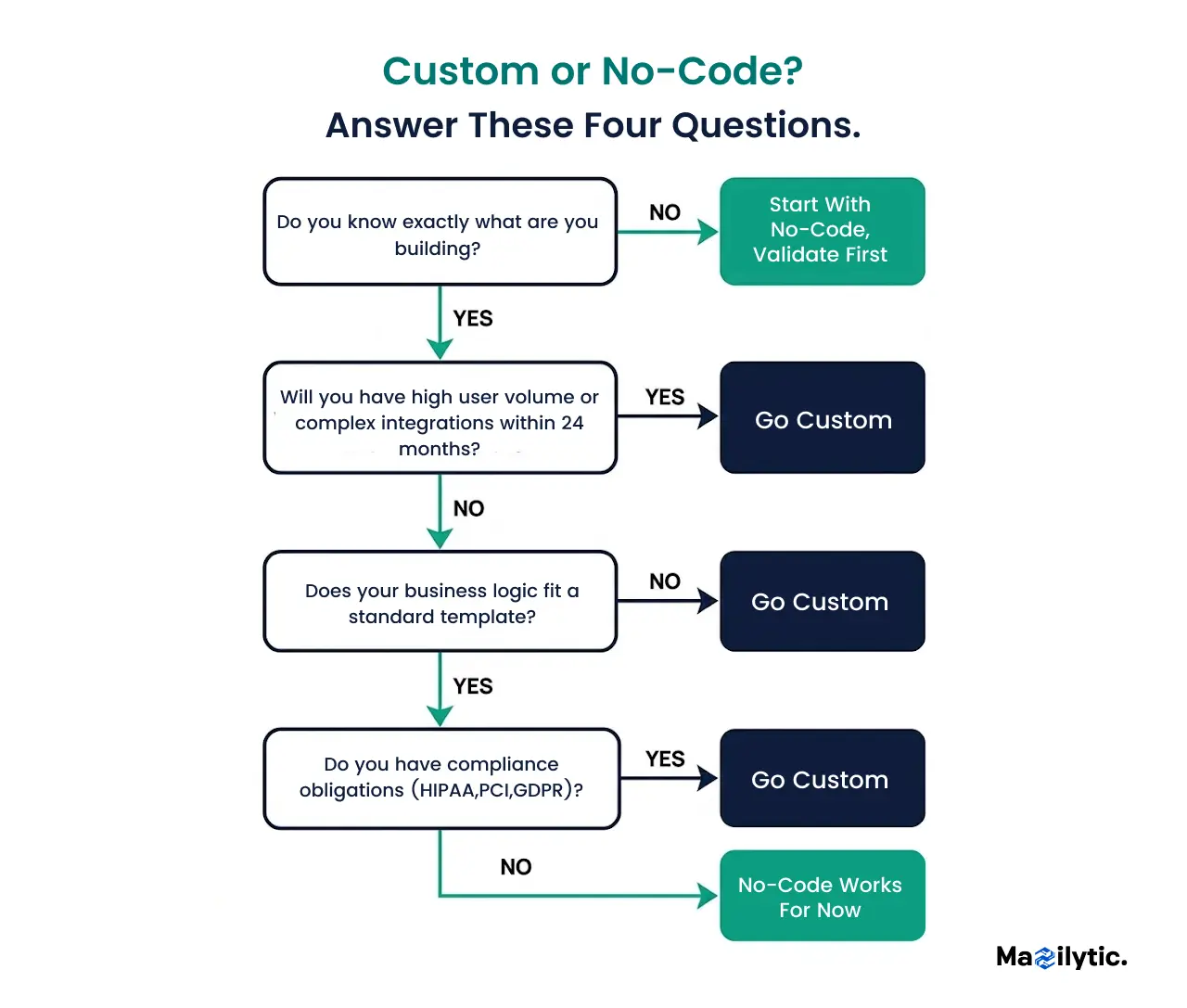
1. Do you know exactly what you're building? If requirements are still fuzzy, no‑code is the right first move. Build something cheap and fast, put it in front of users, and let real behavior tell you what to build properly.
2. What does growth look like in 24 months? If your target state involves high user volume, complex data relationships, or third‑party integrations, design for that now. No‑code pricing tiers can quietly erode your margins as you scale.
3. Does your business logic fit a template? If your core product differentiator is what the software does, no‑code will eventually constrain you. Unique user flows, proprietary algorithms, and novel data models hit no‑code ceilings fastest.
4. What are your compliance obligations? If the answer is anything other than "none," custom development is the correct starting point. Retrofitting compliance into a no‑code platform is expensive, unreliable, and in some cases impossible.
The Honest Summary
No‑code platforms are genuinely powerful. They have lowered the barrier to building useful software and have earned a legitimate place in any smart technology strategy. They are not, however, a replacement for custom development when the stakes are high enough that the limitations matter.
The businesses that extract the most value from technology don't ask which approach is universally better. They ask which approach is right for this problem, at this stage, with these constraints. That's the question worth answering before anything else. Build for your actual needs and your growth plan. Don't pay for complexity you haven't earned yet, and don't get locked into a platform that can't grow with you when you do.
CTA: Decided custom is the right call, or still weighing it? Mazilytic builds compliance‑ready apps from day one, and we'll tell you straight if no‑code is the smarter move for your stage. Let's talk.
FAQ
Q1: How much does a custom app cost compared to a no‑code app in 2026?
For simple use cases, a no‑code app typically costs $10,000 to $50,000 over three years. A custom‑built equivalent runs $40,000 to $150,000 in initial development, and an enterprise platform starts around $500,000. The gap narrows once you account for platform fees that climb at scale, vendor lock‑in risk, and the cost of a rebuild, which industry estimates put at $35,000 to $120,000. No‑code platforms also tend to hit their limits 18 to 24 months in, which is exactly when many businesses face that rebuild.
Q2: Can a no‑code app handle real business operations?
For many standard workflows, yes. Internal tools, booking systems, simple CRMs, and customer portals are well within no‑code capabilities. The issues arise with complexity, scale, and requirements that go beyond standard templates. When your business logic is genuinely different, that's when you start fighting the platform instead of building on it.
Q3: Is no‑code secure enough for a customer‑facing application?
It depends on what that application handles. For a simple booking form or directory, the security offered by established no‑code platforms is generally adequate. For anything handling payment data, personal health information, or sensitive financial records, the answer is almost always no. Security on a no‑code platform is controlled entirely by the vendor, not by you. Custom Development allows you to design compliance with PCI‑DSS, HIPAA, and SOC 2 into the development exactly from the beginning, since you are not relying on the platform's defaults.
Q4: How long does it take to build a custom app vs. a no‑code app?
No‑code apps can go from idea to launch in two to eight weeks for simple use cases. Custom development for a moderate complexity application is usually 3‑6 months. Enterprise platforms that have compliance requirements and integrations that are more complicated can be delivered in phases and take several months. The fair‑to‑all timelines note: If your content, copy, or internal approvals are not available before work begins, increase whatever you were quoted by 20%.
Q5: Is a hybrid approach possible, starting with no‑code and moving to custom?
Yes, and for many businesses it's the savvy route. Use no‑code to validate the product, watch real user behavior, and lock down your requirements. Then pay for a custom build with a brief informed by real data, not assumptions. The rebuild is a real cost, but it's often lower than building custom upfront without knowing exactly what's required. The key is treating the no‑code phase as deliberate validation, not as a permanent home you quietly hope you never have to leave.