Digital Marketing Trends in the UK
Picture this: a local bakery in Manchester. Three years ago, their marketing strategy was a Facebook page and the occasional flyer through letterboxes. Today, they're running AI‑personalised email sequences, tracking click‑through rates on paid social, and showing up in AI‑generated search summaries for "best artisan bread near me." That's not a tech‑forward outlier; it's the new baseline for UK businesses that want to grow.
The pace of change in digital marketing has been relentless, and 2026 is no different. For any digital marketing company in the UK, or any business serious about its online presence, understanding where things are heading isn't optional but a very much needed survival strategy.
Let's break down the trends that are reshaping how UK businesses market themselves this year.
The UK Digital Advertising Market Is Enormous and Still Growing
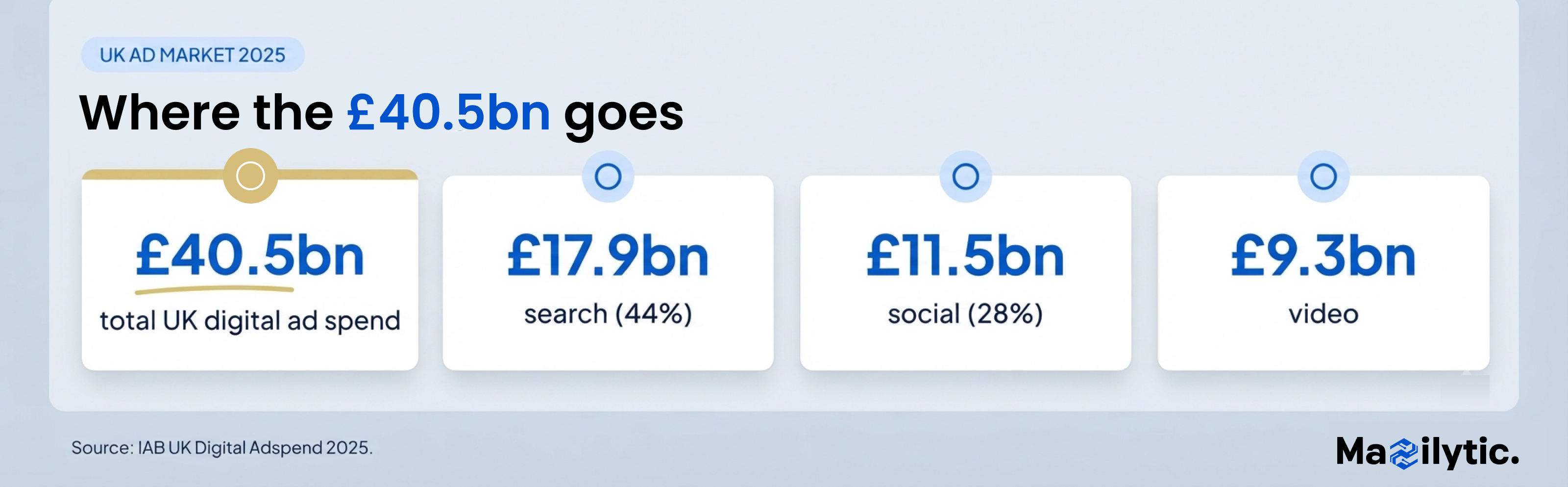
Start with the numbers. UK digital advertising spend reached £40.5 billion in 2025, up 10% year‑on‑year, significantly outpacing UK GDP growth of 1.4%, and is forecast to reach £44.7bn in 2026 and £49.1bn by 2027, according to IAB UK's Digital Adspend study, produced with Oliver Wyman. That growth is being driven disproportionately by social and video: social media spend rose 21% to £11.5bn (28% of the market), and video rose 20% to £9.3bn, while search remained the single largest channel at £17.9bn (44% of the market). This makes the UK one of the most digitally mature advertising markets in the world, and consistently one of the largest in Europe alongside Germany and France.
That's the competitive landscape every UK business is operating in. Whether you're a growing SaaS company or a local business trying to carve out your corner of the market, you're competing for attention in a genuinely world‑class digital arena.
Top UK digital marketing priorities for 2026 are increasing sales revenue (62%), increasing customer engagement (60%), and increasing brand awareness (52%). Notice what's missing from that list: vanity metrics. The smartest businesses have shifted from chasing impressions to measuring outcomes, and strategic marketing is the vehicle that gets them there.
AI Advertising Is No Longer Experimental
Of all the forces reshaping company marketing in the UK, artificial intelligence is the most significant. A remarkable 92% of digital marketers in the UK are already embracing AI in their digital advertising efforts. This isn't a fringe trend; it's mainstream.
Marketing and artificial intelligence have become deeply intertwined across every channel. AI creative optimisation tools are increasingly used to test and refine ad variants at scale, with several independent studies linking higher creative‑variant volume to meaningfully lower cost‑per‑acquisition. The shift extends beyond just ad creative. A 2026 Digital Marketing Statistics Report from UK Marketing Professionals states that 50% of UK businesses utilise AI to increase the volume of their marketing output, and 64% have adapted their SEO strategy to reflect recent AI search changes. The brands that are winning aren't just using AI tools; they're integrating them into the entire content and campaign lifecycle.
What does that look like practically? AI is now handling bid management in real‑time auctions, writing and A/B testing ad copy, personalising landing pages based on user behaviour, and predicting which leads are most likely to convert. For any digital marketing company in the UK, building AI literacy into the team is now as essential as knowing how to run a Google Ads campaign.
Email Marketing: Still the Highest‑ROI Channel
Reports of email marketing's death have been greatly exaggerated. Email marketing ROI in the UK sits at roughly £38-£41 for every £1 spent, according to the DMA UK's Marketer Email Tracker, the industry's most‑cited UK benchmark, which has shown the figure climbing steadily for a decade. This is an exceptional return by any channel's standards. But the landscape has evolved. The days of blasting the same newsletter to your entire list and calling it a strategy are over. Segmentation and personalisation are what separate forgettable campaigns from ones that convert, with the most successful strategies combining behavioural data (such as purchase history and browsing behaviour) with AI‑driven intent scores.
The click‑through rate is where a lot of this plays out. Marketers who have used AI for personalisation report an increase in email marketing revenue by over 40% and a click‑through rate of 13.44%. Compare that to the industry average, and it's clear: AI‑powered segmentation isn't a nice‑to‑have; it's a competitive necessity.
51% of UK marketers believe AI‑supported email marketing is more effective, and 62.9% of UK consumers read emails on their mobile phones. That second statistic matters enormously because if your emails aren't optimised for mobile, a majority of your audience is having a suboptimal experience before they even read your subject line.
For small and medium‑sized businesses especially, email marketing remains the most cost‑effective way to build relationships and drive repeat revenue. A well‑structured sequence (welcome, nurture, conversion) can run largely on automation while generating returns that paid channels simply can't match at scale.
Conversion Rate Optimisation: The Discipline That Multiplies Everything Else
Traffic without conversion is noise. That's why conversion rate optimisation has become a central pillar of serious digital strategy in 2026, not an afterthought. Mobile now drives the majority of UK ecommerce revenue; IRP Commerce's UK Ecommerce Market Data, calculated from first‑party trading data across its merchant platform, puts mobile's share of sales at 63.5% in June 2026. Yet the average UK site conversion rate sits at just 2.03%, even after a 9.7% year‑on‑year improvement. That gap between where the traffic is and where it converts is exactly the opportunity CRO is built to close.
But those figures hide a problem: many businesses are still pouring budget into acquisition while ignoring what happens after someone arrives on their site.
CRO is where marketing and artificial intelligence are particularly well‑matched. AI tools can analyse heatmaps, session recordings, and user flow data at a scale that no human team can replicate. Identifying where drop‑offs happen, what copy converts, and what page structure keeps users moving toward a purchase or enquiry. Personalised CTAs deliver significantly higher conversion rates than generic ones, and modern CRO tools make that level of personalisation achievable even for companies without enterprise‑level budgets.
For businesses working with a digital marketing company in the UK, CRO should always be part of the conversation. Getting more from existing traffic is almost always cheaper than generating more traffic from scratch.
Advertising on Social Media: Where the Budget Is Going
Social media advertising now accounts for 28% of total UK digital ad spend, up from 23% the previous year. A 21% year‑on‑year rise to £11.5 billion. With video making up 59% of that social investment as short‑form and in‑feed formats capture a growing share of budgets. The platform landscape has also shifted in ways that matter for advertising on social media. Ofcom's Online Nation report, based on Ipsos audience measurement data, found that YouTube reaches 94% of UK online adults each month, ahead of Facebook/Messenger at 93%, Instagram at 78%, and TikTok at 56%, while WhatsApp leads all messaging platforms with 90% reach. YouTube's reach is particularly striking, and often underutilised by businesses that default to Meta for their paid social budget.
Nearly half of UK consumers (49.3%) use social media to find product information before purchasing.
For local businesses, social advertising offers something traditional media never could: hyper‑targeted, geography‑specific reach on a flexible budget. A plumber in Leeds doesn't need to advertise to the whole country. They need to appear in front of homeowners within a ten‑mile radius who've just searched for a blocked drain. That kind of precision is what makes paid social so powerful for businesses that understand how to use it.
94% of UK marketing professionals consider social media marketing very important, and 57% use paid social media advertising as part of their strategy. If you're not already among that 57%, you're ceding ground to competitors who are.
First‑Party Data Is Now the Foundation
The demise of third‑party cookies isn't a future concern; it's the current regulatory reality. The UK's Data (Use and Access) Act came into force on 5 February 2026, reshaping PECR cookie consent rules and raising the maximum fine for non‑compliance to UK GDPR levels to £17.5 million or 4% of global turnover, a 35‑fold increase on the previous cap. Advertising and profiling cookies still require explicit consent under the new rules, which means businesses that have spent the past few years building genuine first‑party data, rather than relying on third‑party tracking, are the ones positioned to keep targeting and measuring effectively.
Building first‑party data means owning your audience relationship: email lists, loyalty programmes, customer surveys, gated content, and CRM data all feed into a picture of who your customers actually are, what they need, when they're likely to buy, and what messaging resonates with them.
This is also where strategic marketing pays its biggest dividends. Businesses with clean, well‑segmented customer data can personalise at scale, reduce wasted ad spend, and build the kind of long‑term relationships that generate referrals and repeat business, the things no algorithm can replicate.
What UK Businesses Are Getting Wrong
Only 23% of UK marketing professionals rate themselves as satisfied with their overall performance. The problems tend to be the same ones, repeated across businesses of every size:
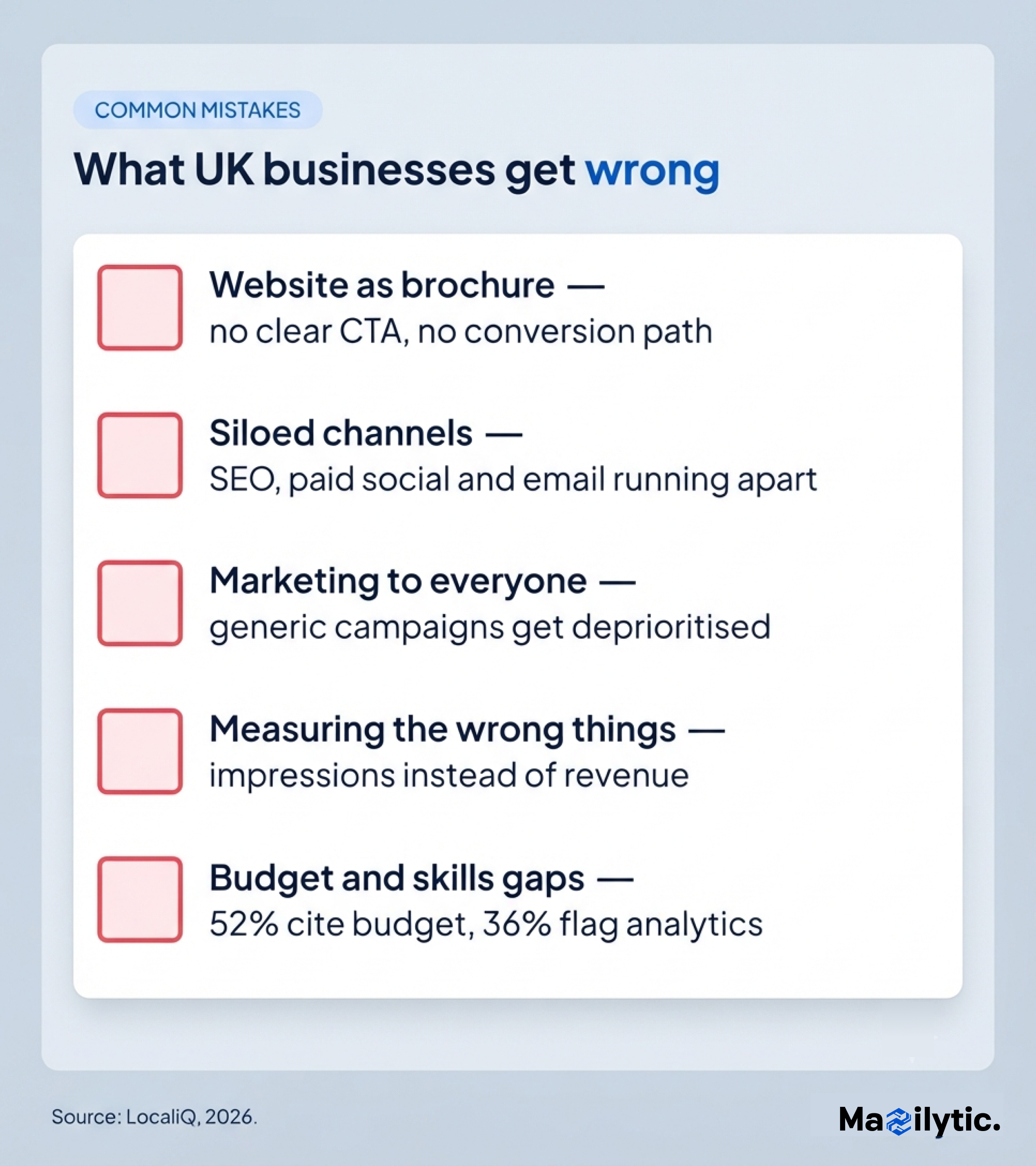
- Website as brochure: No clear CTA, no conversion path, just a description of services with nowhere to go.
- Siloed channels: SEO, paid social, and email running independently with no shared strategy or consistent messaging.
- Marketing to everyone: Generic, audience‑agnostic campaigns are actively deprioritised by algorithms in 2026, so specificity wins.
- Measuring the wrong things: Tracking impressions and follower counts instead of conversions and revenue means you can't tell what's actually working.
- Budget and skills gaps: 52% of UK businesses cite inadequate budget as a top challenge, and 36% flag data analytics as a significant skills gap.
The fix rarely means spending more. It means spending smarter, and a good digital marketing company in the UK can help bridge that gap.
The Blog Post Isn't Dead; But It Has to Earn Its Place
65% of UK businesses use content marketing as part of their current strategy, but the blog post has evolved. In a world where AI generates generic content at scale, the only content that cuts through is specific, useful, and written for a real audience with real problems.
What works in 2026:
✔ Depth over volume: Google's E‑E-A‑T framework rewards authoritative content that fully answers a question
✔Audience‑first thinking: the question isn't "what can we publish?" but "what does our audience need to know?"
✔ Strategic alignment: every blog post should serve a keyword, a funnel stage, or a conversion goal
✘ Keyword stuffing and thin content: systematically deprioritised by search algorithms in 2026
The UK Digital Marketing Landscape in 2026 and Beyond
The trends converging this year aren't separate movements; they're all expressions of the same shift: marketing is becoming more precise, more personal, and more accountable.
The businesses pulling ahead share a common playbook:
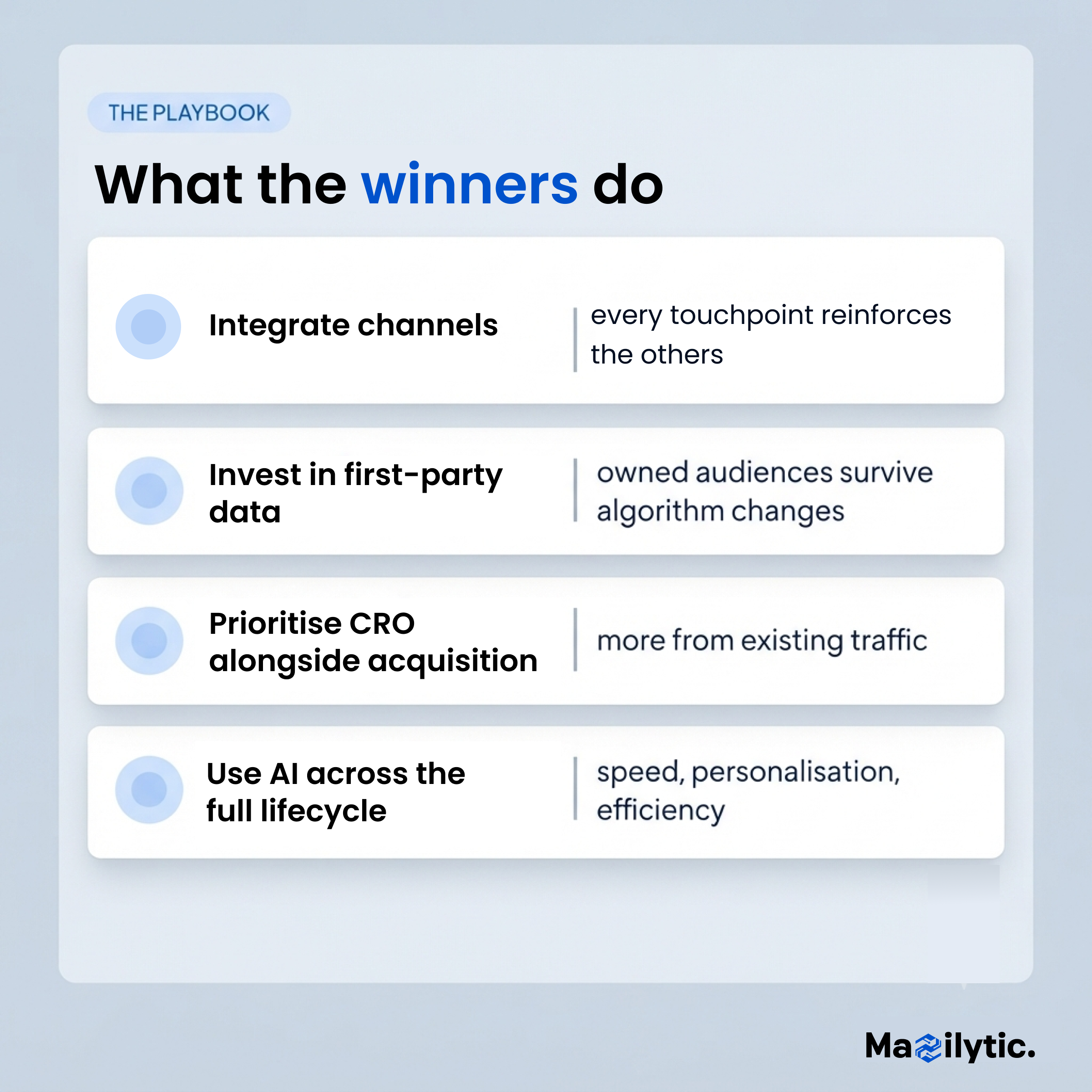
For any local business or growing company, the fundamentals haven't changed. Understand your customers, be where they are, and make it easy to convert. The tools evolve. The logic doesn't.
FAQs
Q1. What are the biggest digital marketing trends in the UK for 2026?
The most significant trends are the mainstreaming of AI in advertising and content creation, the rise of social commerce, growing investment in first‑party data, the continued dominance of email marketing by ROI, and a stronger focus on conversion rate optimisation. Businesses that integrate these areas into a coherent strategy are significantly outperforming those running siloed campaigns.
Q2. How important is email marketing for UK businesses in 2026?
Email marketing remains the highest‑ROI digital channel available to UK businesses, returning somewhere in the region of £38–£41 for every £1 spent, according to the DMA UK's Marketer Email Tracker. The key shift in 2026 is that unsegmented broadcast emails are losing effectiveness, while AI‑powered personalisation and behavioural segmentation are driving significantly higher open rates, click‑through rates, and conversions.
Q3. How is AI changing digital marketing for UK companies?
AI is transforming marketing across every channel. It's being used to generate and optimise ad creative, personalise email campaigns, predict customer intent, automate bidding in paid media, and produce content at scale. A large majority of UK digital marketers already use AI in some capacity, and businesses that haven't integrated it into their workflows are increasingly at a competitive disadvantage.
Q4. What should UK local businesses prioritise in their digital marketing strategy?
Local businesses should prioritise three things: a strong social media presence on the platforms where their audience actually spends time, a well‑segmented email list they own and actively nurture, and a website that converts visitors effectively. Paid social advertising on platforms like Facebook, Instagram, and YouTube offers precise local targeting at relatively modest budgets, making it particularly well‑suited to local businesses with limited marketing spend.
CTA: Ready to Build a Smarter Digital Marketing Strategy?
At Mazilytic, we work with businesses across the UK to develop digital strategies that drive real results; from AI‑powered advertising and email automation to conversion rate optimisation and strategic content. Whether you're starting from scratch or scaling what's already working, our team has the expertise to move the needle.
Get in touch with our team today, and let's build something that performs