Fintech Software: Build Secure Digital Solutions
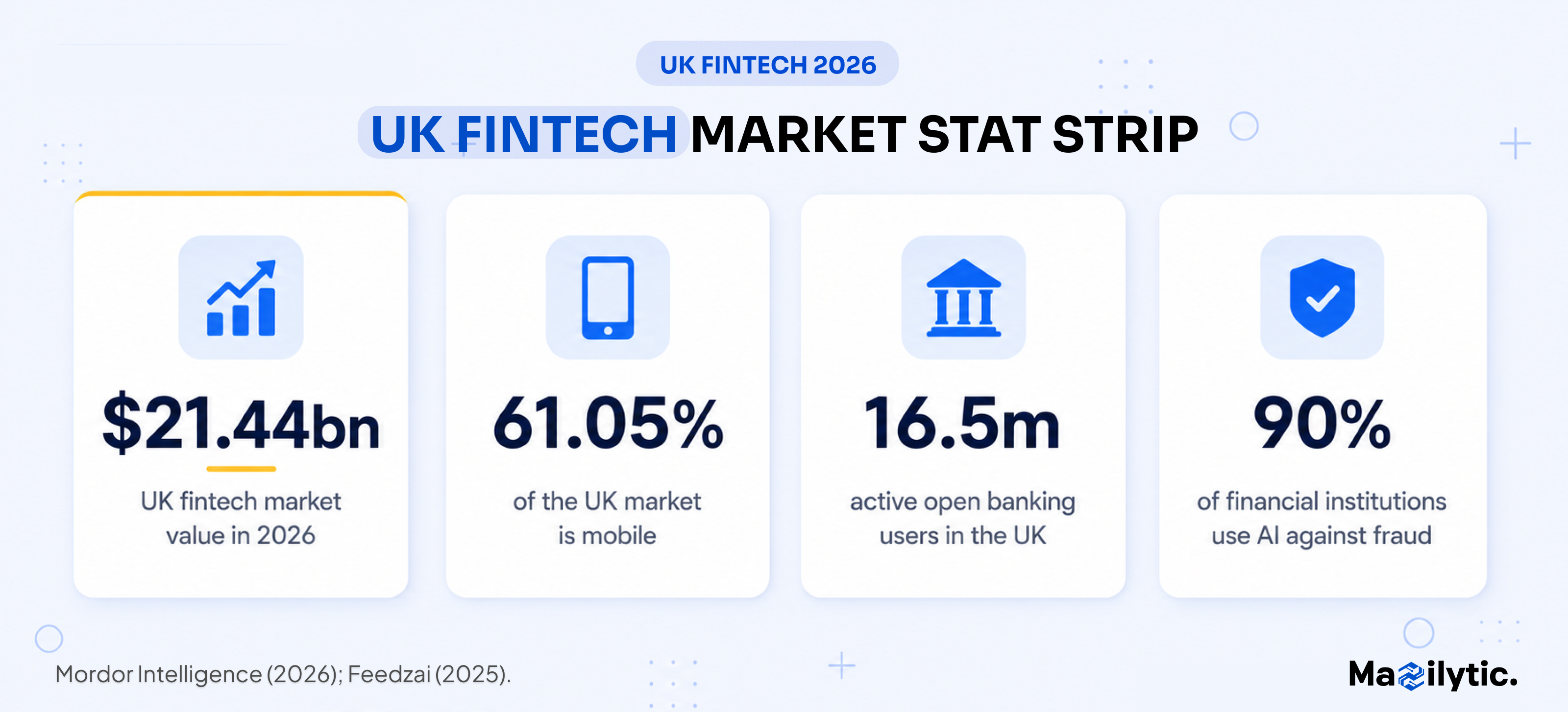
Here's a number worth sitting with: the UK fintech market is valued at $21.44 billion in 2026 according to Mordor Intelligence's market sizing, with growth to $43.92 billion projected by 2031. Other analyst firms size this market differently depending on scope (some measure software revenue alone, others total industry revenue), so treat this as one credible research firm's estimate rather than an undisputed industry consensus; the direction - strong, sustained growth - holds consistently across every source. The UK isn't just participating in the global fintech revolution. It's running it. There are more fintech companies based here than in France, Germany, and the Netherlands combined.
But the market opportunity comes with a caveat: fintech software development is not like building any other kind of software. The regulatory environment is complex and actively enforced. The security requirements are significantly higher. Industry estimates suggest the cost of getting it wrong, in regulatory remediation, fraud exposure, or customer trust, can run several times higher than the cost of building correctly from the start. However, the precise multiplier varies by project and is best treated as a directional warning rather than a fixed figure.
This guide covers everything UK financial businesses need to know about building fintech solutions that are secure, scalable, and built to last.
1. What Is Fintech Software Development?
Fintech software development is the process of designing, building, and deploying digital products that deliver financial services through software, whether that's a mobile banking app, a payment processing engine, a lending platform, or a compliance automation tool.
What separates fintech development from standard software projects is the weight of what's at stake on every transaction. When your app handles someone's salary, savings, or mortgage application, the tolerance for error drops to zero. That shapes everything: architecture decisions, security layers, testing protocols, and the regulatory approvals required before a single user can log in.
In 2026, the starting point for every serious fintech application development project isn't the feature list. It's the compliance architecture. Get that right, and everything else is buildable. Get it wrong, and you'll be rebuilding it under pressure, at high additional cost.
2. Why UK Financial Businesses Are Investing in Fintech Software
The commercial case for investment is straightforward. Consumer expectations have shifted permanently: one industry survey found that 78% of people under 40 say they would switch banks if their current provider didn't offer a fully digital experience. The business that meets those expectations captures the customer. The one that doesn't loses them, often permanently.
Beyond consumer pressure, the UK's regulatory environment has actually become a competitive asset. The FCA's sandbox framework and open banking infrastructure give UK fintech development companies a structural advantage over generalist agencies operating in less mature markets. UK fintech attracted £2.6 billion in investment in 2025, keeping the UK second globally behind only the United States.
The mobile channel is where most of this growth is landing: mobile applications captured 61.05% of the UK fintech market share in 2025, and are forecast to grow at 18.55% CAGR through 2031. If your fintech software development services don't start with a mobile‑first architecture, you're already behind.
3. Types of Fintech Software UK Businesses Can Build
3.1 Digital Banking Platforms
Neobanking is the fastest‑growing segment in the UK fintech market, expanding at a 19.18% CAGR through 2031. Digital banking platforms handle account management, payments, lending, and customer support, all through a single interface. Building one requires a Banking‑as‑a-Service (BaaS) foundation, core banking system integration, FCA authorisation, and thorough KYC/AML flows built in from day one.
3.2 Payment Processing Systems
Digital payments held 32.15% of the UK fintech market share in 2025. Payment processing systems handle the movement of money between parties in real time, across card networks, bank transfers, and digital wallets. PCI‑DSS compliance, Faster Payments integration, and fraud detection are non‑negotiable components of any UK payment solution.
3.3 Digital Wallets
Digital wallets store payment credentials, loyalty cards, and identity documents, allowing users to transact without physical cards. Open banking APIs are transforming what's possible here, enabling account‑to‑account payments that bypass card rails entirely. One industry estimate suggests digital wallets are on track to serve over 5.5 billion users globally by 2029.
3.4 Lending and Loan Management Platforms
Digital lending platforms automate credit scoring, application processing, loan disbursement, and repayment management. AI‑powered underwriting, which analyses alternative data sources alongside traditional credit files, is increasingly standard. FCA authorisation is required for consumer credit, and Consumer Duty obligations apply to how products are designed and communicated.
3.5 Investment and Wealth Management Platforms
Robo‑advisors, portfolio management tools, and retail investment platforms all fall here. Regulatory requirements include FCA authorisation (typically under the Investment Firms Prudential Regime), suitability assessment obligations, and, increasingly, explainability requirements for any AI‑driven recommendations under the EU AI Act.
3.6 Insurtech Solutions
Insurance technology encompasses digital policy management, claims processing, telematics, and parametric insurance products. Insurtech builds are complex because they often involve multiple regulated entities, the insurer, the broker, the technology provider, and data handling requirements that go beyond standard GDPR.
3.7 Accounting and Financial Management Software
From SME bookkeeping platforms to enterprise treasury management systems, financial software for businesses covers a vast range. Open banking APIs have transformed this category: real‑time bank data feeds replace manual reconciliation, and automated VAT and reporting reduce compliance overhead significantly.
4. Key Features of a Successful Fintech Application
4.1 Secure User Authentication
Multi‑factor authentication, biometric login, and device fingerprinting are the baseline. One industry tracker reports that deepfake‑based identity fraud attempts have surged over 1,100% since early 2025, a figure worth treating as directional given how new and fast‑moving this category of fraud tracking is. Strong Customer Authentication (SCA) under PSD2 is mandatory for UK payment applications, and liveness detection is increasingly standard for onboarding flows.
4.2 Payment Integration
Rather than building payment rails from scratch, most fintech applications integrate with proven providers: Stripe and Marqeta for card processing, Faster Payments for bank transfers, and TrueLayer or Yapily for open banking. These integrations reduce PCI scope and accelerate time to market.
4.3 Real‑Time Transactions
Users expect instant confirmation. Real‑time transaction processing requires reliable message queue architecture, idempotent payment flows, and failover handling for every edge case: failed payments, duplicate submissions, partial captures. The engineering here is unglamorous, but it's where trust is won or lost.
4.4 Fraud Detection
According to Feedzai's 2025 AI Trends in Fraud and Financial Crime Prevention, "90% of financial institutions worldwide are using AI to fight fraud and financial crime." Machine learning models now score transactions in milliseconds, analysing device fingerprints, behavioural biometrics, and transaction graphs simultaneously. In a concrete, verifiable example, Experian's own newsroom confirms that its AI fraud detection pilot for UK banks, launched in April 2026, delivered a 200% uplift in APP fraud detection, an 80% drop in false positives, and a 50% fall in total alert volumes. Building without this kind of capability is increasingly a competitive disadvantage.
4.5 Data Encryption
End‑to‑end encryption of data in transit and at rest is mandatory. AES‑256 for stored data, TLS 1.3 for data in transit, and secure key management are the standard. One agency estimate suggests security measures like these typically add 20 to 40% to fintech development cost, but the alternative (a breach, a regulatory fine, a loss of PCI certification) is vastly more expensive.
4.6 Automated Notifications
Push notifications, SMS alerts, and in‑app messages aren't just user experience features. Many are regulatory obligations. Transaction confirmations, fraud alerts, and Consumer Duty communications all require reliable, auditable delivery infrastructure.
4.7 Analytics and Reporting
Regulatory reporting to the FCA, internal risk dashboards, and user‑facing financial insights all draw on the same data infrastructure. Building analytics capability into the architecture from the start, rather than retrofitting it later, saves significant rework. The fastest‑growing AI application in fintech is currently chatbots and virtual assistants, which are projected to grow at a 34.8% CAGR through 2031, built on the same data layer that powers reporting.
5. Fintech Security: What UK Businesses Need to Consider
Security in fintech isn't a feature you add at the end. It's an architectural decision you make at the start, and revisit constantly. The World Economic Forum's Global Cybersecurity Outlook 2026, produced in collaboration with Accenture, found that 73% of respondents reported being personally affected by cyber‑enabled fraud during 2025. CEOs now rank cyber‑enabled fraud and AI vulnerabilities among their top concerns.
For UK fintech software development, the security stack needs to account for:
● AI‑powered attacks: Deepfakes, synthetic identities, and real‑time voice impersonation are live threats, not theoretical ones.
● APP fraud exposure: Since 7 October 2024, UK banks are legally required to reimburse victims of Authorised Push Payment fraud up to £85,000 per claim, making fraud controls a direct financial liability for any payment product.
● Penetration testing: Mandatory before launch. Most fintech development companies will conduct internal testing and engage a specialist third party for external review.
● ISO 27001 and SOC 2: Increasingly expected by enterprise clients and banking partners as proof of security practice maturity.
6. UK Fintech Regulations and Compliance
Regulatory compliance is where most fintech app development UK projects either get right or get expensive. The key frameworks:
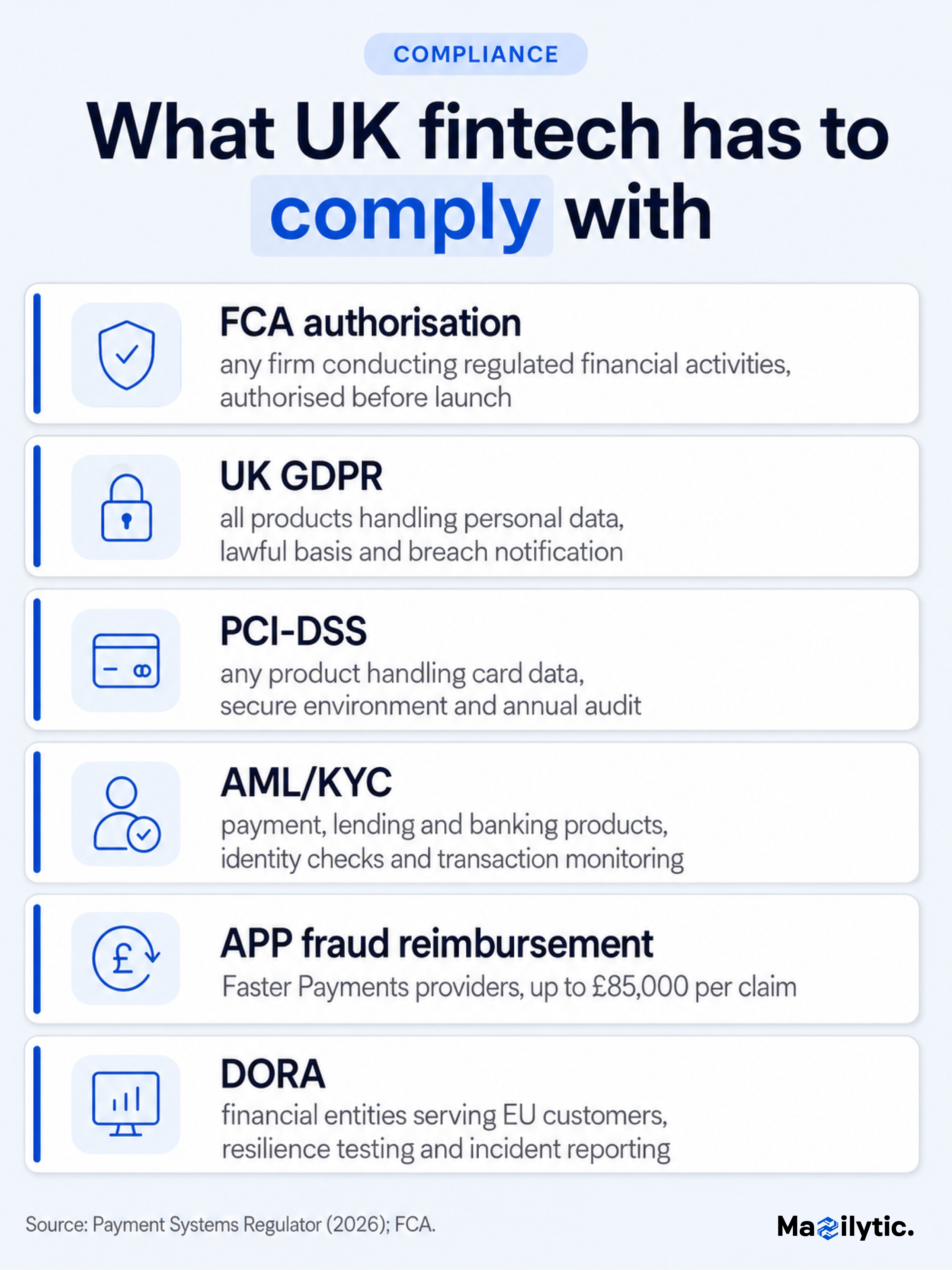
● FCA Authorisation: Any firm conducting regulated financial activities (Authorisation before launch; Consumer Duty obligations for all retail products)
● UK GDPR: All products handling personal data (Lawful basis for processing, data minimisation, right to erasure, breach notification)
● PCI‑DSS: Any product handling card data (Secure cardholder data environment, annual audit (scope depends on integration approach))
● AML/KYC: Payment, lending, and banking products (Identity verification, transaction monitoring, suspicious activity reporting)
● APP Fraud Reimbursement: Faster Payments providers (Mandatory reimbursement up to £85,000 per claim (live since 7 October 2024))
● DORA: Financial entities serving EU customers (IT risk management, operational resilience testing, incident reporting)
Budget 10 to 15% of annual development spend for ongoing regulatory updates; compliance is not a one‑time cost. Regulations change, and your codebase changes with them.
7. How Open Banking Is Changing Fintech Development in the UK
Open banking has 16.5 million active users in the UK and is transitioning from an FCA mandate into a genuine commercial infrastructure. The global open banking market was valued at $39.89 billion in 2025 and is projected to reach $288.36 billion by 2033, growing at a CAGR of 28.2%.
For fintech builders, open banking changes the starting point of every product. Instead of designing around siloed data, you can build on:
● Account aggregation: Unified views of a user's finances across multiple banks.
● Payment initiation: Account‑to‑account payments that bypass card rails.
● Variable recurring payments (VRP): Programmable, consent‑based recurring payments with real‑time control.
The open banking governance framework is currently transitioning to FCA‑led oversight (from August 2025), and open finance, extending the same data‑sharing principles to pensions, insurance, and investments, is the next regulatory frontier. Building open banking integration now positions your product for that broader opportunity.
8. How AI Is Transforming Fintech Software
Artificial intelligence has moved well past the chatbot era in fintech. Mordor Intelligence's own sizing puts the AI in fintech market at $36.61 billion in 2026, projected to reach $99.09 billion by 2031, at a CAGR of 22.04%, though as with overall fintech market sizing, other analyst firms may scope this differently.
Three AI capabilities are defining the modern fintech product roadmap:
- Real‑time fraud detection
Machine learning models score transactions in milliseconds, analysing behavioural biometrics alongside transaction data. One agency reports that automated KYC document extraction is now 99.9% accurate, reducing onboarding times from days to seconds, a figure worth verifying against your own chosen vendor's published accuracy rates rather than treating as a universal benchmark.
- AI‑powered underwriting and credit scoring
Alternative data sources, utility payments, rental history, behavioural signals, combined with ML models, enable faster, fairer credit decisions. One important caveat: the EU AI Act classifies credit scoring as a high‑risk AI application, with explainability and audit requirements enforceable from 2 August 2026 for products serving EU customers. A proposed "Digital Omnibus" package would delay this specific deadline to December 2027, but as of writing this has not been enacted into law, so 2 August 2026 remains the deadline to plan around.
- Agentic AI
One industry report puts the figure at 70% of banks already deploying some form of agentic AI: systems that don't just answer questions but take autonomous action within defined guardrails, across loan processing, AML monitoring, and customer onboarding. These are production systems handling real transactions. The FCA launched a live AI testing lab in 2025, enabling firms to safely test autonomous financial AI, a signal that the regulator is actively enabling responsible innovation rather than constraining it.
9. How Much Does Fintech Software Development Cost in the UK?
Fintech app development cost in the UK varies widely by product complexity, regulatory scope, and the level of security and testing required. These figures are synthesised from multiple UK agency pricing guides and should be treated as indicative ranges rather than fixed quotes:
● MVP / proof of concept: £25,000 to £80,000
● Production‑ready payment app: £80,000 to £180,000
● Digital banking platform: £200,000 to £500,000+
● Lending platform (FCA‑regulated): £150,000 to £350,000
● Wealth management/investment platform: £200,000 to £600,000
● RegTech / compliance ecosystem: £40,000 to £400,000+
Additional cost layers to budget for:
● Security measures: an estimated additional 20 to 40% of base development cost
● Compliance build (GDPR, FCA reporting, audit logs): roughly £45,000 to £85,000 for a mid‑tier product
● Ongoing regulatory updates: an estimated 10 to 15% of annual development spend
One cautionary note: choosing a low‑cost agency that skips proper compliance architecture consistently produces the worst financial outcomes. Regulatory remediation after launch typically costs several times more than building correctly from the start.
10. How Long Does It Take to Build a Fintech Application?
Timelines are driven by complexity, regulatory scope, and the quality of the discovery process upfront. Realistic ranges:
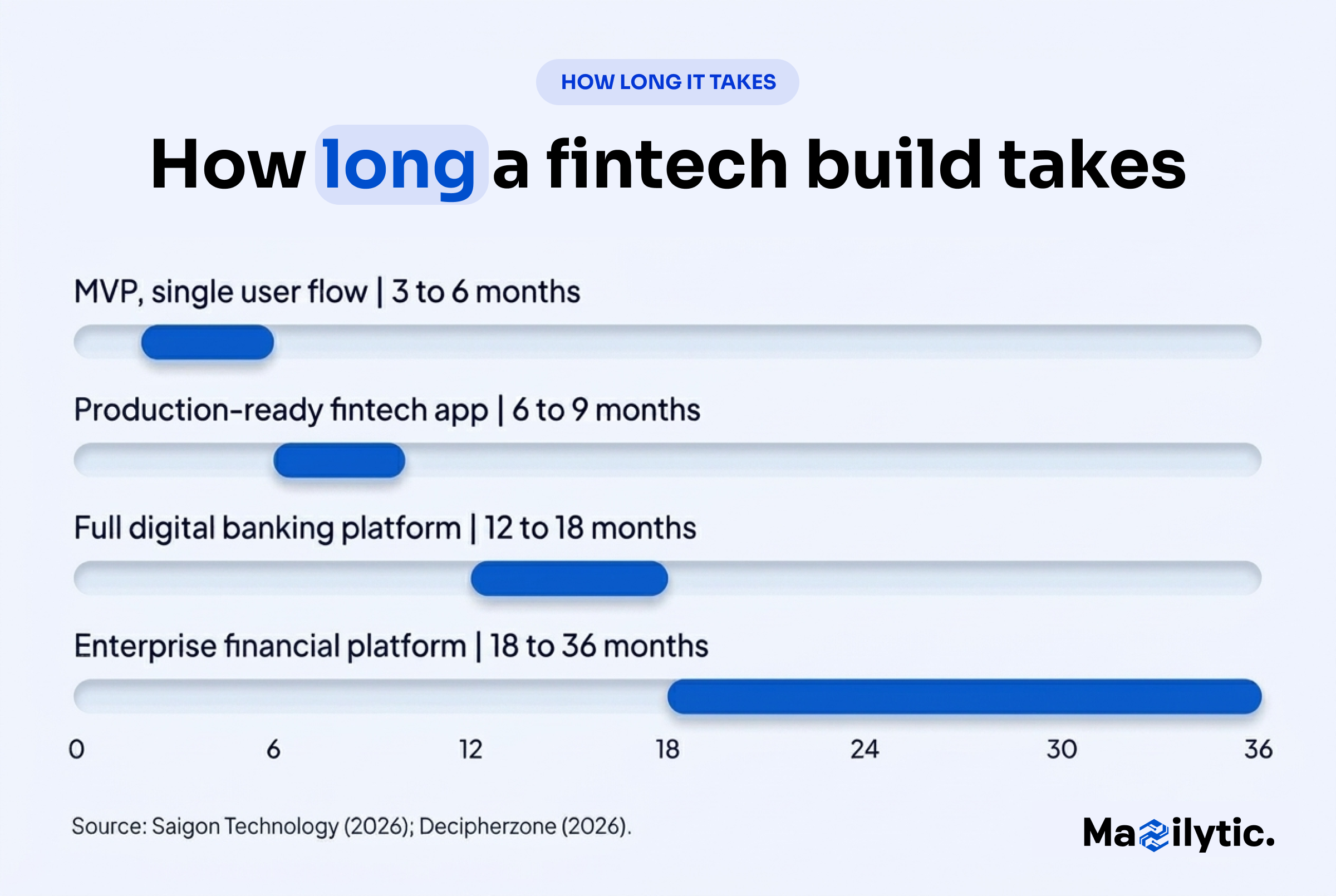
● MVP (limited features, single user flow): 3 to 6 months
● Production‑ready fintech app: 6 to 9 months
● Full digital banking platform: 12 to 18 months
● Enterprise financial platform: 18 to 36 months
Two factors consistently extend timelines beyond initial estimates: regulatory changes mid‑project (PSD2 updates added three to six weeks to many builds in 2024 to 2025) and API integration complexity with banking partners, whose documentation and test environments are notoriously unreliable. Building buffer time and budget flexibility into your project plan is not pessimism. It's experience.
11. Choosing the Right Fintech Software Development Company in the UK
The difference between a fintech development company and a standard software agency is regulatory fluency. Anyone can build something that looks like a fintech app. Far fewer can build one that will survive FCA scrutiny, pass a PCI audit, and scale without compromising security.
When evaluating a fintech software development company in London or elsewhere in the UK, ask[1] :
● Can you demonstrate experience with FCA‑regulated product builds?
● How do you handle compliance architecture: is it built from day one, or added later?
● What's your approach to security testing and penetration testing?
● Who manages open banking integrations: do you have direct experience with TrueLayer, Yapily, or Tink?
● Can you provide references from comparable projects in our sector?
● What does your post‑launch regulatory support look like?
Avoid any agency that treats compliance as a checkbox rather than an architectural discipline. In fintech, it's the other way around.
Our Fintech Software Development Process at Mazilytic
At Mazilytic, our fintech software development services follow a process built for regulated environments, where the cost of rework is high, and the margin for compliance error is zero.
- Discovery and Compliance Mapping
Before a line of code is written, we map every regulatory obligation that applies to your product: FCA authorisation requirements, PCI scope, GDPR data flows, AML/KYC obligations, and open banking integration points. This document becomes the foundation for every architecture decision that follows.
- Architecture Design
Security‑first, API‑first, scalable from day one. We design for the edge cases, failed transactions, authentication errors, session timeouts, regulatory reporting, not just the happy path.
- Development and Integration
Iterative builds with regular compliance checkpoints. Third‑party integrations (payment providers, KYC vendors, open banking APIs) are scoped and tested early, not left to the final sprint.
- Security Audit and Penetration Testing
Internal security review followed by independent third‑party penetration testing before any production deployment.
- Regulatory Review and Launch
Final compliance review against the obligations mapped in Discovery. We work alongside FCA‑experienced legal advisers to ensure nothing is missed.
- Ongoing Support and Regulatory Updates
Regulatory change is continuous. Our post‑launch support includes monitoring for relevant FCA guidance and building required updates into your product roadmap.
Common Fintech Development Mistakes to Avoid
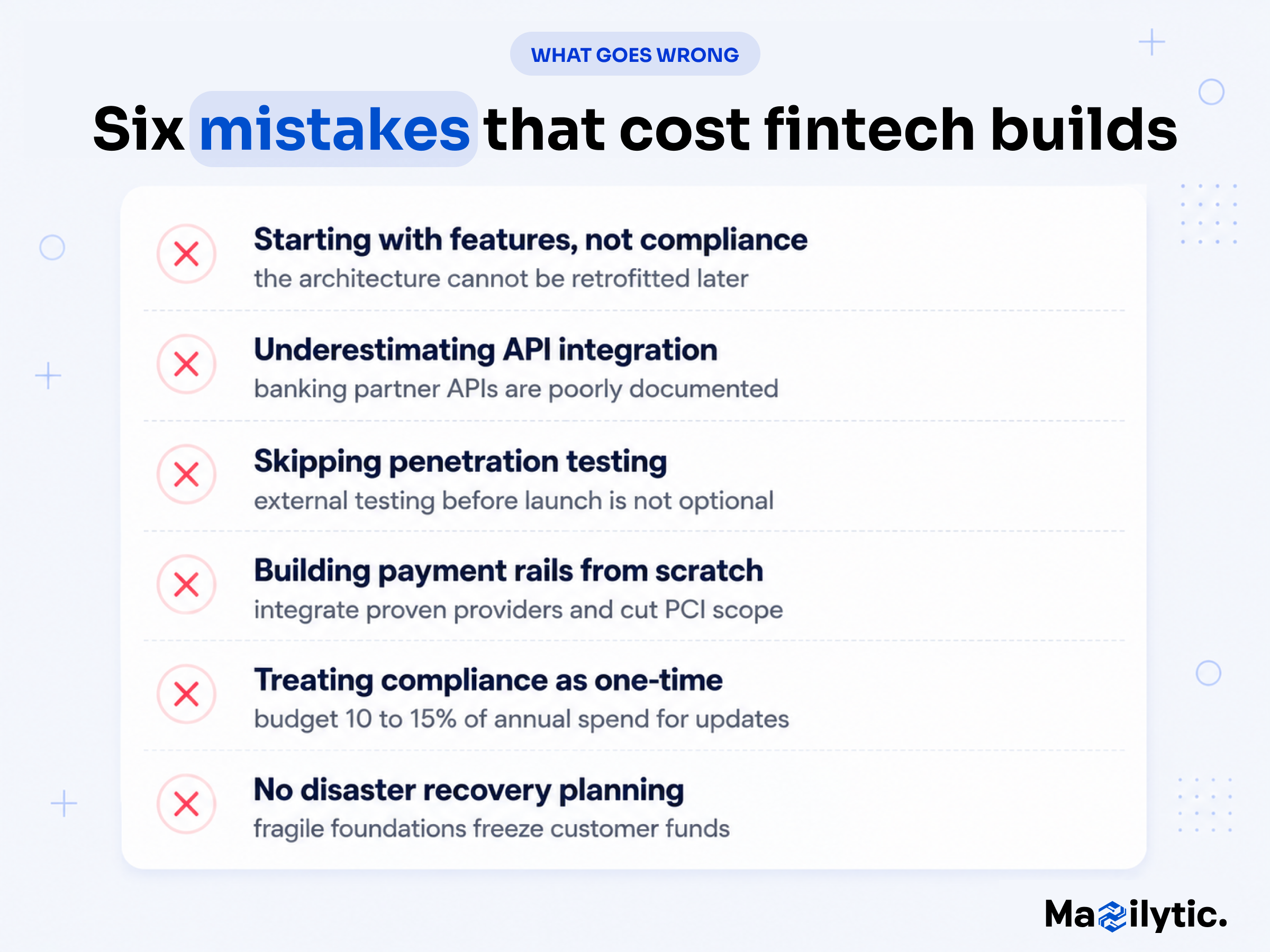
● Starting with features, not compliance: The architecture that supports FCA reporting, PCI scope reduction, and GDPR data flows has to be designed in. You cannot add it retroactively without significant rework.
● Underestimating API integration complexity: Banking partner APIs are often poorly documented and inconsistently available in test environments. Budget time and contingency for this.
● Skipping penetration testing: External security testing before launch is non‑negotiable. The cost of a post‑launch breach, in fines, remediation, and customer trust, dwarfs the cost of the test.
● Building payment rails from scratch: Unless you have a specific reason to, integrate with proven payment providers. You reduce PCI scope, accelerate development, and inherit years of battle‑tested reliability.
● Treating compliance as a one‑time cost: Budget 10 to 15% of annual development spend for regulatory maintenance. Regulations change, and your product must change with them.
● No disaster recovery planning: The Synapse bankruptcy in 2024 froze $160 million in customer funds, caused not by bad code but by fragile compliance foundations. Operational resilience isn't optional.
Frequently Asked Questions
Q1: How much does fintech software development cost in the UK?
Costs range from £25,000 for a compliance‑light MVP to £500,000+ for a full digital banking platform. The primary cost drivers are regulatory scope (FCA authorisation, PCI‑DSS, AML/KYC), security requirements, and the number of third‑party integrations involved. Budget an additional 20 to 40% for security measures and 10 to 15% of annual spend for ongoing regulatory updates.
Q2: How long does it take to develop a fintech application?
MVPs typically take three to six months. Production‑ready fintech applications, with proper compliance architecture, security testing, and open banking integrations, take six to nine months. Full digital banking platforms take twelve to eighteen months or more. Mid‑project regulatory changes and banking API complexity are the most common causes of timeline overruns.
Q3: What technologies are used to build fintech software?
Common stacks include .NET Core or Node.js for backend services, React or React Native for frontend and mobile, and AWS or Azure for cloud infrastructure. For AI and fraud detection, TensorFlow and PyTorch are widely used. Payment integrations typically use Stripe, Marqeta, or Faster Payments APIs; open banking integrations use TrueLayer, Yapily, or Tink.
Q4: How can fintech applications protect customer data?
A layered approach: AES‑256 encryption for stored data, TLS 1.3 for data in transit, multi‑factor authentication and biometric verification at login, AI‑powered fraud detection for transaction monitoring, regular penetration testing, and ISO 27001‑certified security practices. APP fraud reimbursement obligations since October 2024 have made strong fraud controls a direct financial liability for UK payment providers.
Q5: Does fintech software need to comply with UK regulations?
Yes, and the framework is extensive. Depending on your product, you may need FCA authorisation, PCI‑DSS certification, UK GDPR compliance, AML/KYC processes, Consumer Duty obligations, and APP fraud reimbursement controls. If you're serving EU customers, DORA and the EU AI Act also apply. Compliance is not a one‑time project. It's an ongoing operational discipline.
Q6: Can AI be integrated into fintech applications?
Yes, and increasingly it's a competitive requirement. AI is used for fraud detection, credit scoring, KYC automation, personalised financial guidance, and agentic process automation. One important consideration: the EU AI Act classifies credit scoring and fraud detection as high‑risk AI applications, with explainability and audit trail requirements currently enforceable from 2 August 2026. Any AI integration in a UK fintech product serving EU users needs to be built with governance, model auditability, and human oversight in mind from the start.
Final Thoughts
The UK fintech market is one of the most significant commercial opportunities in European technology, and it rewards businesses that build with rigour. The ones that cut corners on compliance, security, or architecture don't just encounter problems. They encounter them at the worst possible moments, at the highest possible cost.
Secure fintech software development UK isn't about being cautious. It's about building a foundation solid enough to scale on. The businesses that get this right don't just survive FCA scrutiny. They use it as a competitive differentiator, because their customers know their money is safe.
If you're planning a fintech app development UK project, whether it's a payment solution, a lending platform, or a digital banking product, the right time to think about architecture, compliance, and security is before you write the first line of code.