
SEO vs Google Ads: Which Is Better for Your Business
Let’s be real you've probably Googled around this exact topic at times when you're hit with a tight marketing budget and wondering where to invest your funds. We can assure you, you're not the only one. We've had this same conversation with multiple clients at Mazilytic, and the conclusion is nearly never as straightforward as “just do SEO” or “just run the ads”.
So let's cut to the chase.
The Real Difference Nobody Talks About
If you skim through the internet, you'll land on one claim almost every article repeats: SEO is free, and Google Ads is pay‑to‑play. Technically, that's true. In practice, it's deeply misleading.
Search engine optimization is not free. It costs time, strategic planning, content creation, and a lot of unglamorous technical work. Google Ads, meanwhile, isn't simply paying by the click. When done right, it's buying data, speed, and precision. The real question was never “which is cheaper.” It's “What does my business actually need right now?”
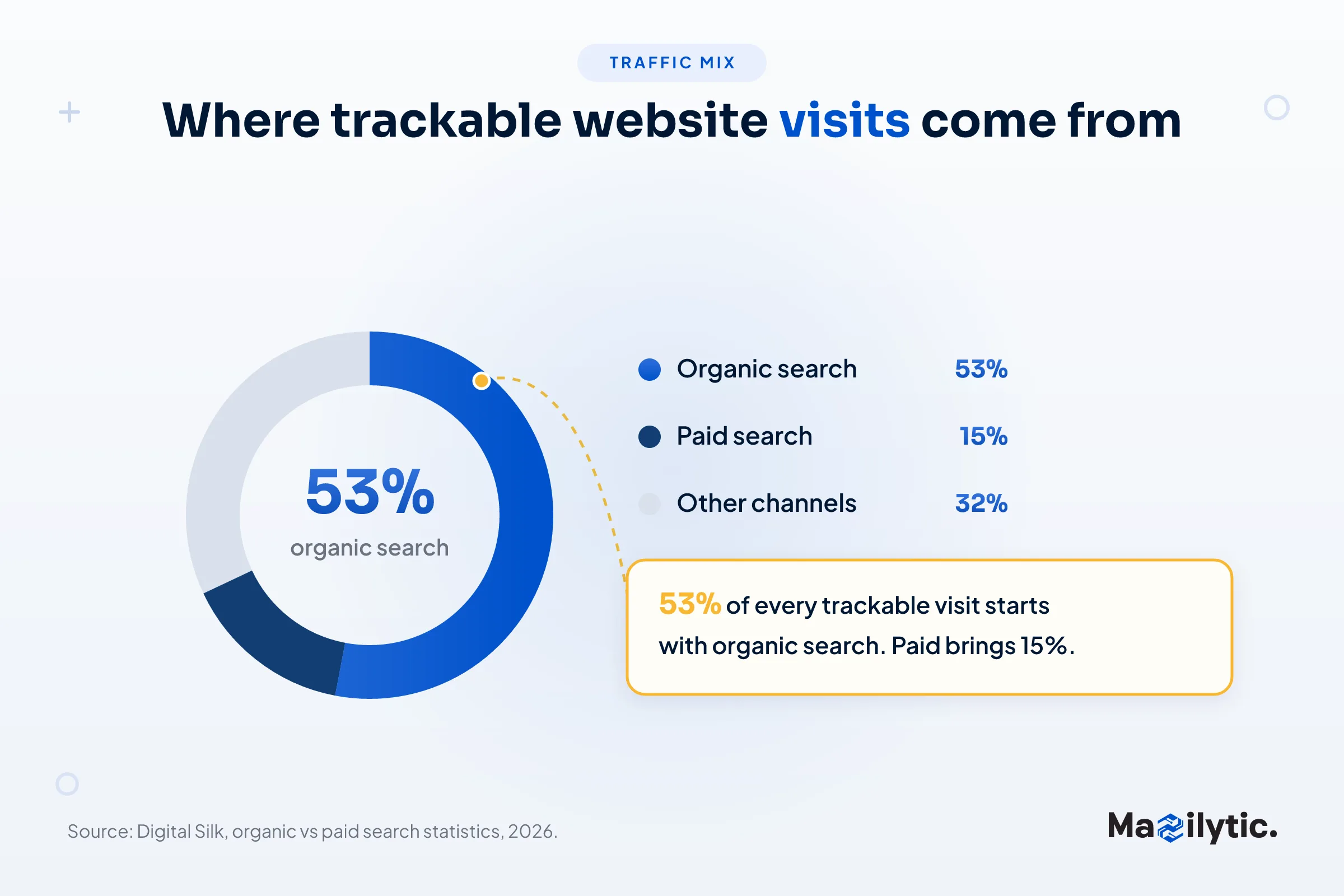
Here's the backdrop worth keeping in mind for the rest of this guide. Organic search still drives the majority of website traffic; roughly 53% of all trackable site visits originate from organic search, versus around 15% from paid.
Paid search has been gaining ground fast: between January 2025 and January 2026, Similarweb found paid results roughly doubled their click share across major verticals while classic organic clicks fell 11 to 23 percentage points, driven largely by AI Overviews reshaping the results page.
In other words, both channels are moving targets. Decisions made on 2023 assumptions don't hold anymore.
When Google Ads Wins
You can rely on Google Ads when you need to make sales the week after introducing a new product. Within 24 hrs, you can be live and visible in front of high‑intent buyers. You do not need to wait for the Google search engine algorithm to prefer you.
In 2026, Google Ads are much more robust. With the help of AI, Performance Max campaigns automatically serve your ads across Search, YouTube, Gmail, Display, and Maps, all from one campaign. Assuming that you know your customer and that you have a clear offer, much of the heavy lifting is done by the machine.
Here's where Google Ads genuinely shines over SEO:
- Speed to market: campaigns appear within a day, not months.
- Granular targeting: connect with individuals based on their location, device, income level, and even time zones.
- Scalability: increase budget when something works, pause instantly when it doesn't
- Testing power: run A/B tests on messaging, landing pages, and offers in real time
- Retargeting: re‑target visitors who did not originally purchase the product.
The catch? The minute you quit spending, you disappear. Every click costs money, and in competitive industries, those clicks can get expensive quickly.
When SEO Wins
SEO is the long game, and in 2026, it rewards quality more than ever. Google's algorithm has shifted hard over the last two years. E‑E-A‑T (Experience, Expertise, Authoritativeness, Trustworthiness) is no longer a nice‑to‑have guideline; it's a survival requirement. Link farms, thin content, and keyword stuffing get penalized more heavily than before. But businesses that invest in genuinely helpful, well‑organized content compound their returns month after month.
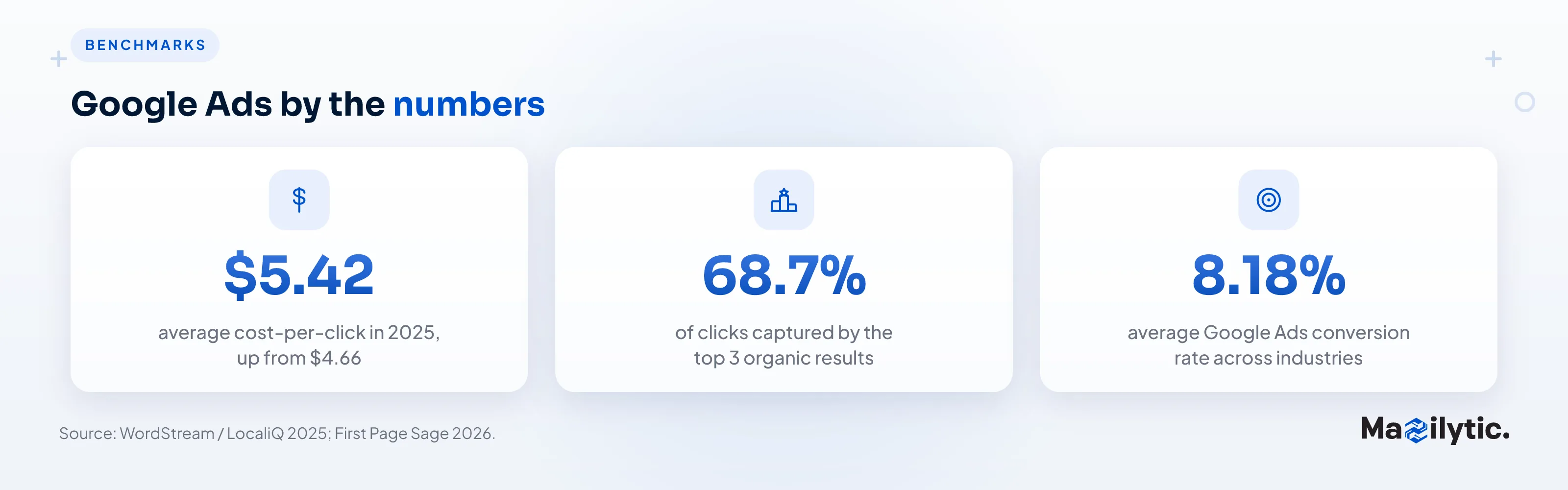
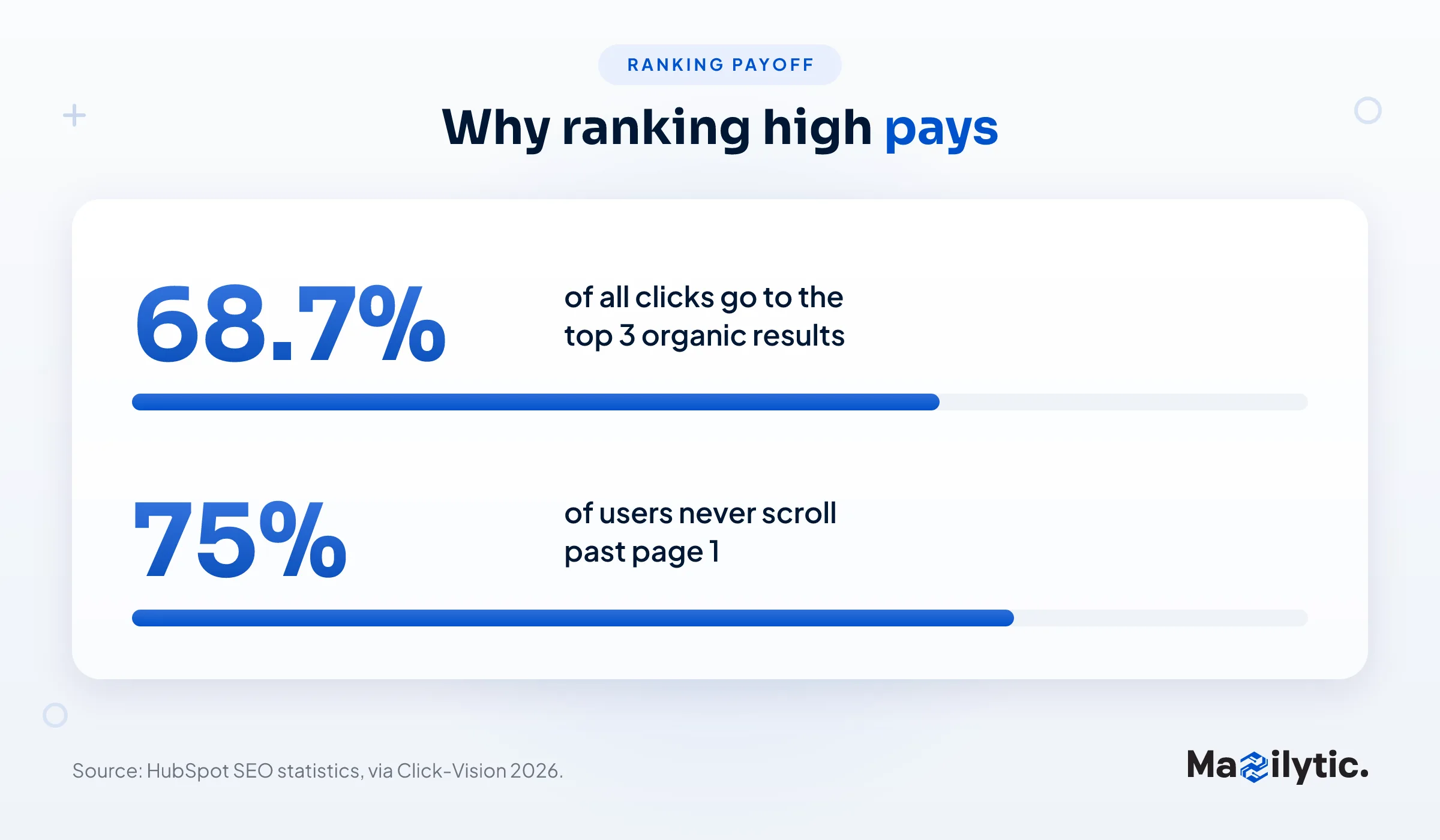
And the traffic concentration at the top is staggering. The top three organic results capture roughly 68.7% of all clicks on a search page, and about 75% of users never scroll past the first page at all. Rank well, and the math works heavily in your favor, without paying for a single click. That's also why 49% of marketers report organic search delivers the best ROI of any channel they run.
In many important ways, SEO is better than paid ads:
- Long‑term ROI: a highly‑ranking page will continue to draw traffic over the years without you even spending a dollar.
- Trust and credibility: organic rankings possess a certain degree of authority that the ads lack.
- Long‑term cost‑effectiveness: the lower your ranking, the lower your cost per lead will be.
- Brand visibility: Being among many search results (such as blogs, service pages, and FAQs) will create a brand presence at scale.
- Algorithm resilience: The content strategy of high quality and diversity is more resistant to changes.
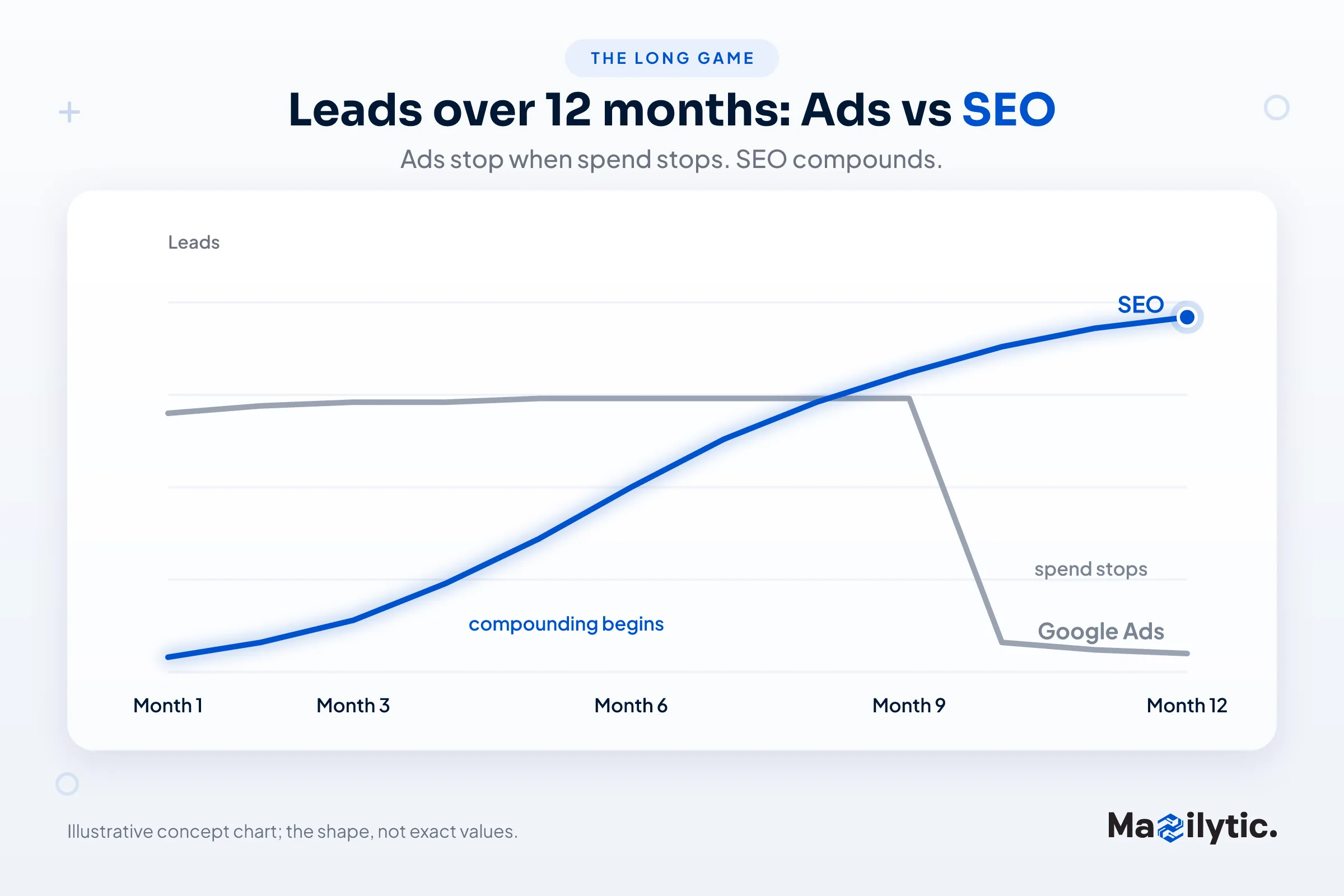
The downside is patience. Depending on your industry and competition level, meaningful SEO results typically take 3 to 6 months minimum. If you need results next week, SEO alone won't cut it.
The 2026 Reality: It's Not Either/Or
Most businesses in 2026 are starting to accept that the best‑performing brands aren't choosing between SEO and Google Ads. They are smartly employing both. It is a clever approach to use Google Ads as a means of making money immediately and collecting information on which keywords actually convert. Then take that data to enhance your SEO strategy by targeting the terms that are already making you money.
The higher your organic rankings in the long‑term, the less you would need to spend on advertising those keywords, and you could divert that money elsewhere.
It's not a matter of which channel is "better." It has to do with where you are in your business and what role each channel plays at that stage.
Which One Should You Choose?
Ask yourself three questions:
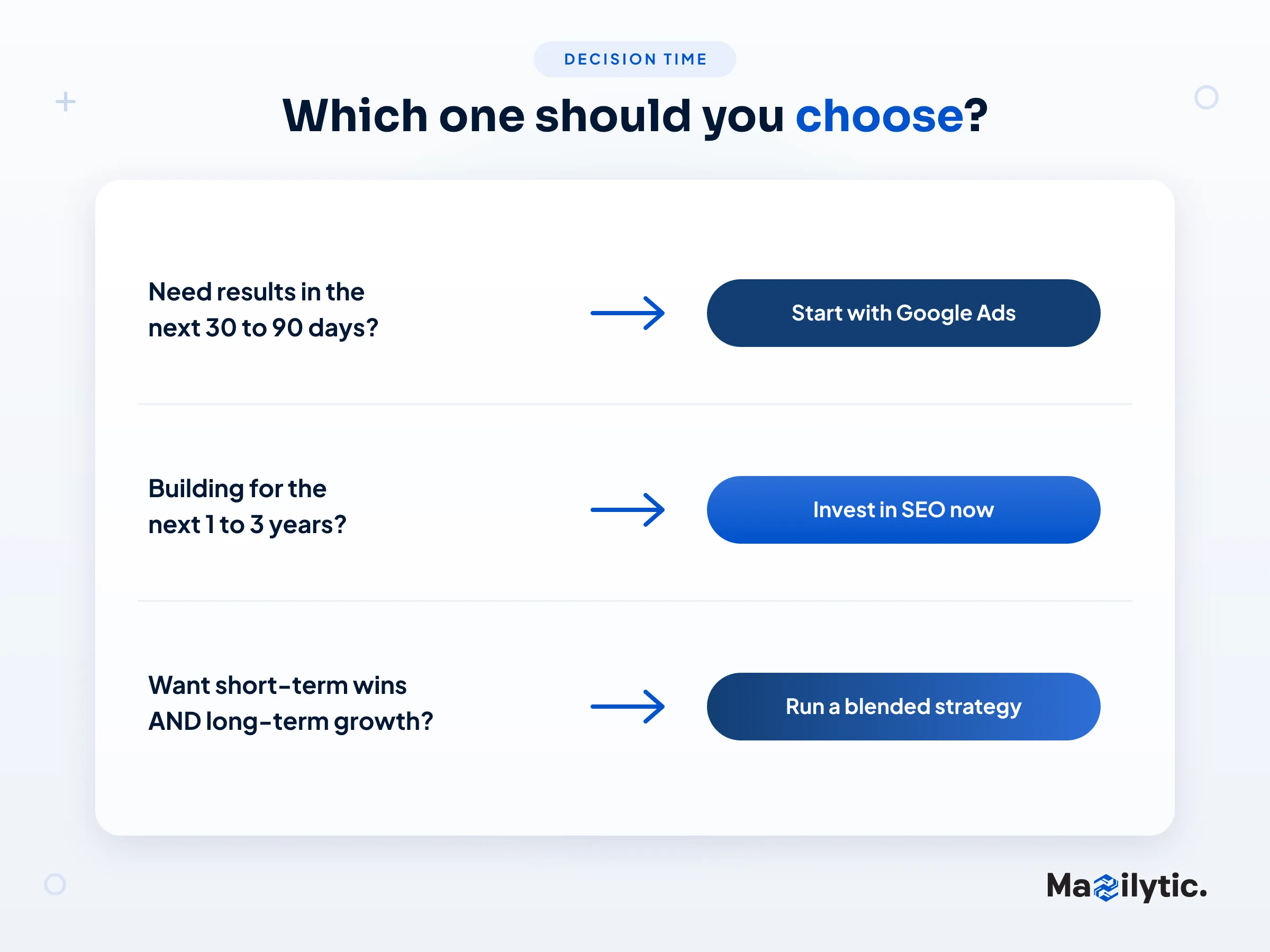
- Do you need results in the next 30 to 90 days? Start with Google Ads.
- Are you building for the next 1 to 3 years? Invest in SEO now.
- Do you want both short‑term wins and long‑term growth? You need a blended strategy.
At Mazilytic, we help businesses figure out exactly where to focus based on their goals, industry, and budget - not what's trendy. Because the best strategy isn't the one everyone else is doing. It's the one that actually works for you.
Frequently Asked Questions
Q1: Is SEO or Google Ads cheaper?
It depends on your time horizon, not the sticker price. Google Ads has a clear, immediate cost. The 2025 average cost‑per‑click was $5.42 and the average cost per lead was $70.11, and that meter runs every single day you advertise. SEO has a low per‑click rate but requires real upfront investment in content, technical work, and time, with results typically taking 3 to 6 months. Over a one‑to‑three‑year window, SEO usually wins on cost per lead because ranking pages keep working without per‑click fees. For immediate revenue, Ads is cheaper to start; for durable, low‑cost traffic, SEO is cheaper to own.
Q2: How long does SEO take to show results?
Three to six months minimum in most industries, and longer in competitive niches. SEO compounds: the curve is flat at first, then rises as the site gains authority. If you need leads this month, run Google Ads alongside the organic work until it bears fruit, then shift budget toward SEO as rankings build.
Q3: Do Google Ads actually convert better than organic traffic?
Yes, in most cases. Paid search visitors convert at a higher rate, roughly 50% better than organic visitors, because targeting brings in people who are ready to buy. Organic volume, however, is much larger, roughly 53% of all site traffic versus about 15% from paid, so organic often delivers more total conversions through sheer volume. There's no conflict between the two: conversion rate and total conversions measure different things.
Q4: Are Google Ads still worth it in 2026 with AI Overviews changing search?
Yes, but they demand more precise targeting now. AI Overviews have reduced organic click‑through rates and, on general information queries, have cut into paid CTR as well. The answer isn't to stop running Ads; it's to focus paid budget on high‑intent commercial keywords and measure cost‑per‑acquisition and ROAS, not just CPC. Where budgets drain in 2026 is broad, informational campaigns.
Q5: Can I just do one channel instead of both?
You can, and plenty of businesses start with one. If you need cash flow now, start with Google Ads. If you're playing a long‑term game on a lean budget, start with SEO. But the data consistently favors a combination: Ads reveal which keywords actually convert, and that makes your SEO highly targeted. Most brands that can afford both end up running both for a reason.