Shopify vs WordPress: Which Platform Is Better for Your Business in 2026?
Let's start with a story, because it's the kind we hear far more often than we'd like. A client approached us with a two‑year history of running their business, frustrated, over‑budget, burdened and stuck on the wrong platform. They'd picked it on a friend's recommendation. Moving everything across cost them more than their entire first‑year marketing budget. The platform wasn't bad. It was just the wrong tool for the job they were actually trying to do.
That's the whole problem in one sentence. So if you're starting a new website or thinking about migrating the one you've got, this guide is built for you. We're going to skip the surface‑level feature checklist that every other comparison repeats, and talk about what actually matters: where each platform quietly wins, where it quietly fails, and how to tell the difference before it costs you.
Shopify and WordPress are two of the most well‑known platforms on the internet, and people often compare them to each other. But here's something that no one really tells you: they're not really trying to get the same customer. It is significant to know where each platform shines and where it quietly fails. This helps you distinguish between a platform that grows with your business and one that becomes a headache you can't shake.
What Shopify Actually Is
Shopify is a specialized eCommerce platform, and that word specialized is doing a lot of work. It was built from the ground up to do one thing extremely well: let you sell things online. Physical products, subscriptions, digital downloads; if it can be sold, Shopify is engineered to move it. The moment you sign up, you inherit hosting, SSL, payment processing, inventory management, and a checkout flow that's been obsessively optimized for conversions across millions of stores. You never have to think about the plumbing. It just works.
If your primary goal is to sell, that's a genuinely powerful position to start from. A small clothing brand, a local artisan, or a dropshipping operation can be live and taking orders fast, with no developer on retainer. That speed is real, and it's worth paying for when selling is the whole point.
The trade‑offs are equally real. You're renting the platform, not owning it. Unless you use Shopify Payments, Shopify takes a cut of every sale through transaction fees, and even on Shopify Payments, you're paying processing rates. As of 2026, those processing rates sit at roughly 2.9% + 30¢ per transaction on the Basic plan, scaling down to around 2.15% + 30¢ on Shopify Plus, with an additional fee layered on top if you bring your own payment gateway.
Source: First Pier - Shopify Pricing and Fees 2026.
There's also a ceiling on customization. Shopify is wonderful right up until you hit the edge of what its theme system and app ecosystem allow. After that point, the problems you run into can usually only be solved by an expensive app subscription or custom development, and those costs compound quietly, month after month.
What WordPress Is All About
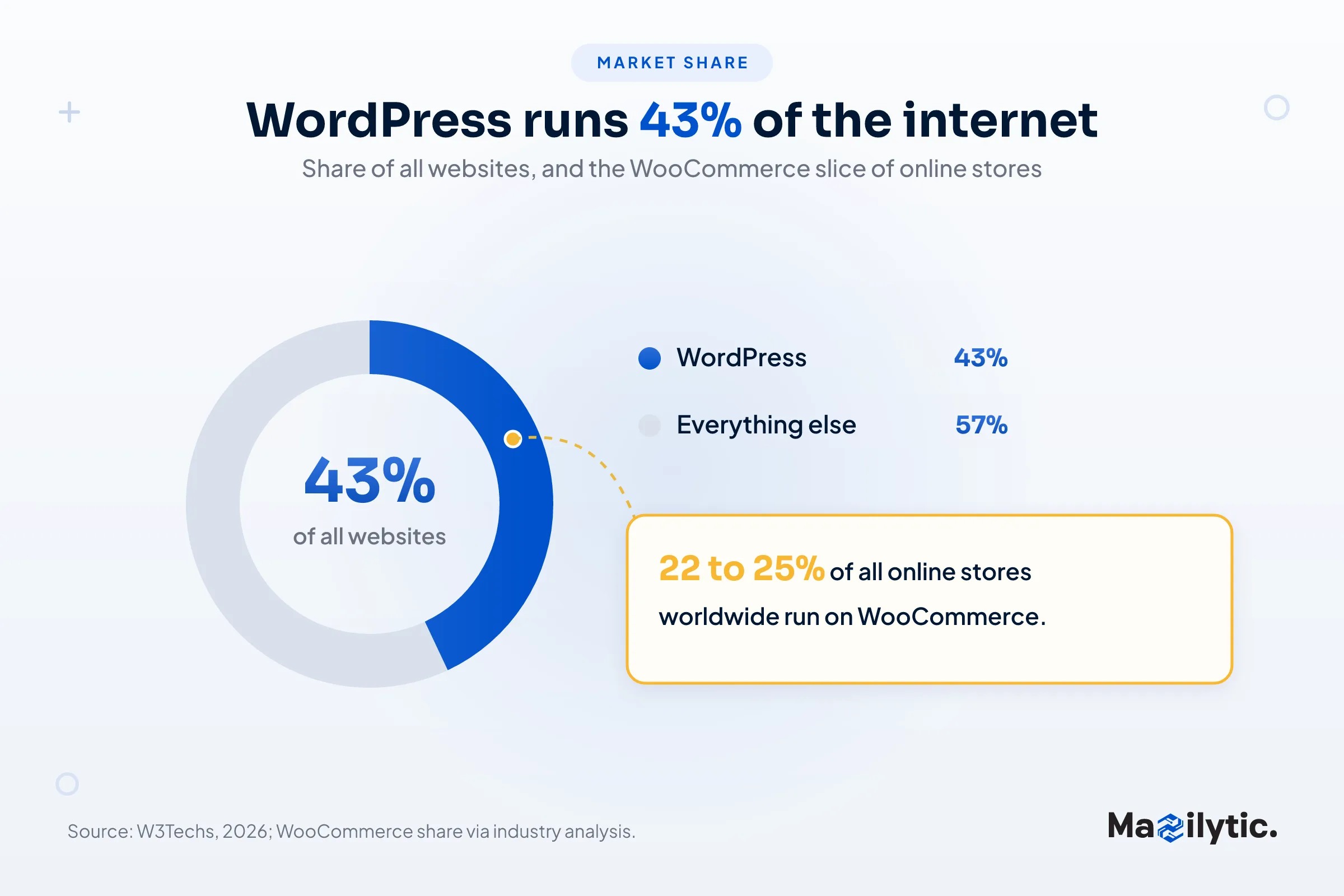
WordPress powers roughly 43% of the entire internet, and that single number should tell you something. According to W3Techs, it holds around 43% of all websites and close to 60% of the market among sites running a known content management system, a lead so large that no competitor is within striking distance.
Source: W3Techs. Usage Statistics and Market Share of Content Management Systems, 2026.
It started life as a blogging platform back in 2003. Two decades on, it's evolved into a full content management system capable of running anything from a one‑page portfolio to a multinational corporate site. Pair it with WooCommerce (its eCommerce plugin), which powers somewhere between 22% and 25% of all online stores worldwide, and it competes directly in the commerce space too.
Source: WooCommerce Statistics (2026) Marketing LTB industry analysis
What makes WordPress fundamentally different is ownership. You own your platform outright. You host it, you control it, you modify it however you want, and nobody takes a cut of your sales. The developer ecosystem is enormous, and there's a plugin for very nearly everything. The flip side is responsibility: hosting, security, updates, and backups are now your job. When something breaks, you fix it, or you pay someone who can. Freedom and responsibility are the same coin here.
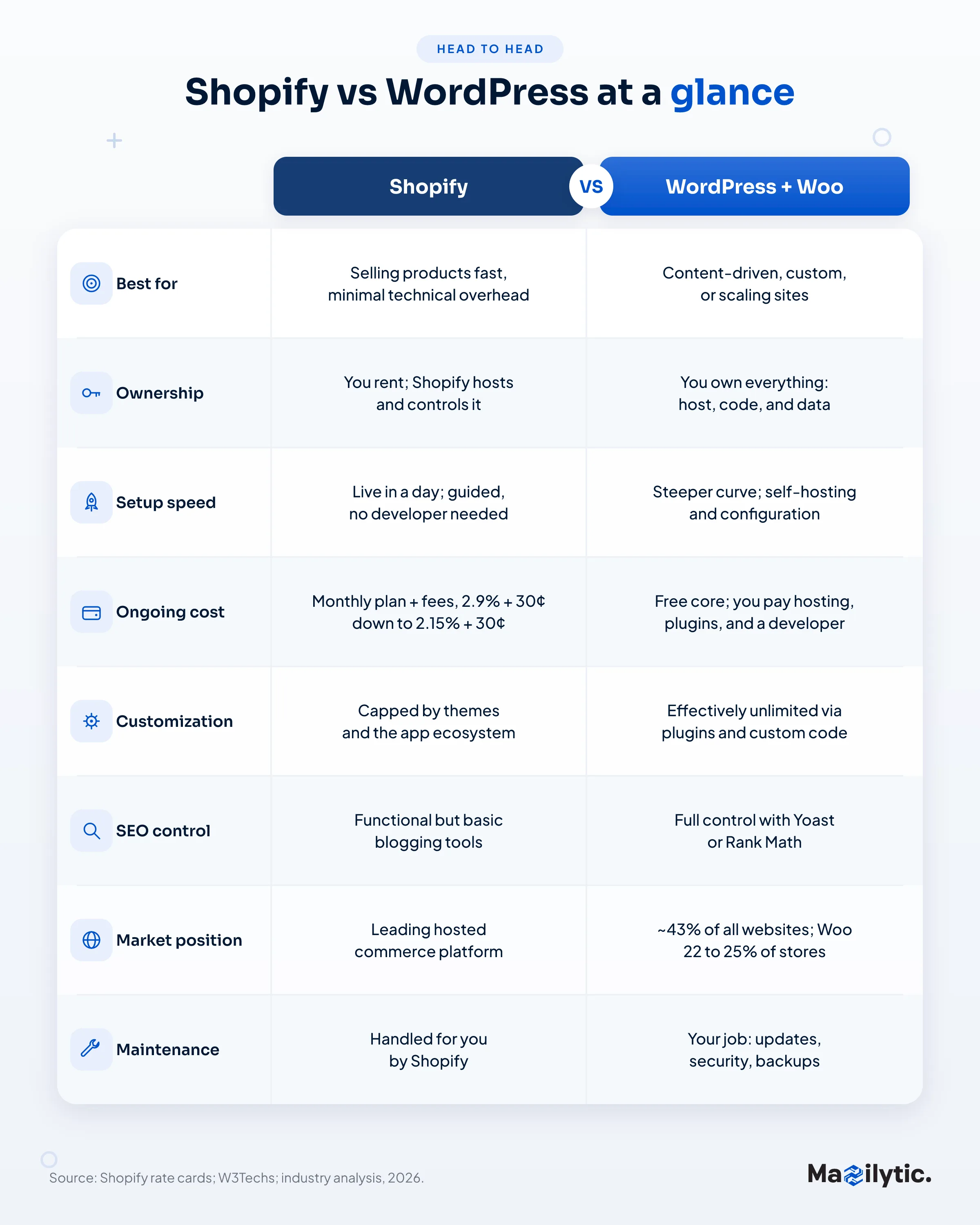
Shopify vs. WordPress at a Glance
| Table notes: processing rates per Shopify rate cards; market‑share figures per W3Techs and industry analysis. |
Ease of Use vs. Freedom
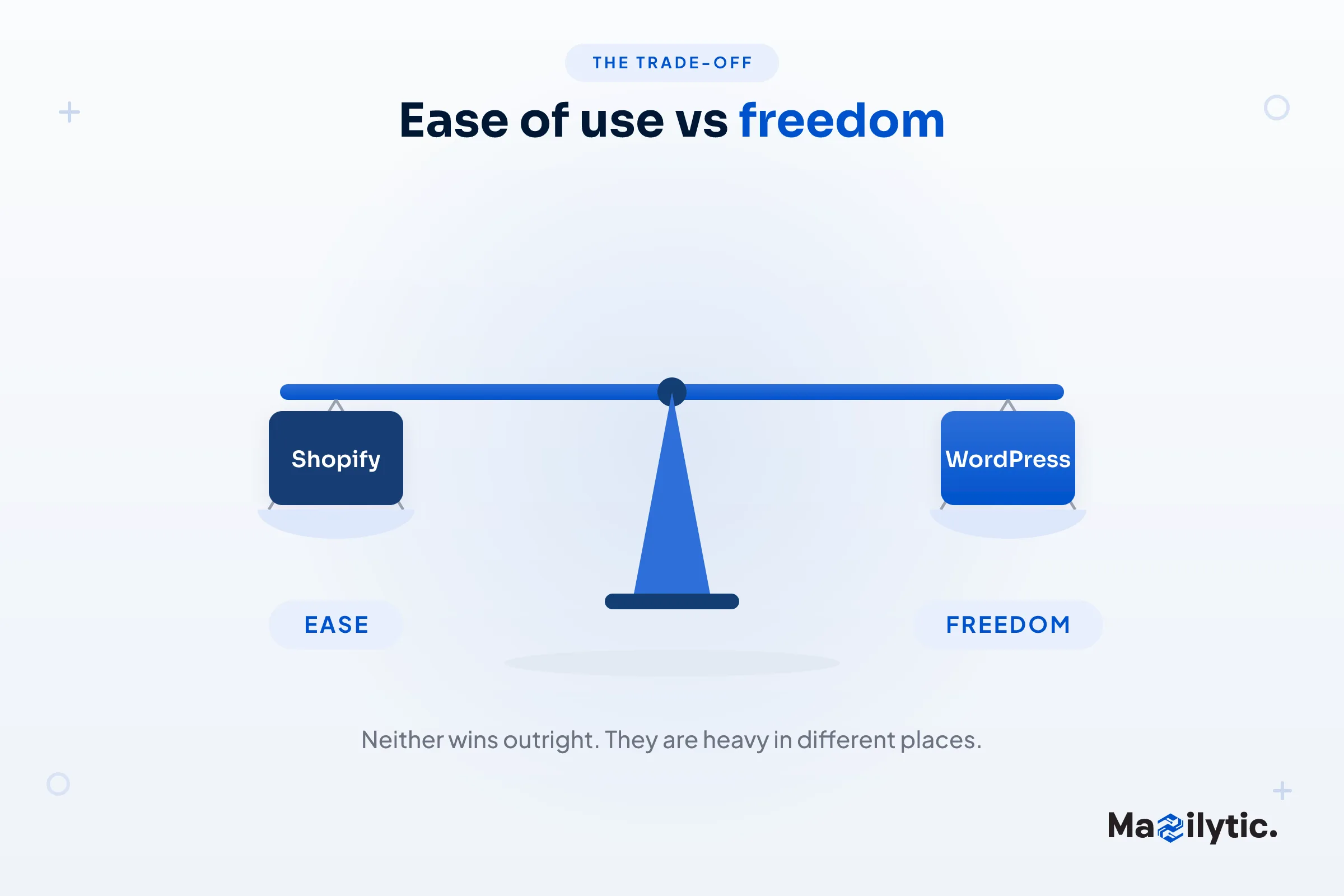
This is where most people make the decision, and it's a fair place to make it. Shopify is genuinely easier to use out of the box. Step‑by‑step setup and a clean interface can have you running a working store in a day. WordPress asks more of you: a steeper learning curve, self‑hosted management, manual updates, and real configuration time across third‑party themes and plugins. Its vast flexibility is powerful, but it can overwhelm beginners with options.
But ease of use today can become a constraint tomorrow. Businesses that outgrow Shopify's limitations often end up paying more in apps and workarounds than they would have spent building on WordPress properly from the start. It's worth thinking two or three years ahead, not just about launch day.
The Technical Requirements: Who Owns What
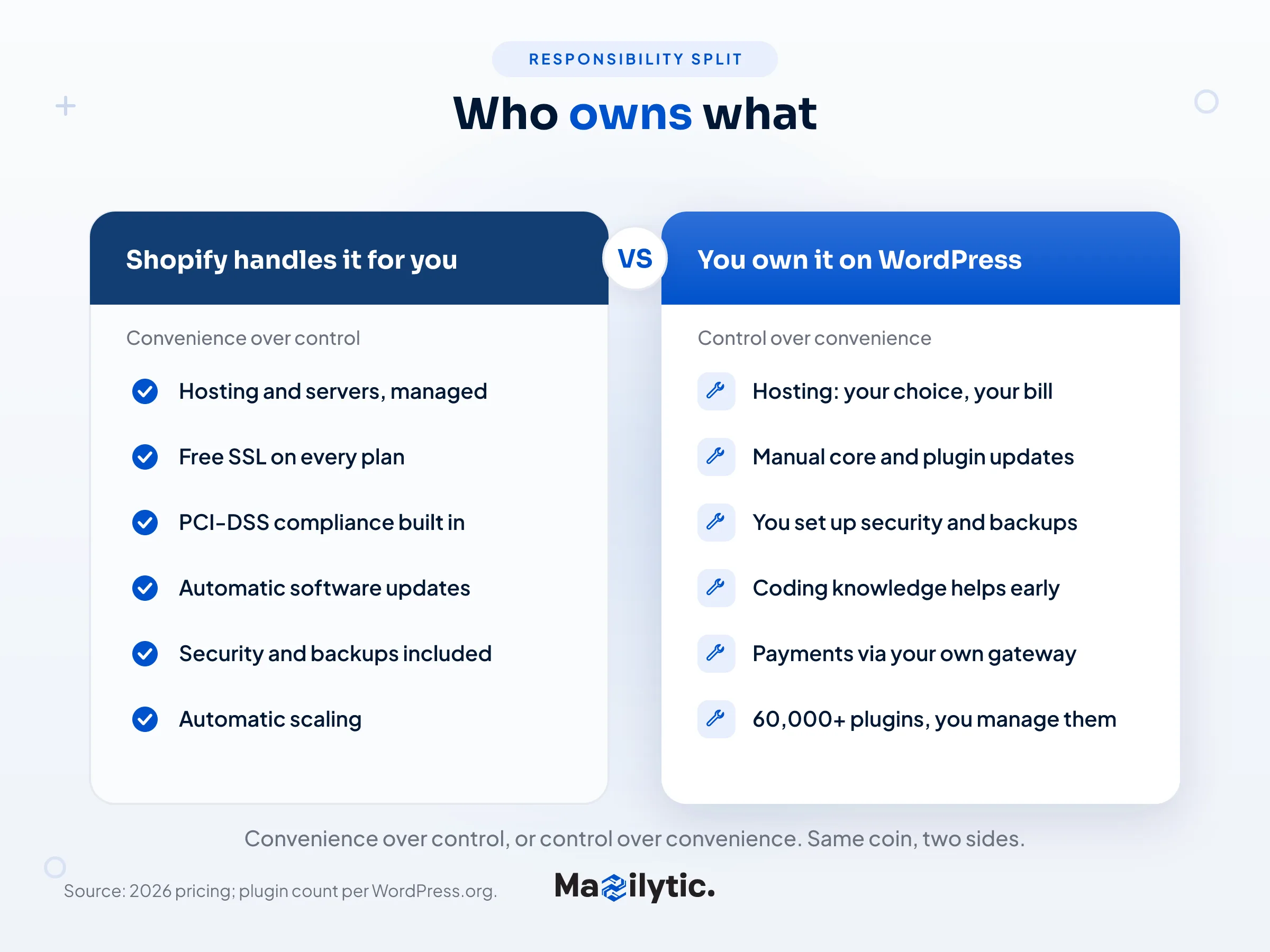
Shopify's core promise is that it owns nearly all of it for you. WordPress hands you that ownership in exchange for control. Here's how the responsibilities are split:
Shopify handles it for you
Convenience over control
- Hosting & servers: Included and fully managed. Nothing to provision or maintain.
- SSL certificate: Free on every plan, configured automatically.
- PCI‑DSS compliance: Handled out of the box for payment security.
- Software updates: Automatic. The platform is maintained for you.
- Security & backups: Built‑in monitoring; no plugins to wire up.
- Scaling: Automatic; move to Plus for high‑volume traffic.
You (or your developer) own it
Control over convenience
- Hosting & servers: Your choice and your bill: ~$3 to $10/mo entry, $20 to $120+/mo for serious stores.
- Updates & maintenance: Manual: core, themes, and plugins are on you.
- Security & backups: You configure firewalls, scanning, and backups (often via plugins).
- Coding knowledge: Helpful from day one: PHP, HTML, CSS, JS for real customization.
- Compliance & payments: PCI handled via your gateway; pick any processor, no platform surcharge.
- Customization: 60,000+ plugins and full code access. You manage compatibility.
Source: Hosting and fee figures reflect 2026 pricing; plugin count per the WordPress.org directory
The SEO Question
If content marketing and organic search are part of your strategy, and for most businesses, they should be, then WordPress is the stronger platform, and it isn't especially close. Shopify's blogging and content tools are functional but basic. WordPress was literally designed as a publishing platform, and with a plugin like Yoast SEO or Rank Math, you control nearly every lever that affects search visibility: URL structure, metadata, schema markup, internal linking, and site‑speed tuning.
That ecosystem is mature, not experimental. SEO plugins appear in the overwhelming majority of serious WordPress sites, with Rank Math alone passing 2 million active installations and Yoast remaining the long‑standing category leader since 2010. You're choosing between two battle‑tested tools, not gambling on an unknown.
Source: WordPress.org Plugin Directory; Rank Math and Yoast SEO active‑installation data, 2026.
For businesses that need to rank for competitive keywords, publish long‑form content, or build topical authority over months and years, WordPress gives you the infrastructure to do it properly.
The shorthand we use with clients: Shopify will get you ranking for your product names. WordPress will get you ranking for everything around it.
What We Tell Our Clients
At Mazilytic, after working with businesses across retail, SaaS, hospitality, and professional services, here's the honest breakdown we give; no hedging.
Choose Shopify if your business revolves around selling physical or digital products, or if you want to move fast without getting bogged down in the technical side of running a website. It's a finely tuned commerce platform, and for the right business, it's worth every cent of what it charges.
Choose WordPress when you want full control, when your site is content‑driven and shouldn't be boxed in by platform limits, or when you simply want room to scale without hitting a wall. You'll likely need a developer at some point, but you'll never be locked into one platform's roadmap or pricing decisions.
The Bottom Line
Here's the thing almost nobody says out loud: the platform question is usually the wrong place to start. Start instead with your business model, your growth plan, and your technical capacity, then let those answers point you to the platform, rather than the other way around.
Both Shopify and WordPress are excellent tools. Neither is objectively “better.” The entire difference comes down to knowing which tool fits the job you're actually trying to do. Get that right, and the platform becomes an accelerator. Get it wrong, and it becomes the thing you spend two years and a marketing budget trying to escape.
CTA: Still not sure which way to go? That's exactly the conversation we're here for. Tell us what your business actually needs to do, and we'll tell you straight which platform gets you there.
FAQ
Q1: Which platform is genuinely better for SEO?
WordPress, and it isn't especially close but it's worth being precise about why. Shopify does a great job with product pages; its fault is that it has difficulty with editorial content and fine granularity. WordPress was created as a publishing platform, and with Yoast SEO or Rank Math, you have complete control over the structure of your URLs, metadata, schema markup, internal linking, and speed tuning, down to the detail. Not experimental plugins: Rank Math has 2 million active installs, and Yoast has been a leader in the category since 2010. When it comes to how you get customers for your business, and they're coming through organic search and long‑form content, then that depth is important.
Q2: Can I really run a serious store on WordPress instead of Shopify?
Yes, plenty of serious stores do. WooCommerce, the eCommerce plugin for WordPress, powers between 22% and 25% of all online stores in the world and supports physical goods, subscriptions, and digital downloads. What actually differs is who does the work. Shopify includes security, PCI compliance, hosting, and updates in a single package. WooCommerce lets you (or your developer) assemble those parts and keep them updated. Freedom and responsibility, the same coin again.
Q3: Do I actually need a developer?
For Shopify, usually not at launch. Most small businesses go live without bringing in help; the need shows up later, at the limits of themes and apps, where custom Shopify work commonly runs $3,000 and up. With WordPress, you'll probably want development help earlier: setup, custom features, security hardening, and routine updates all benefit from someone who knows the stack. The upside is that you're never locked into a single platform's roadmap or pricing, and you can switch hosts or hire from a huge developer talent pool.
Q4: How expensive is it to switch platforms later?
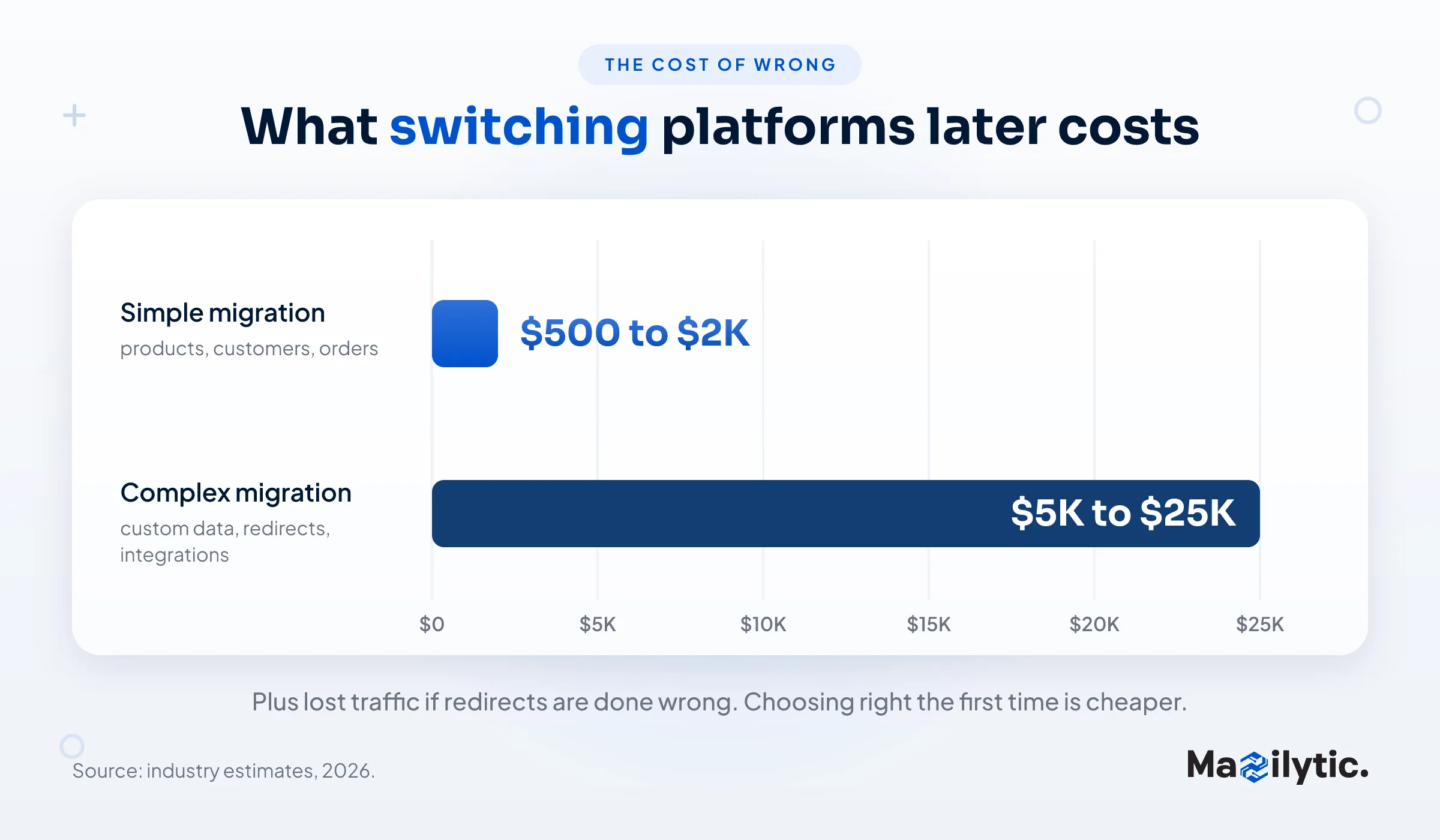
More than most people expect, which is why the client in our opening story got burned. A simple data transfer (products, customers, orders) runs $500 to $2,000, while a complex migration involving custom data, redirects, and integrations can cost $5,000 to $25,000, not counting the traffic you lose if redirects are done wrong. The lesson isn't "never switch." It's that deciding with a two‑to‑three‑year view now costs far less than migrating after you've outgrown the choice you made.