The Real Cost of Poor UI/UX Design for UK Businesses
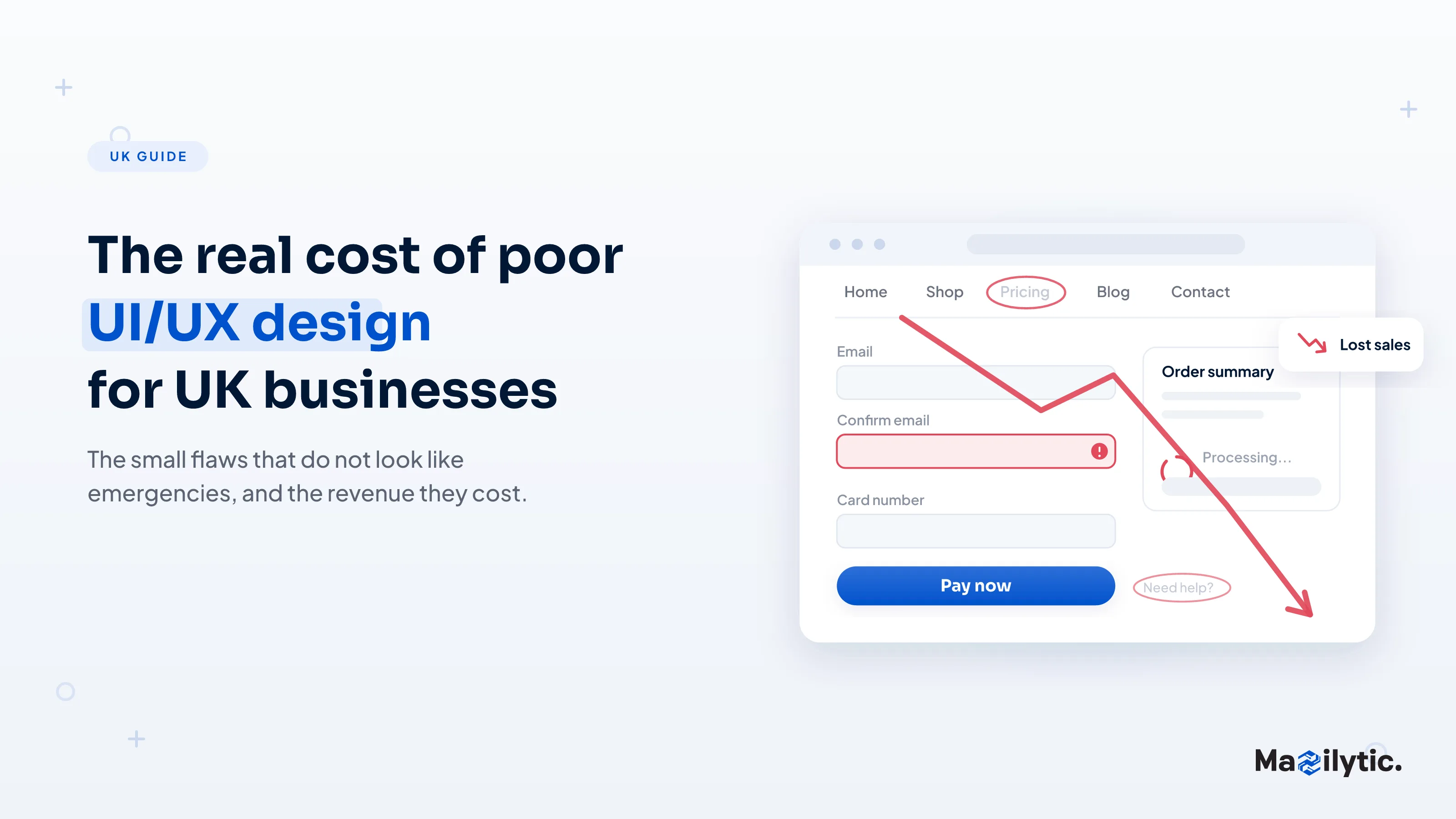
A slow‑loading page. A checkout form that asks for the same information twice. A menu that hides the one link a visitor actually came to click. None of these look like business emergencies. They look like small, forgivable annoyances; the kind of thing a busy founder shrugs off with "we'll fix that eventually."
But "eventually" has a price tag, and for UK businesses in 2026, that price tag is bigger than most people assume. Poor design decisions don't just make a site look dated. They quietly erode trust, tank conversion rates, and send customers straight to a competitor's site, often without the business ever realising why.
This blog breaks down exactly what bad UI/UX design costs UK businesses, using credible, traceable data rather than recycled marketing claims, and explains what separates a website that merely exists from one that actually works.
UX Design: What Is It, and Why Does It Matter So Much?
Before getting into the cost of getting it wrong, it's worth being precise about what we're actually discussing. UX design, or user experience design, is the discipline of designing how a person feels when they interact with a product, how easy it is to find information, complete a task, or trust what they're looking at. UI design, or user interface design, is the visual and interactive layer that makes that experience possible: buttons, layout, typography, colour, spacing, and the small visual cues that tell a user where to look and what to do next.
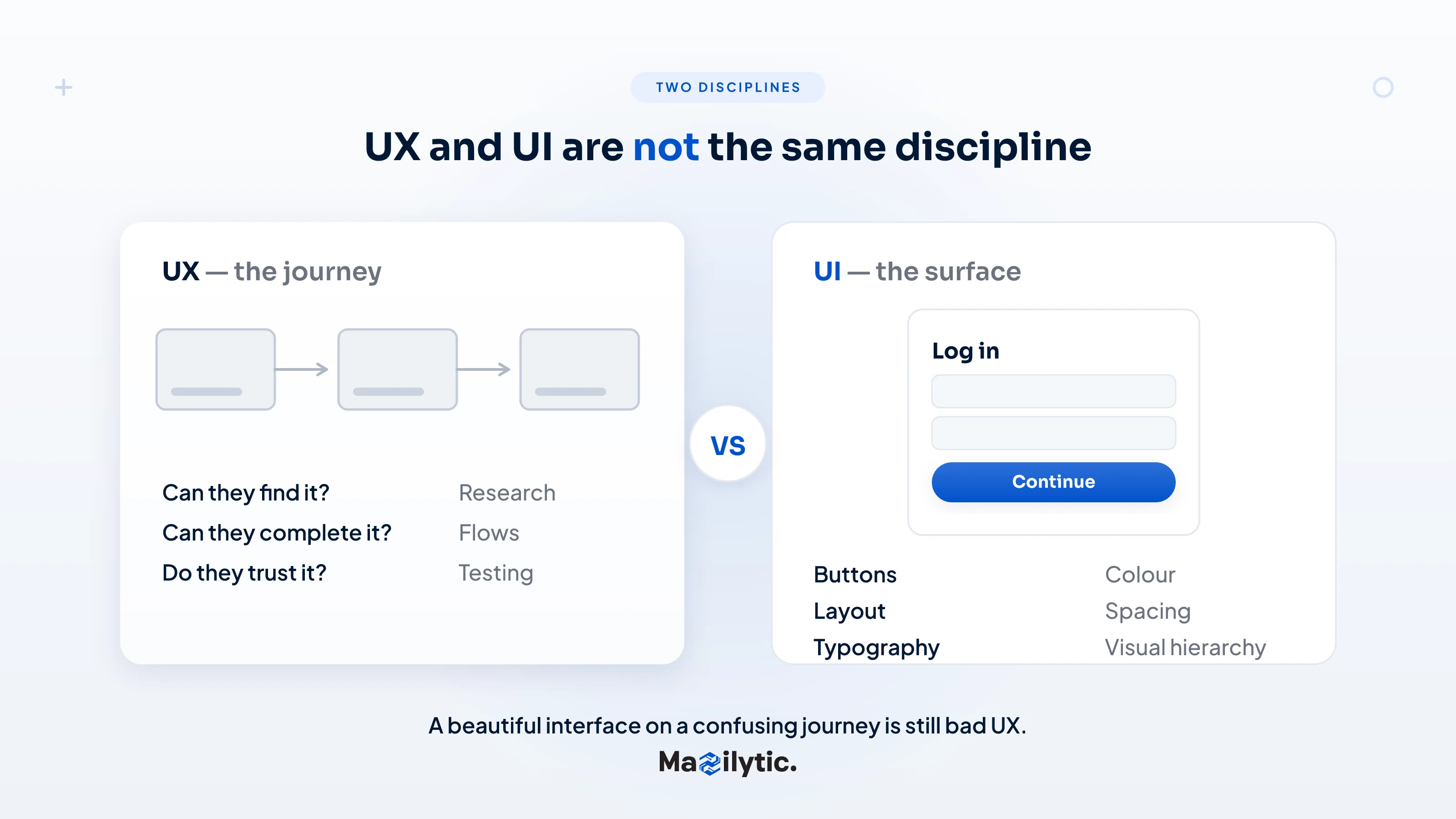
UX design and UI design work together, but they aren't the same discipline, and conflating them is one of the most common and also the most expensive mistakes UK businesses make when commissioning a website. A beautifully designed interface built on a confusing user journey is still bad UX. A perfectly logical user journey wrapped in a cluttered, inconsistent interface is still bad UI. User interface and user experience design need to be treated as two distinct, interlocking disciplines, not a single line item on an invoice.
The Data: What Poor UX Actually Costs
Abandoned carts and lost revenue
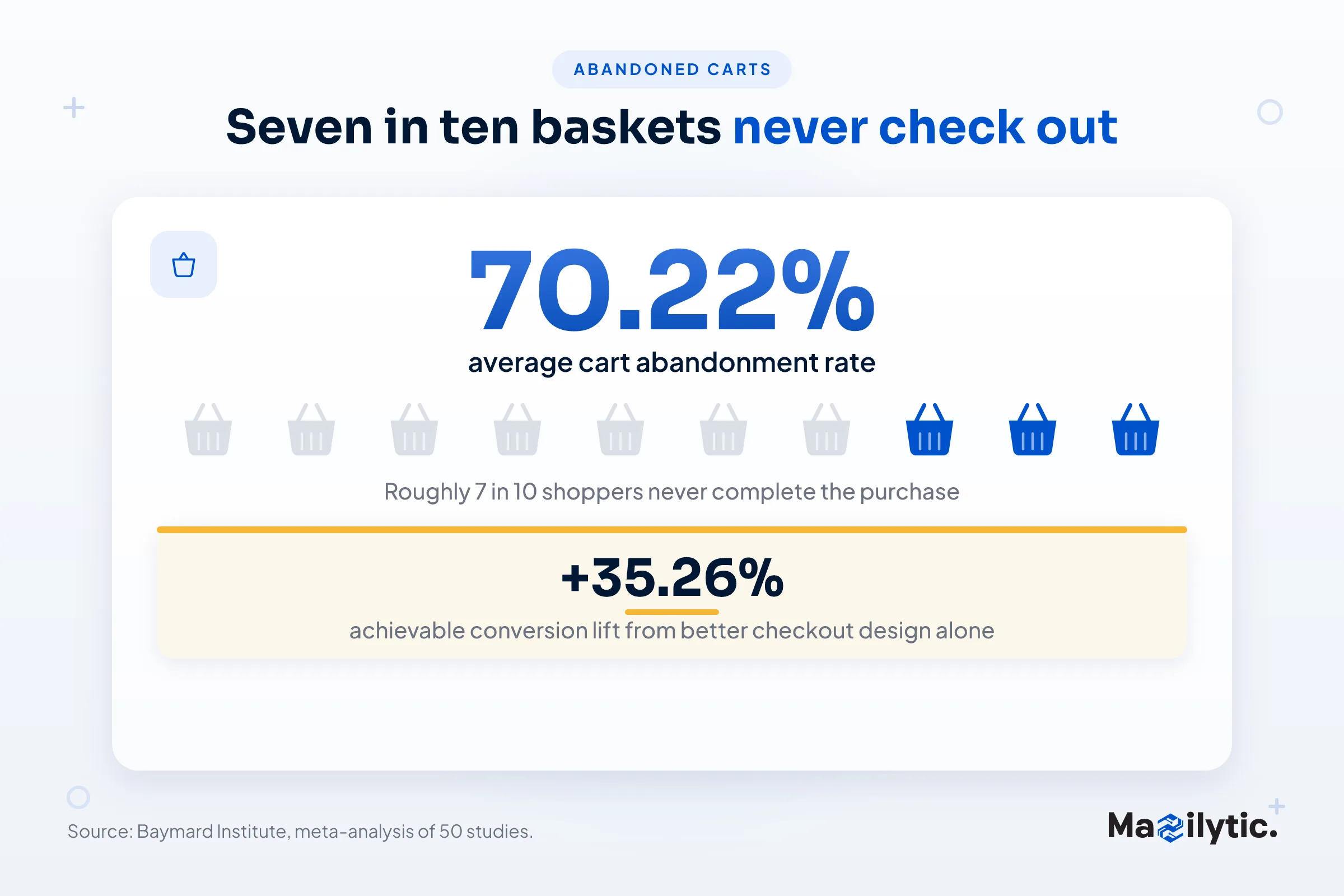
The most measurable cost of poor UX sits in e‑commerce checkout flows. The Baymard Institute, a research organisation that has spent over a decade running large‑scale usability testing on checkout experiences, maintains what is widely regarded as the most authoritative dataset on this subject. Its meta‑analysis of 50 separate studies puts the average online cart abandonment rate at 70.22%, meaning roughly seven in ten shoppers who add an item to their basket never complete the purchase.
Baymard's own checkout‑usability testing, conducted over ten years, found that the average large e‑commerce site could realistically achieve a 35.26% increase in conversion rate purely through better checkout design, by addressing friction such as unnecessarily long forms, unclear shipping costs, and forced account creation. That is not a marketing exaggeration; it is the practical, measurable ceiling of what fixing bad UX is worth to a business that sells online.
Page speed and the cost of waiting
Speed is a UX problem as much as a technical one, and it has been studied rigorously. Google's 2017 research with SOASTA, published via Think with Google, analysed roughly 900,000 mobile landing pages using a neural network trained on real bounce and conversion data. It found that as page load time increased from one second to ten seconds, the probability of a mobile visitor bouncing rose by 123%. The same research found that as the number of elements on a page grew from 400 to 6,000, the probability of conversion dropped by 95%.
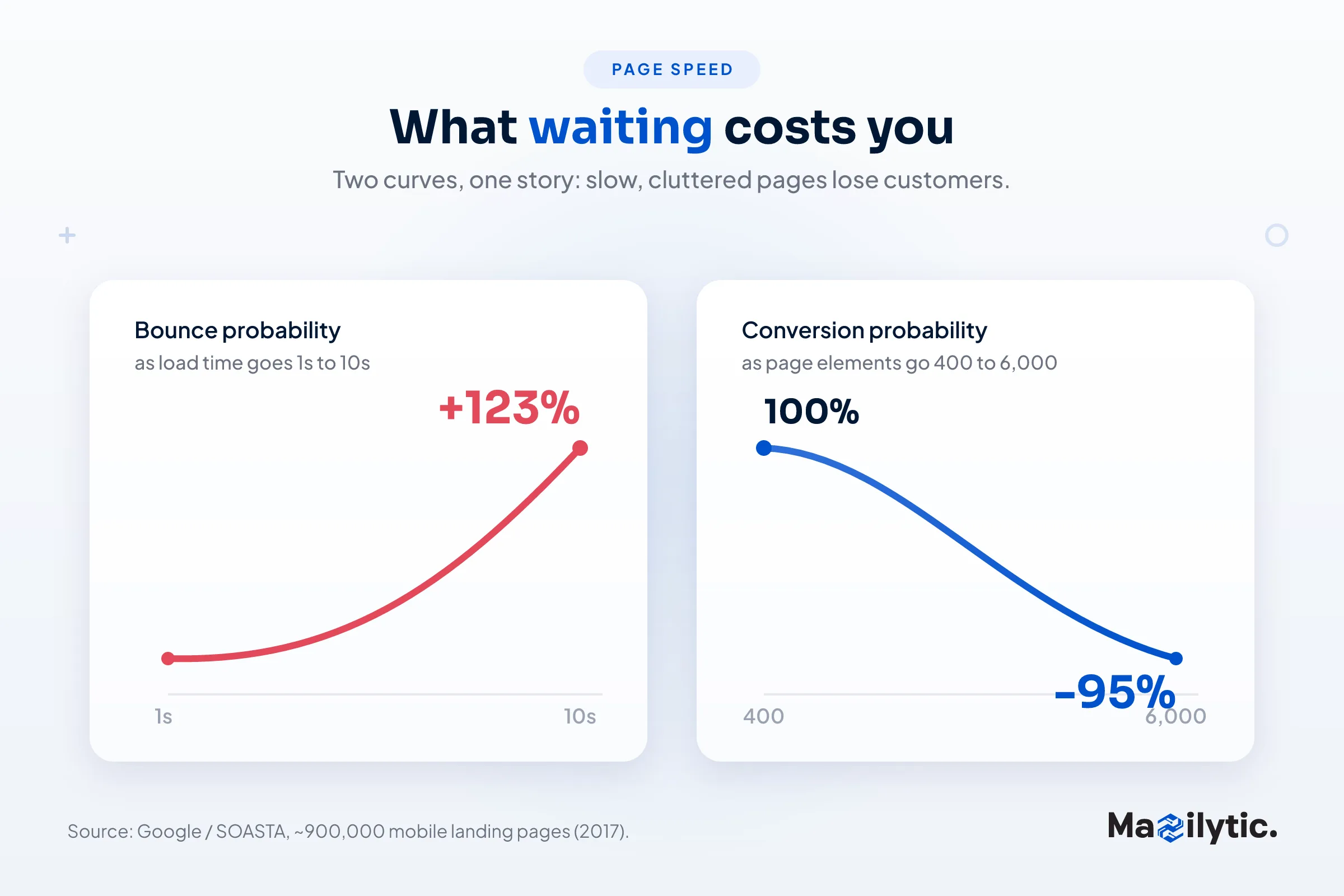
That data is now several years old, but the underlying pattern - slow, cluttered pages lose customers before they ever see a product or a price - hasn't changed; if anything, user patience has only grown shorter as expectations set by fast, well‑designed apps and sites have risen across every sector.
Accessibility isn't optional; it's regulated
In the UK specifically, poor UX design carries a compliance dimension that many businesses overlook. The Public Sector Bodies (Websites and Mobile Applications) Accessibility Regulations 2018 legally require public sector websites and apps to meet WCAG 2.2 at Level AA, covering everything from keyboard navigation to colour contrast and screen‑reader compatibility. Private businesses aren't directly bound by these regulations, but they operate under the Equality Act 2010's duty to make "reasonable adjustments" for disabled users; and UK courts and the Equality and Human Rights Commission have both signalled that inaccessible websites can fall foul of that duty.
For any organisation building or maintaining a public‑facing digital service, ignoring accessibility isn't just poor user experience. It's a live legal exposure, and retrofitting an inaccessible site is consistently more expensive than designing it in from the start.
Why UK Businesses Keep Making the Same Mistakes
Treating a website as a one‑off cost, not an asset
The single biggest mistake in UK web design commissioning is treating a website like a static brochure that gets built once and left alone. Good UX is iterative. It responds to real user behaviour, gets tested, and gets refined. A site that was well‑designed in 2022 can easily be poor UX by 2026 simply because user expectations, device behaviour, and competitor standards have all moved on.
Choosing based on price alone
UK website design cost varies enormously depending on scope, and that variation is exactly where businesses get burned. A simple brochure site from a freelancer might run anywhere from roughly £800 to £3,000, while a fuller small‑business build from an established agency typically sits somewhere between £2,500 and £10,000, with genuinely bespoke, feature‑rich builds climbing well beyond that. These figures vary widely between providers and regions, so they should be treated as market ranges rather than fixed benchmarks, but the pattern across UK pricing guides is consistent: the cheapest quote is rarely the one that includes proper user research, testing, and accessibility work, because those are exactly the line items that get cut to hit a lower number.
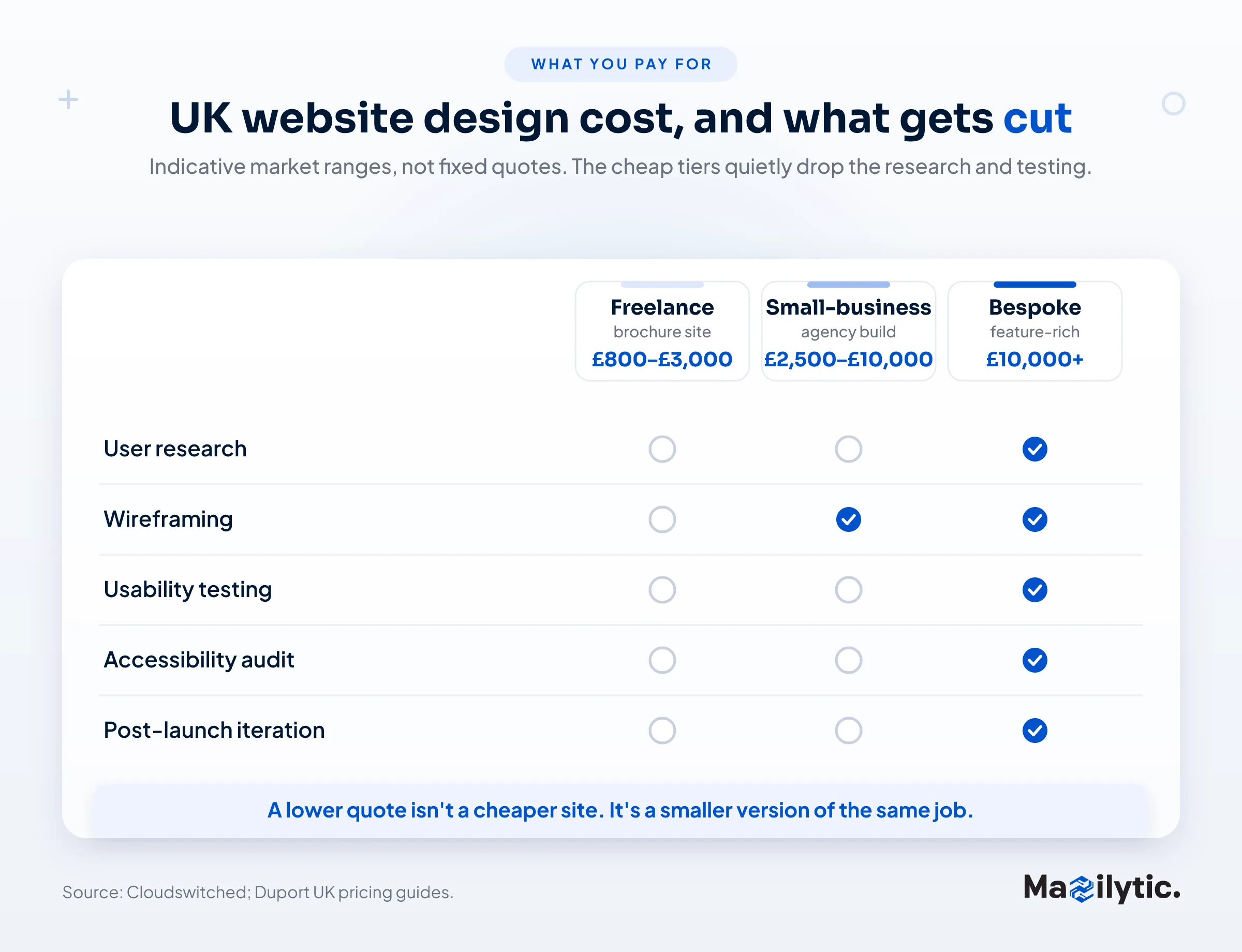
The result is a false economy. A business that pays less upfront for a site built without real UX input often ends up paying twice. Once for the original build, and again for the rebuild that follows once poor conversion rates or customer complaints make the problem impossible to ignore.
Confusing "looks good" with "works well"
It is entirely possible to commission a visually striking website that performs badly. Good UI/UX work is judged by outcomes such as completed purchases, submitted enquiries, and reduced support tickets, not by how a homepage looks in a portfolio screenshot. This is precisely why briefs that ask only for "a modern‑looking website" tend to produce sites that photograph well and convert poorly.
What Good UX Actually Delivers
Trust, before a single word is read
Users form judgements about a website's credibility within seconds, largely based on its design and usability rather than its written content. That's not a soft, subjective claim; it's the entire premise behind conversion‑rate optimisation as a discipline: fix the experience, and the content underneath it finally gets a fair chance to do its job. A confusing layout, inconsistent navigation, or a form that fails silently will undermine even excellent copywriting and a genuinely strong offer.
Lower support costs and higher retention
Every unclear interface generates a support ticket, a confused phone call, or a customer who simply gives up. Good UX design reduces this operational drag directly: fewer people get stuck, fewer people need help, and the ones who do get through the intended flow smoothly enough to come back. This is one of the more overlooked benefits of investing properly in UI/UX design: the savings show up in your support team's workload just as much as they show up in your conversion dashboard.
A genuine competitive advantage
In most UK sectors, competitors are now investing seriously in digital experience, which means a business with a clunky, hard‑to‑use website isn't just losing to bigger brands; it's losing to smaller, sharper competitors who took UX seriously from day one. This is exactly why design‑as‑a-service models have grown in popularity: rather than commissioning a single static build, businesses retain ongoing design support that evolves the experience as user behaviour, devices, and expectations shift.
How to Choose the Right Partner
Look for a genuine UX process, not just a portfolio.
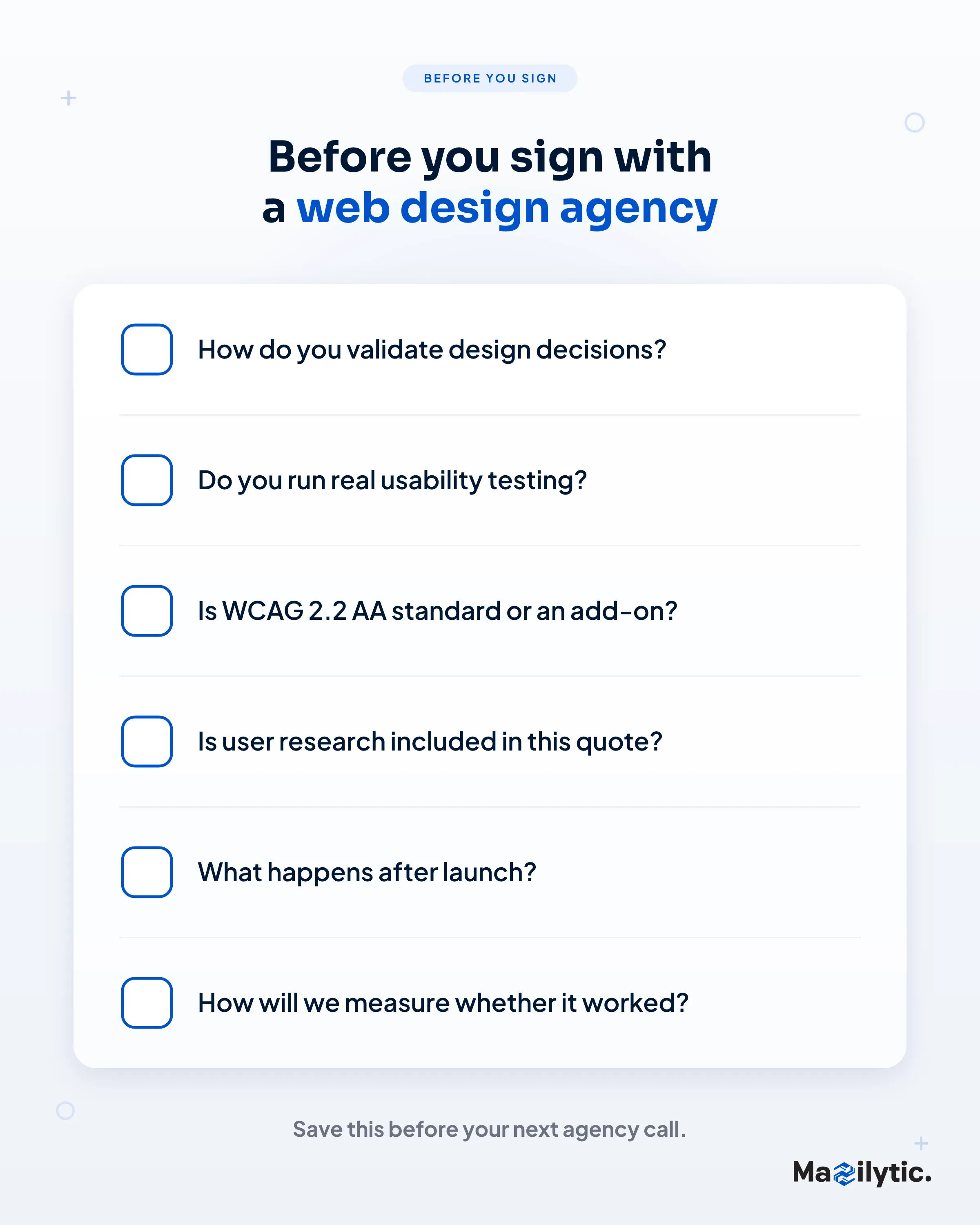
The best UX design firms and website design company UK providers will talk about research, testing, and iteration before they talk about visual style. Ask any prospective partner how they validate design decisions: do they run usability testing, analyse real user behaviour, or test against accessibility standards, rather than relying purely on aesthetic judgement.
Ask about accessibility as standard, not an add‑on
Given the legal landscape around the Equality Act and the Public Sector Bodies Accessibility Regulations, any credible web design services provider working in the UK should be able to speak fluently about WCAG 2.2 AA compliance without treating it as a specialist extra.
Understand what you're actually paying for
When comparing quotes for website design cost, ask specifically what's included: user research, wireframing, usability testing, accessibility auditing, and post‑launch iteration are the components that separate a site built to convert from a site built to simply exist online. A lower quote that strips these out isn't cheaper; it's a smaller, incomplete version of the same job, with the expensive parts deferred to a future rebuild.
The Bottom Line
Poor UI/UX design rarely announces itself as a crisis. It shows up as a slightly lower conversion rate, a slightly higher bounce rate, a slightly more overworked support team. Small numbers that compound quietly until a business finally asks why growth has stalled. The data is consistent across every credible source: fixing checkout usability alone can lift conversion by more than a third, and slow, cluttered pages measurably drive visitors away before they ever reach a product or a price.
For UK businesses weighing up web design UK options in 2026, the real question isn't whether good UX is worth the investment. It's whether the cost of not investing in lost sales, lost trust, and lost customers who quietly go to a better‑designed competitor has already been paid without anyone noticing.
Frequently Asked Questions
Q1: How much does poor UI/UX design cost a business?
It rarely shows up as a single number; it compounds through lost conversions, higher bounce rates and more support tickets. Baymard's research shows better checkout design alone can lift conversion by 35.26%, and Google/SOASTA found that the probability of a mobile visitor bouncing rises 123% as a page slows from one to ten seconds.
Q2: What is the average cart abandonment rate?
The Baymard Institute puts the average online cart abandonment rate at 70.22%, based on a meta‑analysis of 50 studies. That means roughly seven in ten shoppers who add an item to their basket never complete the purchase.
Q3: Is web accessibility a legal requirement in the UK?
For public sector websites, yes: the Public Sector Bodies (Websites and Mobile Applications) Accessibility Regulations 2018 require WCAG 2.2 AA. Private businesses are not directly bound by those regulations but fall under the Equality Act 2010's duty to make reasonable adjustments for disabled users, and inaccessible sites can breach that duty.
Q4: How much should a UK website cost?
It depends on scope. A freelance brochure site typically runs 800 to 3,000 pounds, a small‑business agency build 2,500 to 10,000 pounds, and a bespoke, feature‑rich build 10,000 pounds or more. Treat these as market ranges, and always check what is included: user research, usability testing and accessibility work are the first things cut at the cheapest quotes.
Q5: What is the difference between UX and UI design?
UX design is the user's journey: can they find it, complete it and trust it. UI design is the visual surface: layout, typography, colour and spacing. A beautiful interface on a confusing journey is still bad UX, so the two are best treated as interlocking disciplines rather than one line item.
CTA: Ready to find out what your website's UX is really costing you?
Mazilytic works with UK businesses to audit, redesign, and rebuild digital experiences that convert, combining proper UX research, accessible design, and clean UI execution from day one.
Get in touch for a free UX review and a clear, honest breakdown of where your site is losing customers.