
Top Benefits of HR Software for Modern Businesses
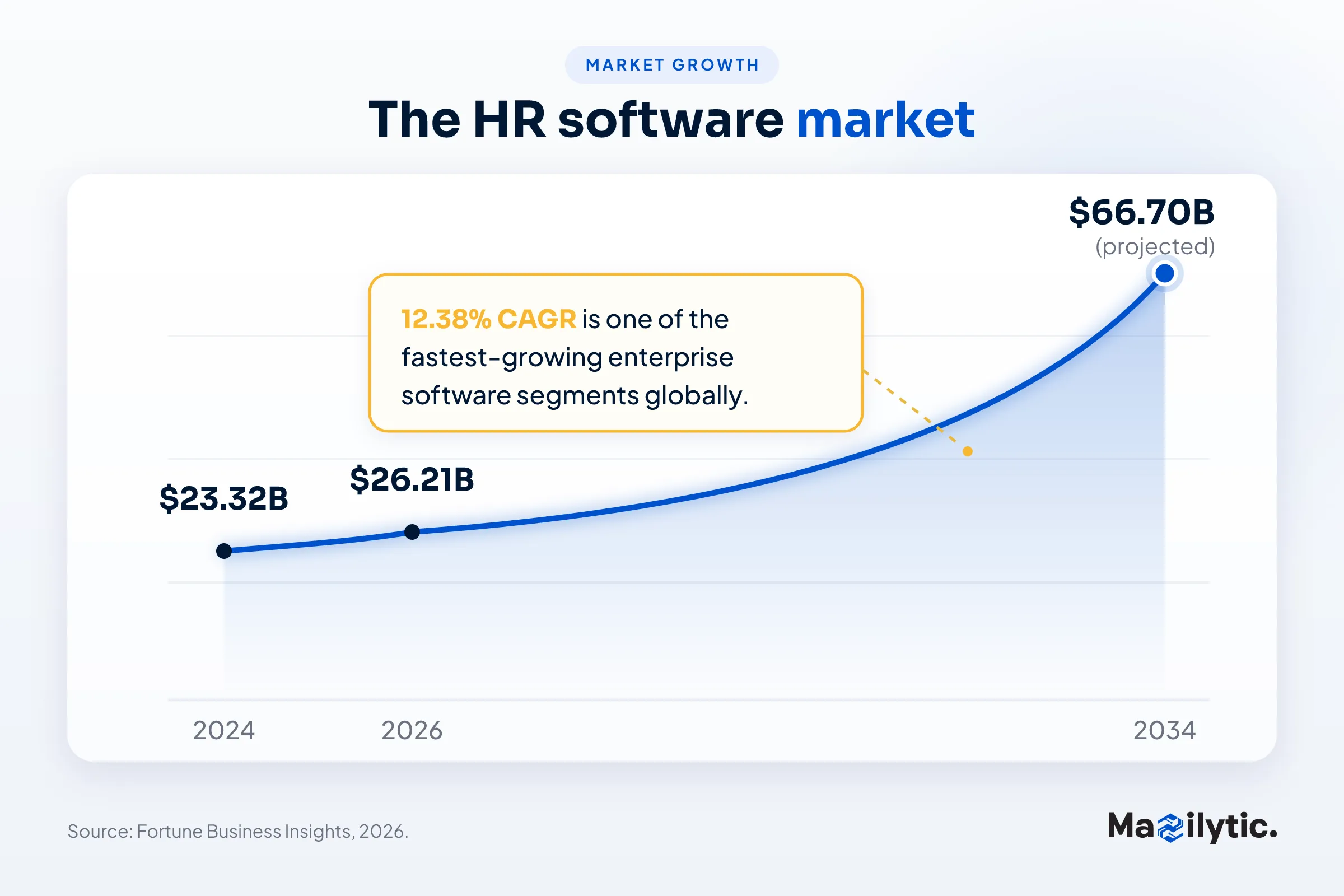
Managing people manually in 2026 is expensive. Not just in hours but in errors, in missed compliance deadlines, in turnover you could have seen coming if you'd had the data. The global HR software market was valued at $26.21 billion in 2026 and is projected to reach $66.70 billion by 2034, growing at a CAGR of 12.38%. That's not a niche tech story. That's nearly every serious organization on the planet moving their people operations onto modern platforms, and doing it fast.
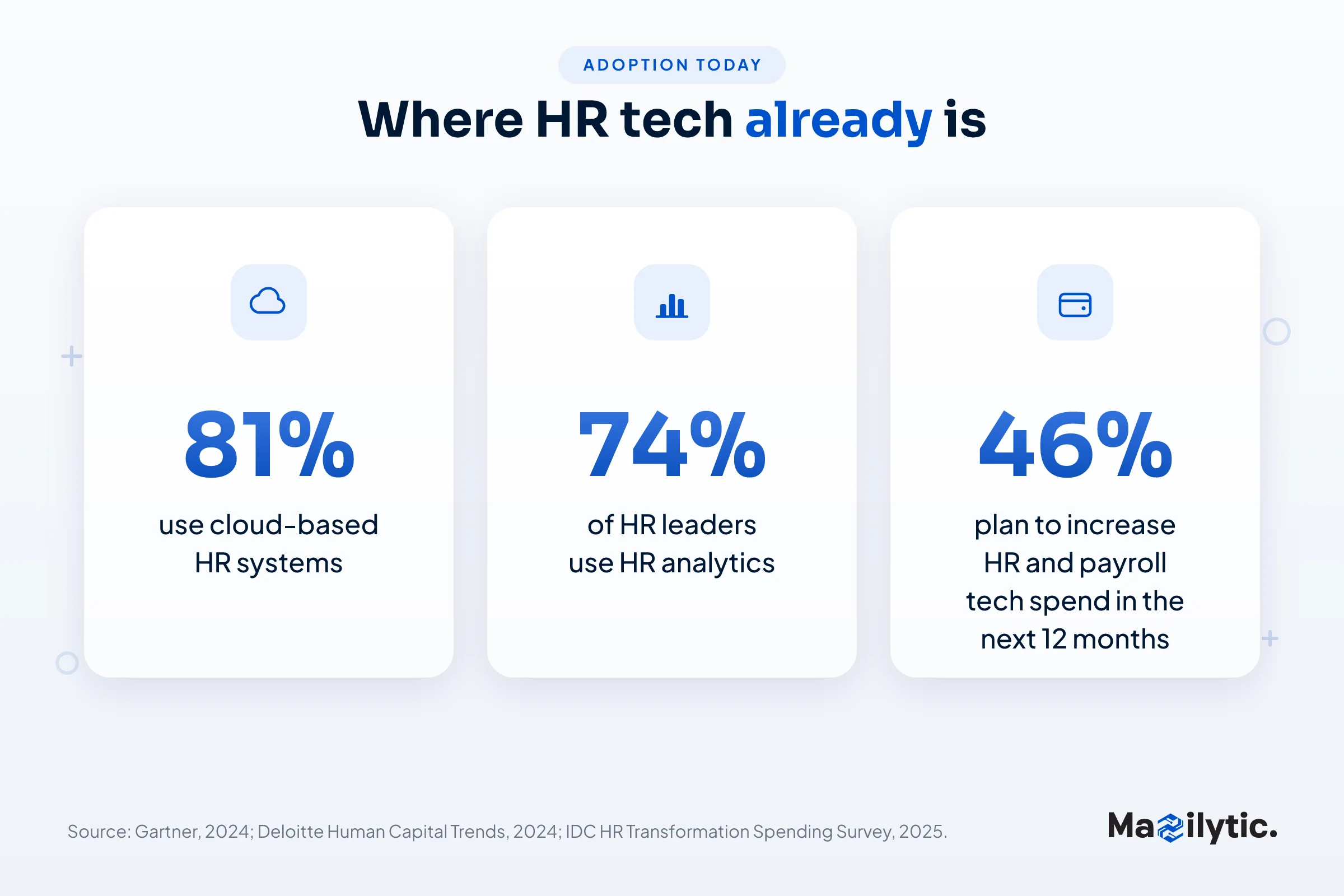
81% of organizations already use some form of cloud‑based HR systems, and 74% of HR leaders say their companies use HR analytics to improve decision‑making. And yet plenty of businesses are still running payroll on spreadsheets and tracking leave requests through email chains.
If that's you, this blog is worth your time. Here are the five benefits of HR software solutions that are genuinely changing how businesses manage their people, not in theory, but right now.
1. Streamline HR Processes with Automation
The average HR professional spends more than half their week on administrative tasks that contribute nothing to actual business growth. Payroll processing. Leave approvals. Attendance reconciliation. Data entry across systems that don't talk to each other.
Human resource management software eliminates most of that.
Modern HR software systems automate payroll calculations, including tax deductions, benefits administration, shift scheduling, and compliance reporting. Employees submit leave requests through a self‑service portal. Managers approve them in one click. The system updates attendance records, adjusts payroll, and files the relevant records without anyone manually touching a spreadsheet.
The downstream impact is real. 46% of organizations plan to increase spending on HR and payroll technology over the next 12 months, specifically because of the efficiency gains. And the payroll software segment alone is projected to grow from $9.10 billion in 2025 to $19.13 billion by 2032 at an 11.2% CAGR.
What automation actually handles inside a modern HR software for businesses:
· Payroll processing and tax calculations
· Leave and attendance management
· Recruitment workflows and applicant tracking
· Onboarding documentation and task checklists
· Benefits enrollment and administration
· Offboarding and exit procedures
And critically it handles them consistently. Human error in manual payroll processing costs businesses real money in corrections, penalties, and employee trust. Automation removes the variable.
2. Improve the Employee Experience
Here's something most companies underestimate: your HR software is part of your employee experience. The way people interact with HR, submitting a leave request, checking their payslip, updating their bank details, enrolling in benefits, shapes how they feel about working for you.
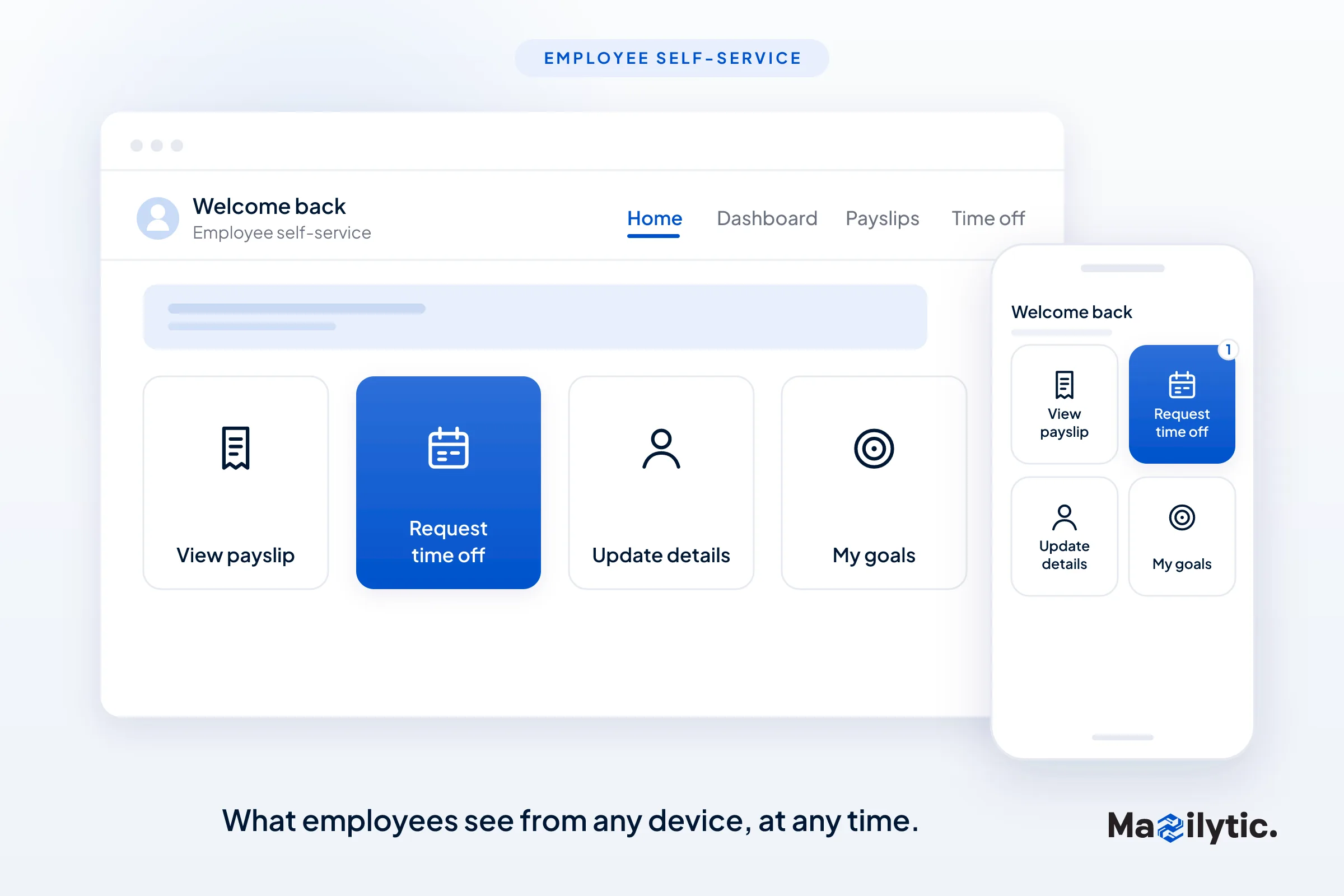
Modern employee management software gives people self‑service access to everything they need. Employees can view payslips, request time off, update personal information, and track their own performance goals without needing to call HR or wait for someone to respond to an email.
That independence matters. According to the 2025 Deloitte Global Workforce Report, employees who rate their workplace technology as effective are significantly more likely to report high job satisfaction and intent to stay. This is a retention metric, not just a convenience metric.
Mobile accessibility makes it even more relevant. Employees in field roles, remote workers, and those on shift schedules can access HR services from any device. The system is available at 10 pm when someone needs to submit an emergency leave request; HR doesn't need to be.
And for managers, HR management software creates visibility. Instead of chasing down information across email threads and shared drives, managers have a clear view of their team's attendance, performance reviews, training completion, and headcount data in one place. Decisions that used to take a week can take an afternoon.
3. Make Better Decisions with Real HR Analytics
HR has historically been one of the least data‑driven functions in a business. That's changing fast, and the companies that embrace the shift are gaining a genuine competitive advantage.
74% of HR leaders now say their organizations use HR analytics to improve decision‑making. Modern HR software solutions make this accessible to organizations that don't have a dedicated data science team.
What this looks like in practice:
Turnover forecasting: AI‑powered human resource management software can flag employees at high flight risk before they hand in their notice, based on factors like engagement scores, time since last promotion, peer comparison on compensation, and manager relationship signals. Workday reports that 75% of its customers are now testing its Talent Optimizer tools to surface internal mobility matches and reduce regrettable attrition.
Hiring efficiency: AI‑assisted recruitment tools are reducing time‑to‑hire by up to 30% while improving candidate quality metrics. That's a meaningful advantage in a competitive talent market.
Compensation analysis: compensation benchmarking built into HR software for businesses lets HR leaders compare internal salary bands against real‑time market data, identify pay equity gaps before they become legal problems, and model the cost impact of different raise scenarios.
Workforce planning: headcount modeling, succession planning, and skills gap analysis used to require a consultant and a month of work. Modern HR software systems pull this from live data and surface it in a dashboard.
The organizations using HR data well aren't just more efficient. They're making better calls on hiring, retention, compensation, and team structure, and those calls compound over time.
4. Stay Compliant Without Losing Sleep Over It
Compliance is where HR gets genuinely painful. Labor laws change. Tax codes update. Industry‑specific regulations shift. And the penalties for getting it wrong (fines, back pay, and litigation) can be very severe.
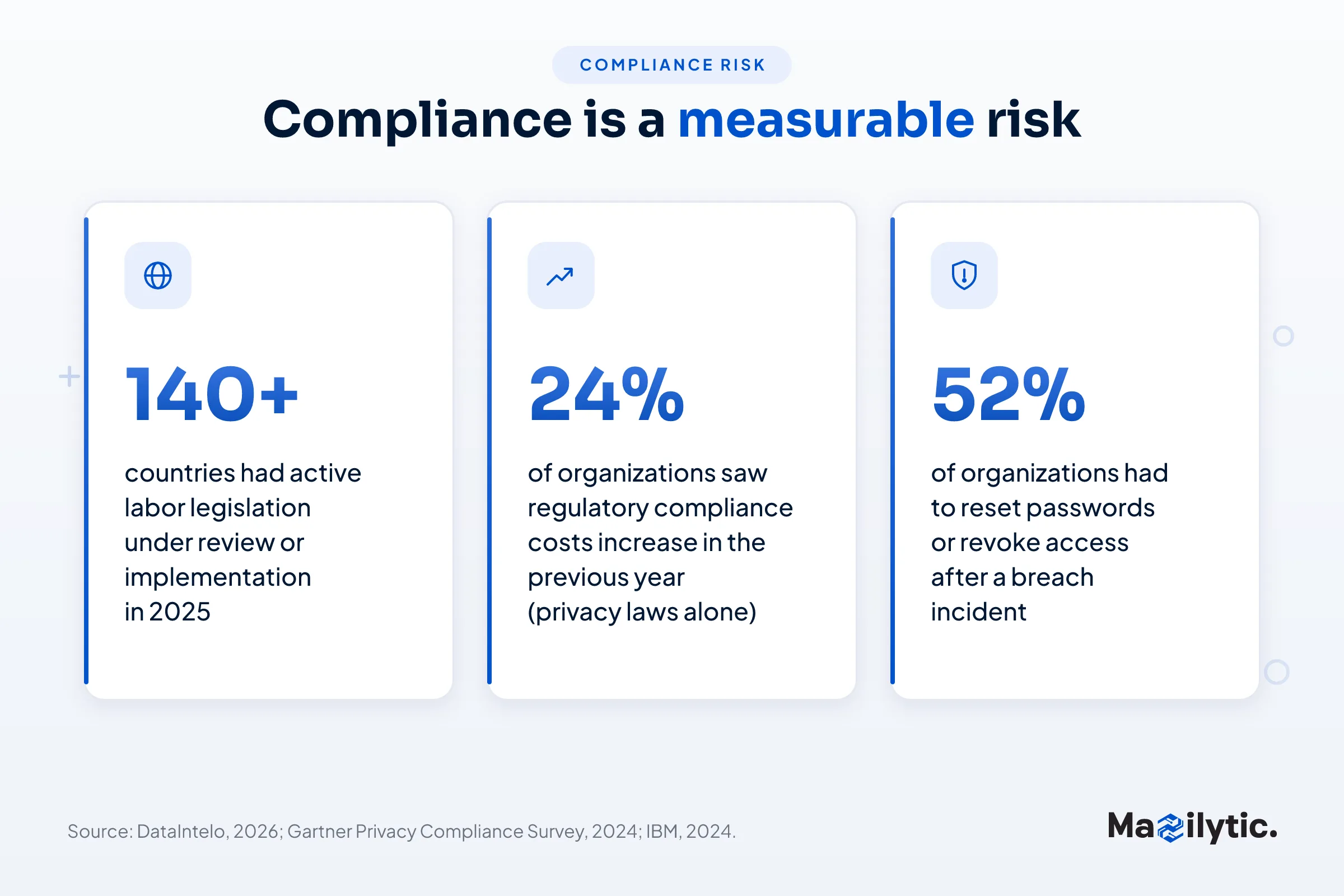
In 2025 alone, more than 140 countries had active labor legislation under review or implementation directly affecting HR operations, including mandatory pay transparency laws across the EU effective in 2026, expanded paid leave mandates across multiple US states, and enhanced modern slavery reporting requirements in the UK and Australia.
Trying to track all of that manually, across multiple jurisdictions, while also running day‑to‑day HR operations, is genuinely difficult. Human resource management software handles most of it automatically.
Specifically, a solid HR software system gives you:
· Automated regulatory updates built into the system (no manual rule changes required)
· Audit trails for every HR action and decision
· Certification and training tracking with automated reminders before deadlines lapse
· Multi‑jurisdictional payroll compliance for businesses operating across states or countries
· Built‑in reporting for mandatory filings: EEO‑1, OSHA, ACA, and equivalents in other markets
For context on the risk side: 24% of organizations reported that regulatory compliance costs increased in the previous year due to privacy laws alone.
And 52% of organizations had to reset passwords or revoke access after a breach incident, an operational nightmare that proper HR software access controls and audit logging can prevent.
Compliance work isn't glamorous. But getting it wrong is expensive. The right HR software for businesses turns it from a constant liability into a managed process.
5. Support Smarter, Faster Decision‑Making at Every Level
The final benefit is the one that ties everything else together.
When HR processes are automated, when employees have self‑service access, when analytics are surfaced in real time, and when compliance is handled systematically, leaders at every level can make better decisions faster. Without digging for data. Without waiting for a monthly report. Without having to trust that the spreadsheet someone built in 2019 is still accurate.
HR management software puts real‑time workforce data in front of the people who need it. A department head can see their team's capacity before committing to a project timeline. A CEO can review headcount costs against revenue per employee before finalizing a budget. An HR director can model the impact of a new parental leave policy on headcount before presenting it to the board.
Predictive analytics takes this further. Modern HR software solutions can:
· Forecast turnover risk at the individual and team level
· Identify skill gaps before they create project delivery problems
· Model the ROI of different training and development investments
· Optimize shift scheduling against demand forecasting
This isn't a hypothetical capability. UKG's AI agents, branded as "Bryte", already orchestrate multi‑step workflows including peer feedback collection and compensation change authorization without manual intervention. Workday's predictive payroll forecasting was launched in October 2025, giving finance and HR leaders scenario modeling directly inside their existing platform.
The organizations making the best workforce decisions in 2026 aren't doing it on instinct. They're doing it on live data surfaced by employee management software built to support exactly that.
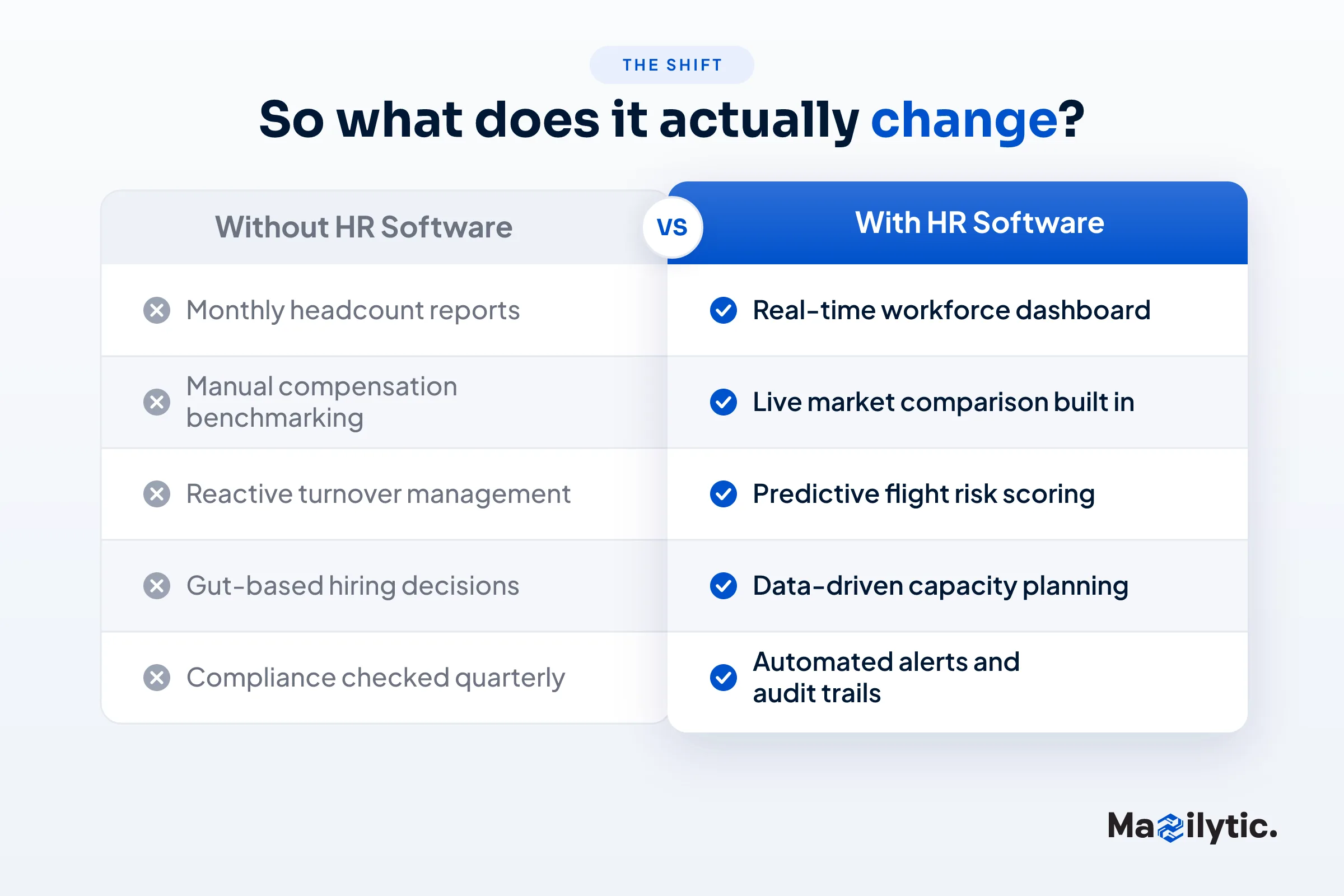
So what does it actually change?
Without HR Software: monthly headcount reports; manual compensation benchmarking; reactive turnover management; gut‑based hiring decisions; compliance checked quarterly.
With HR Software: real‑time workforce dashboard; live market comparison built in; predictive flight risk scoring; data‑driven capacity planning; automated alerts and audit trails.
Choosing the Right HR Software for Your Business
Not all HR software systems are the same. The right choice depends on your company size, the complexity of your compliance environment, and which capabilities matter most to your current stage.
A few things worth evaluating before you commit:
· Does it handle your compliance context? If you operate across multiple states or countries, you need a system that manages multi‑jurisdictional payroll and regulatory requirements natively, not through workarounds.
· Is it genuinely integrated? The value of human resource management software comes from having one source of truth for people data. A system that requires manual exports between payroll, benefits, and performance modules defeats the purpose.
· Can it grow with you? The HR software market is consolidating around composable, modular platforms that let you add capabilities without replacing the whole system. Look for API‑first architecture and a track record of regular product updates.
· What does the reporting actually look like? Ask for a demo of the analytics dashboard before you sign anything. If the reporting feels like an afterthought, it probably is.
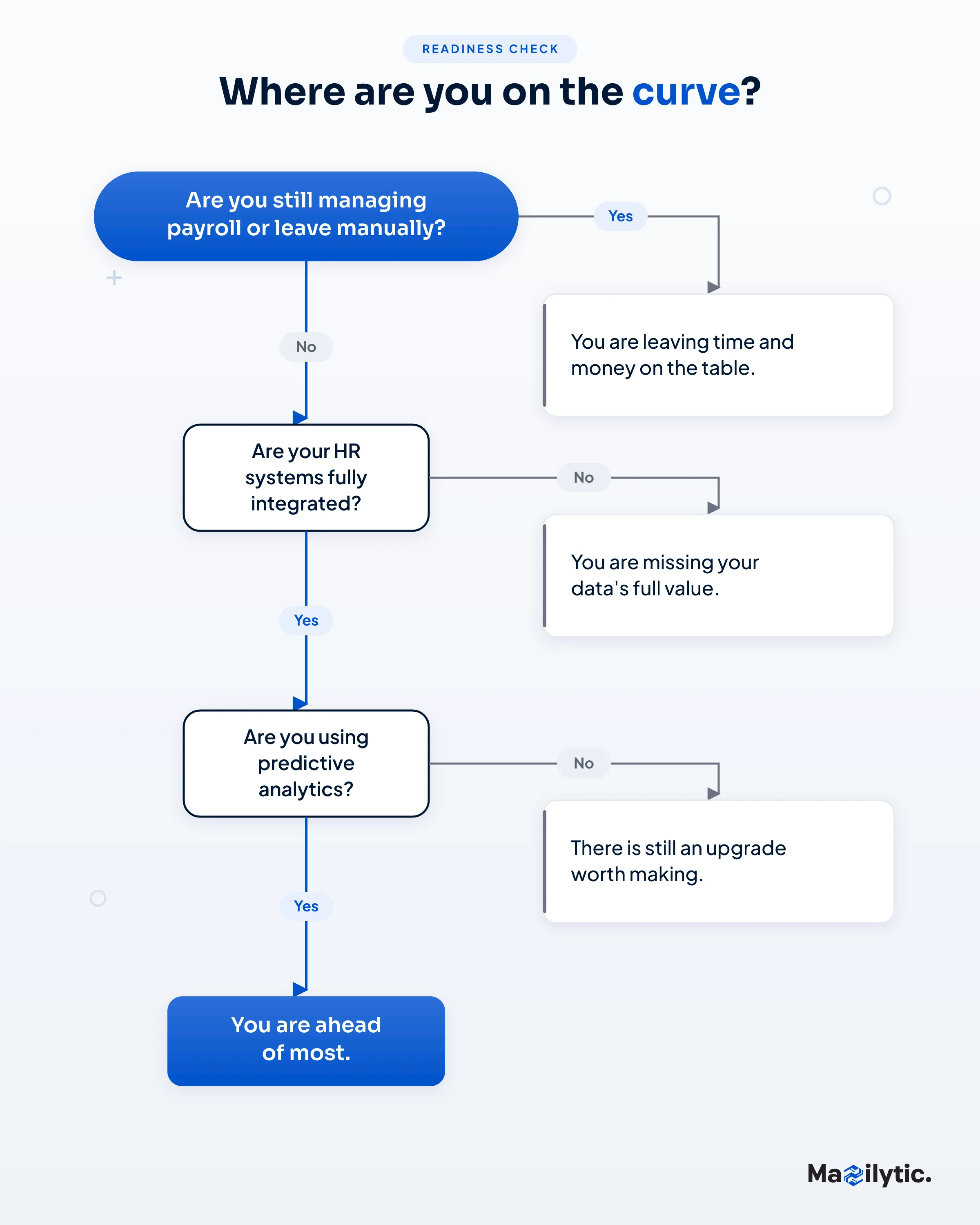
Starting question: "Are you still managing payroll or leave manually?" Yes: "You are leaving time and money on the table." No: "Are your HR systems fully integrated?" No: "You are missing your data's full value." Yes: "Are you using predictive analytics?" No: "There is still an upgrade worth making." Yes: "You are ahead of most."
Conclusion
HR software is no longer a nice‑to‑have. It's the infrastructure that modern workforce management runs on. The five benefits covered in this blog, automation, employee experience, analytics, compliance, and decision‑making, aren't separate features. They compound. A well‑implemented HR software solution makes each one better because they share the same data, the same workflows, and the same source of truth.
The market has already made its call. $26.21 billion invested in HR software this year globally, growing at double‑digit rates, tells you that organizations across every industry and size are drawing the same conclusion.
The question isn't whether human resource management software is worth it. It's whether your organization can afford to keep operating without it.
CTA: Mazilytic builds custom HR software solutions tailored to your business.
If you're evaluating your options or outgrowing your current system, get in touch and we can help you figure out what you actually need.
FAQ
Q1: What is HR software and what does it do?
HR software is an online solution for managing and automating HR tasks such as hiring, attendance, performance, compliance, payroll and onboarding. Today's HR tools also offer employee and manager self‑service as well as analytics.
Q2: What are the key advantages of HR software for businesses?
The five core benefits are process automation (saving time and avoiding mistakes), a better employee self‑service experience, HR analytics (data‑informed decision making), compliance management automation, and real‑time workforce reporting that enables faster, better business decisions.
Q3: What will be the HR software market size in 2026?
As per Fortune Business Insights, the global HR software market is estimated at $26.21 billion in 2026 and is expected to expand at a 12.38% CAGR throughout the forecast period, reaching $66.70 billion by 2034.
Q4: What is the difference between HR software and human resource management software (HRMS)?
The terms are often used interchangeably. Usually, HRMS is an umbrella term for a complete solution including core HR functionality (payroll, compliance, benefits), talent management, analytics and workforce planning. In some cases HR software is a point solution, and in others it is a full package.
Q5: Can HR software fit the needs of small businesses?
Yes. Many HR software packages are tailored for small businesses with flexible pricing and functionality. The compliance and payroll‑saving features tend to benefit smaller HR teams the most, because that is where manual processes pose the greatest risk.