
Top 10 Fintech Software Development Companies in the UK
The UK's financial technology sector doesn't just punch above its weight; it sets the standard. Whether you're a challenger bank looking for a development partner, a payments company modernising legacy infrastructure, or an enterprise scaling a product, the country has an unusually dense pool of companies that actually understand financial software from the inside.
But "understanding fintech" gets claimed by everyone. This guide cuts through that noise. Below you'll find a detailed look at the top 10 fintech software companies serving the UK market in 2026. Some are UK‑founded; others are international firms with established UK delivery, and the comparison below states each one's actual headquarters rather than flattening everyone into London. For each you'll find what sets them apart, a direct comparison, the technology trends shaping development decisions this year, and a practical buying guide for choosing the right partner.
The UK Fintech Landscape in 2026: A Quick Industry Overview
The numbers behind the UK's fintech sector make a compelling case for why this is still one of the most attractive environments in the world to build, scale, or partner on financial technology.
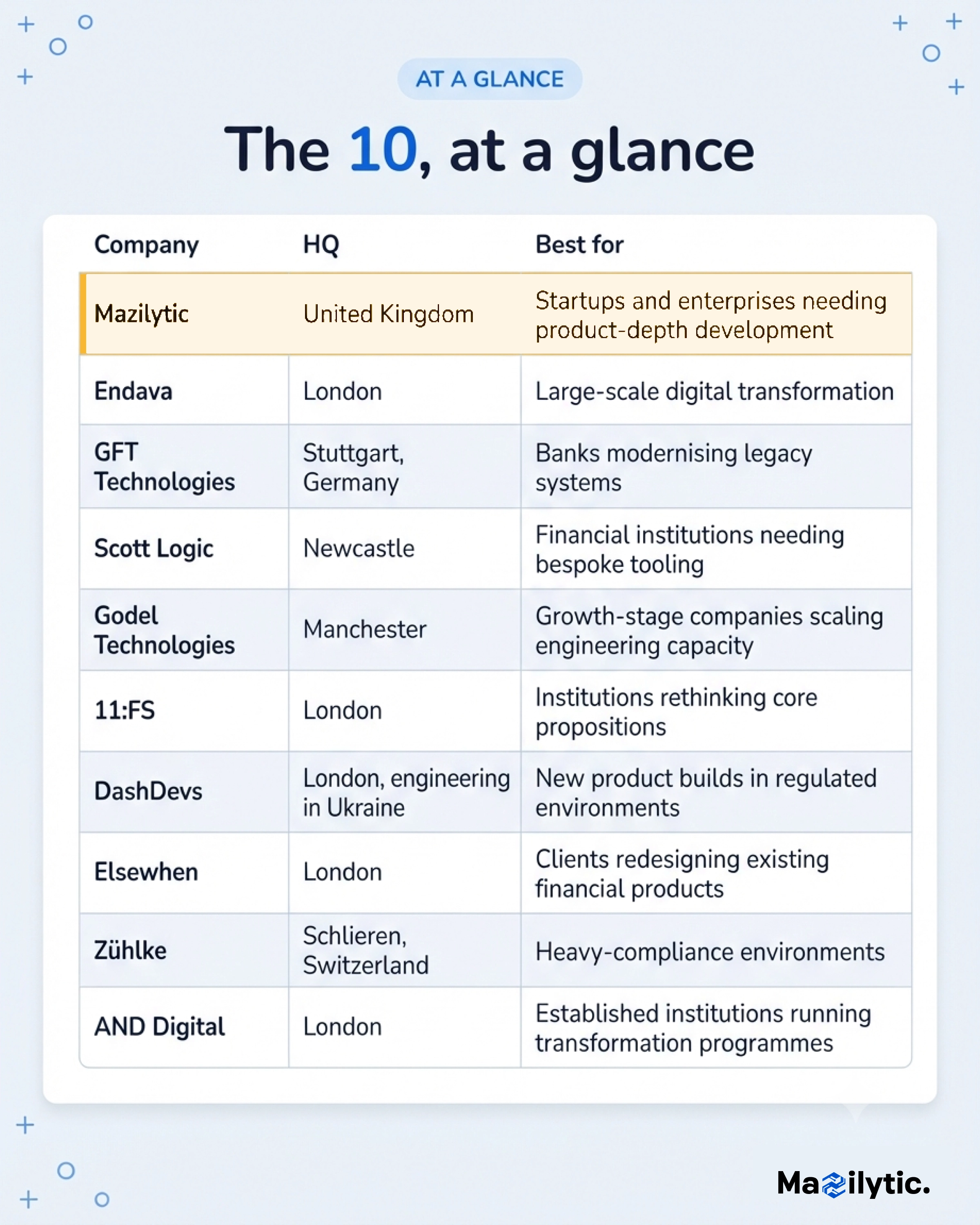
According to IBISWorld, the UK Financial Technology industry is valued at £34.7 billion in 2025‑26, having grown at a 19.8% compound annual growth rate over the preceding five years. The number of UK fintech businesses grew at a separate 7.4% CAGR over the same period, to roughly 2,890 firms. Mordor Intelligence sizes the UK fintech market on a narrower basis at $21.44 billion in 2026, rising to $43.92 billion by 2031 at a 15.42% CAGR. That figure counts only the fee, interest and interchange revenue earned by regulated fintech entities themselves, and excludes the banking software and IT services that IBISWorld's industry classification takes in. The two are measuring different things and are not directly comparable.
Funding tells a more mixed story. UK fintech investment reached $1.9 billion across 67 deals in Q1 2026, up 32% on the same quarter a year earlier, with deals over $100 million accounting for roughly 60% of the quarter's total. On that basis Fintech Global projected in May 2026 that full‑year funding could rise 26%. That projection has not held so far, with UK fintech funding cooling over the first half of the year. The more durable signal is the change in deal composition: capital is concentrating in fewer, larger rounds for established players rather than spreading thin across early‑stage bets.
Open‑banking adds another layer of structural optimism. Open Banking Limited reported 16.56 million connected users as of November 2025, more than double the 7 million milestone the UK passed in January 2023. Mobile applications accounted for 61% of the UK fintech market by user interface as of 2025, a share projected to grow at an 18.55% CAGR through 2031.
For any company evaluating a fintech software development company as a delivery partner, this context matters. The UK offers not just talent but regulatory proximity, market density, and a culture of building financial products that are actually expected to work under scrutiny.
Top 10 Fintech Software Development Companies in the UK in 2026
1. Mazilytic
Mazilytic is a software product company headquartered in the United Kingdom, founded in 2024, with its development team in Karachi. It builds custom software for clients in regulated sectors and develops its own products in the same verticals.
That shapes how it approaches fintech work. Compliance architecture, eKYC flows, PCI scope and the data decisions behind them are designed in from the start rather than retrofitted, because those are the same problems its own product work runs into.
For businesses that want a partner engaged with the same problems rather than a template‑driven delivery shop, Mazilytic is worth a conversation.
Core strengths: Custom fintech development, compliance‑first architecture, UK company with a Karachi development team.
Core strengths:
- Payments and lending product development
- Cross‑domain engineering
- Custom software at product depth
2. Endava
Endava occupies a unique position in the market: a large‑scale engineering company, headquartered in London and publicly listed on the NYSE as DAVA, that has built a substantial portion of its reputation on payments and financial services. Its clients span payments, banking, capital markets, and insurance. Unlike generalist IT firms, Endava's financial services practice has the depth to match.
Recent milestones underscore this. In May 2026, Endava announced a collaboration with Mastercard to accelerate development of next‑generation payments infrastructure and embedded digital commerce experiences. Its 2025 research with Censuswide, surveying 500 fintech and payments leaders, found that 77% were planning cross‑market expansion within a few years; a finding that positions Endava squarely in the conversations driving global payments strategy.
Their work on the Nexus cross‑border payments architecture, designing the cross‑border switch software connecting domestic real‑time payment rails across Asia, reflects the kind of infrastructure‑level thinking that distinguishes genuine fintech software development services from surface‑level consulting.
Core strengths:
- Payments infrastructure
- Real‑time systems
- Capital markets
- AI‑native delivery
- Global scale
3. GFT Technologies
GFT has carved out one of the most defensible niches in UK fintech: cloud‑native core banking implementation. IDC's December 2025 MarketScape assessment, announced by GFT in January 2026, named the firm a Leader in Worldwide Cloud‑Native Core Banking Implementation Services. This designation reflects years of delivery on platforms like Thought Machine Vault and Mambu. QKS Group's 2025 SPARK Matrix for Digital Banking Services placed GFT at the top for service excellence.
Their BankLiteX and BankStart accelerators are designed to launch digital‑first banks faster than conventional builds allow. The track record is credible: GFT helped launch Salt Bank in Romania in under a year, with 100,000 customers on board in the first 10 days. Mox Bank in Hong Kong, backed by Standard Chartered, went live within 18 months with GFT as the technical partner.
In June 2026, the firm appointed Andrew Nelson, who previously led NTT DATA's Banking and Financial Markets business, as its UK CEO, signalling increased investment in agentic AI integration, legacy decoupling, and regulated multi‑cloud architecture, all priorities for UK banks navigating FCA operational resilience frameworks.
Core strengths:
- Cloud‑native core banking
- Legacy modernisation
- AI‑powered compliance (Smaragd suite)
- Digital bank launches
4. Scott Logic
Scott Logic sits in a specific and valuable lane: capital markets and banking software, built and delivered by a UK‑native consultancy that has never chased scale for its own sake. The firm works with financial institutions on trading platforms, risk management systems, and regulatory reporting infrastructure. These are the software categories where correctness is non‑negotiable.
As a financial software development company with deep capital markets heritage, Scott Logic brings engineering rigour to environments where a poorly written matching engine or a risk calculation bug can have real consequences. They are a trusted name in financial services technology circles, particularly among UK banks and asset managers building bespoke tooling.
Core strengths:
- Capital markets software
- Trading systems
- Regulatory compliance tools
- Risk management platforms
5. Godel Technologies
Godel Technologies has built a strong reputation as a delivery partner for businesses that need reliable, high‑quality engineering capacity without the overhead of building full in‑house teams. Its client base spans several sectors including retail, travel and e‑commerce, with financial services as one named vertical; its fintech work includes the lending platform Freedom Finance.
As an independent fintech app development services provider, Godel competes on delivery quality and cultural fit, particularly valuable for growth‑stage fintechs that need a partner capable of scaling alongside them. Their Manchester base gives them access to one of the UK's most active fintech talent pools outside of London.
Core strengths:
- Agile delivery across sectors including financial services
- Nearshore engineering talent
- Long‑term partnership model
6. 11:FS
11:FS sets itself apart by operating as both a fintech consultancy and a product company. Its banking‑as‑a-service platform, Foundry, works hand in hand with its advisory business, showcasing the company's expertise through a solution it has built and uses to validate its own approach. The firm's founders and senior staff come from inside the industry: they've run digital banks, led product teams at major financial institutions, and built the infrastructure they now advise others on.
That insider credibility gives 11:FS a different register in client conversations. Where many consultancies speak in frameworks, 11:FS tends to speak in examples because they've made the same decisions they're being asked to help with. For financial institutions looking to redesign their digital propositions rather than just digitise their existing ones, this is a meaningful distinction.
Core strengths:
- Digital banking strategy
- Product design
- Banking‑as‑a-Service (Foundry)
- Neobank transformation
7. DashDevs
DashDevs has a specific origin story that gives it credibility: the team was the product development partner behind Dozens, building its core banking architecture and apps on top of regulated infrastructure from ClearBank and Visa. Dozens was marketed as a UK challenger bank, though it was regulated as an e‑money and investment firm rather than holding a full banking licence, and it closed its consumer business in August 2022. The experience still counts, because it means the firm has taken a financial product from early architecture decisions through to regulatory approval and live customer usage, a journey that most development teams only claim to understand.
As a financial app development company with experience in challenger banking, DashDevs is particularly well‑suited to fintechs building something new rather than extending something old. DashDevs maintains a London office as its UK registered entity, with engineering teams based in Ukraine. Their work spans mobile banking apps, payment platforms and investment products, all categories where regulatory fluency and mobile‑first architecture are table stakes.
Core strengths:
- Mobile fintech development
- Challenger bank builds
- Payment platforms
- Investment apps
8. Elsewhen
Elsewhen is a product consultancy, and product thinking is exactly what it leads with. The firm's work with Mastercard (one of the most demanding clients in the payments industry) speaks for itself. Elsewhen operates at the intersection of strategy, design, and engineering, making it well‑suited for financial services clients who have an established product but need to rethink how it works, looks, or is positioned.
For fintech app development services that begin with understanding the problem before writing a line of code, Elsewhen's approach is distinct from build‑first development shops. They tend to attract clients who have outgrown their original product thinking and need a partner to reset.
Core strengths:
- Product strategy
- UX/UI for financial services
- Mastercard‑tier delivery experience
- Fintech redesign
9. Zühlke
Zühlke works across multiple regulated sectors, including medical devices, defence and transport, and financial services. They bring a rigorous engineering culture shaped by environments where failure has serious consequences. In fintech, this translates to disciplined architecture, security‑first development, and a preference for doing things correctly over doing them quickly.
For financial institutions operating under heavy regulatory oversight, such as insurance firms, investment banks, and wealth managers, Zühlke's reputation in regulated‑industry engineering is a genuine differentiator. The firm's London presence makes them accessible to UK clients who need that level of delivery confidence.
Core strengths:
- Regulated‑industry engineering and security
- IoT‑to‑cloud financial systems
- Compliance‑ready architectures
10. AND Digital
AND Digital has built a substantial financial services practice by focusing on something many delivery firms undervalue: the human side of transformation. Their model centres on embedding teams within client organisations to build internal capability alongside delivering software. Which means clients don't just get a product at the end; they get engineers and product managers who understand how to evolve it.
Their UK heritage and financial‑services book make them a natural fit for established banks and insurance companies navigating digital transformation programmes that need to land internally, not just technically.
Core strengths:
- Digital transformation
- Embedded teams
- Financial services and capability building
Detailed Company Comparison
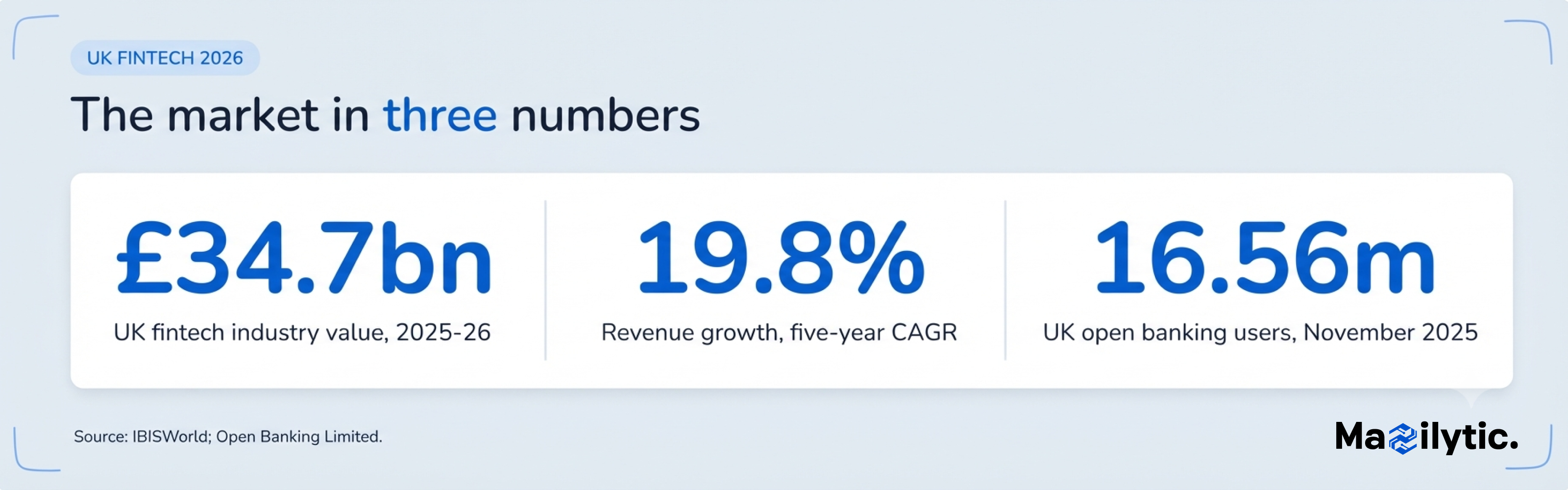
| Company | HQ | Fintech Specialisation | Best for |
| Mazilytic | United Kingdom | Payments, lending, custom products | Startups and enterprises needing product‑depth development |
| Endava | London | Payments infrastructure, capital markets | Large‑scale digital transformation |
| GFT Technologies | Stuttgart, Germany | Core banking, cloud migration | Banks modernising legacy systems |
| Scott Logic | Newcastle | Capital markets, trading systems | Financial institutions needing bespoke tooling |
| Godel Technologies | Manchester | Multi‑sector delivery including financial services | Growth‑stage companies scaling engineering capacity |
| 11:FS | London | Digital banking strategy, Banking‑as‑a-Service | Institutions rethinking core propositions |
| DashDevs | London, engineering in Ukraine | Mobile fintech, challenger banks | New product builds in regulated environments |
| Elsewhen | London | Product strategy, UX, payments design | Clients redesigning existing financial products |
| Zühlke | Schlieren, Switzerland | Regulated‑industry engineering | Heavy‑compliance environments |
| AND Digital | London | Digital transformation, embedded teams | Established institutions running transformation programmes |
Fintech Technology Trends Shaping Development in 2026
Understanding which companies to consider is only half the decision. The other half is knowing what the development landscape looks like, so you can assess whether a partner is ahead of the curve or behind. These are the trends that matter most in 2026.
Agentic AI Is Moving from Pilot to Production
AI agents (systems that don't just process information but act on it autonomously) are crossing the line from experimental to operational across lending, fraud, and compliance. Lenders are moving AI out of advisory scoring and into live decisioning, and real‑time models are increasingly used in production fraud detection rather than after‑the‑fact batch review. Any fintech software development company you engage with in 2026 should have a clear and credible position on how it integrates agentic AI into financial workflows. Not a roadmap, but live experience.
Real‑Time Payments Are the New Baseline
The operational expectation has shifted: 24/7 availability, immediate transaction confirmation, and real‑time fraud response are no longer premium features. Global digital payment transaction value is projected to reach roughly $27 trillion in 2026 (Statista Market Insights). For development partners, this means an architecture that handles multi‑rail routing (cards, account‑to‑account transfers, faster payment rails, and tokenised settlement networks) at scale without compromising compliance.
Open‑Banking Is Maturing Into Open Finance
The UK's 16.5 million open‑banking users are a foundation, not a destination. In 2026, open‑banking frameworks are expanding into open finance: the same data‑sharing and API‑access principles applied across pensions, investments, and insurance. This shift fundamentally changes what custom fintech software development needs to support, and companies that are already building on open finance infrastructure will have a significant head start.
Embedded Finance Is Becoming the Default Distribution Model
Financial services are increasingly delivered within non‑financial platforms such as retail apps, HR systems, and logistics software, rather than through standalone banking products. Embedded finance could account for 20 to 25% of European retail and SME lending revenues by 2030, up from 5 to 6% in 2023 (McKinsey, 2024). Development partners that understand how to build financial capabilities as composable services, rather than standalone applications, are better positioned to support this model.
Tokenisation and Programmable Finance
Real‑world asset tokenisation and regulated stablecoins are no longer experimental. Blockchain‑based settlement rails are entering the multi‑rail stack alongside traditional payment infrastructure. While this remains an emerging area in AI and open banking, it is progressing faster than most anticipated, and development teams lacking experience in this area risk being caught flat‑footed.
How to Choose the Right Fintech Software Development Company
The companies listed above are genuinely capable. The harder question is which one is right for your specific situation. Here is a practical framework for that decision.
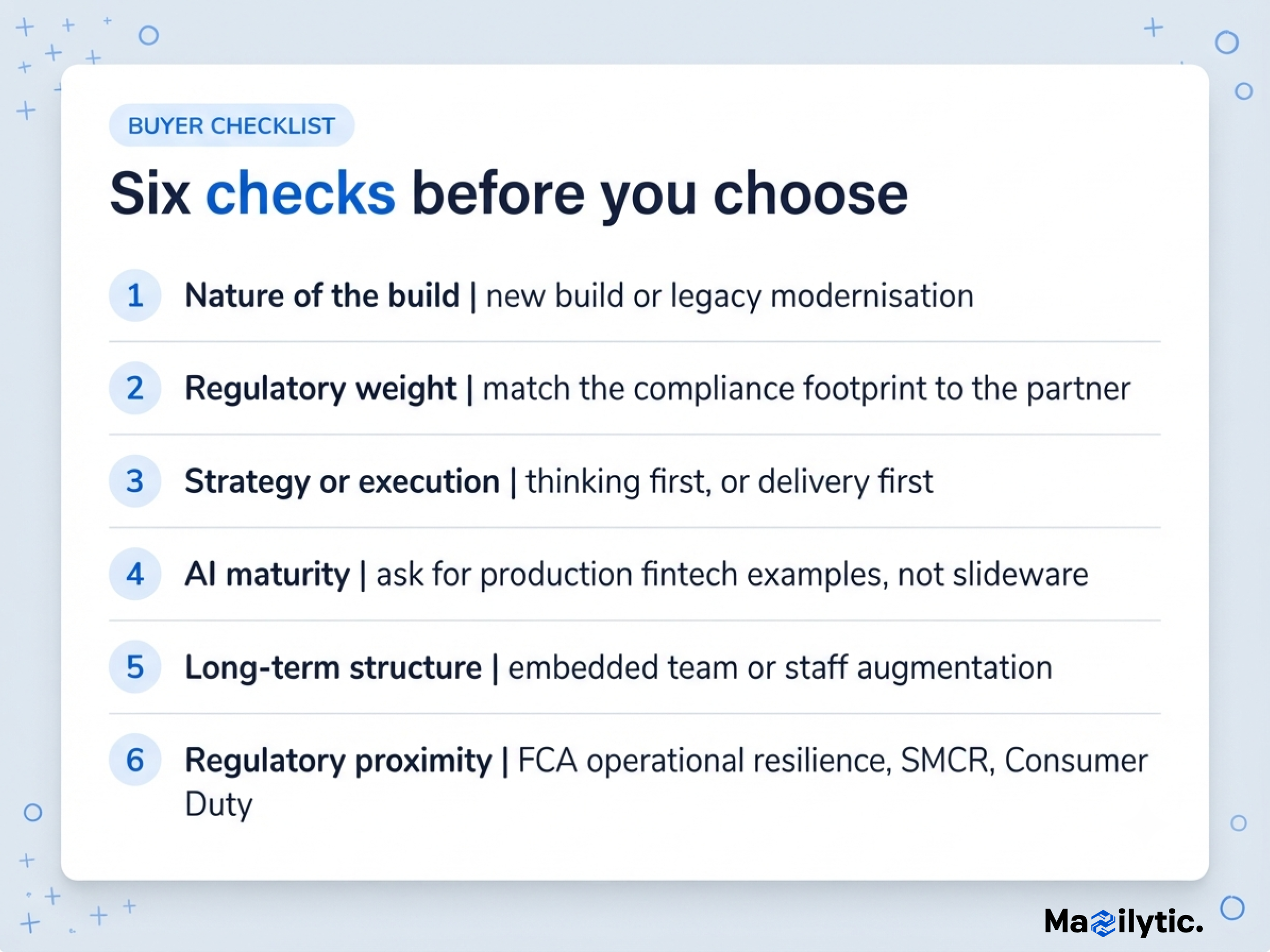
- Start with the nature of your build.
Are you launching something new, or modernising something that exists? New builds benefit from partners with product ownership experience, like Mazilytic (which has shipped live fintech products) or DashDevs (product development partner on the Dozens build). Legacy modernisation projects are better served by specialists like GFT, which has deep expertise in core banking migrations and the accelerators to de‑risk them.
- Match the regulatory weight to the partner's experience
A payment gateway for a consumer app has a very different compliance footprint from a core banking system for a regulated institution. Zühlke and Scott Logic are natural fits for the latter. Godel Technologies and DashDevs are better suited to the former.
- Evaluate whether you need strategy or execution.
Some companies, like 11:FS and Elsewhen, lead with thinking before they lead with delivery. If you have an execution‑ready brief, this layer adds cost. If your product strategy is still forming, it adds value. Be honest about which phase you're in.
- Assess AI maturity in the context of your product, not theirs
Ask any prospective partner not what their AI practice looks like in the abstract, but how they have integrated AI into a production fintech product. Clients, timelines, and measurable outcomes are the right questions. Marketing copy is not.
- Consider the long‑term structure, not just the initial engagement
AND Digital's embedded‑team model builds internal capability while delivering software, reducing dependency over time. A staff‑augmentation model may look cheaper upfront but can create dependency that costs more to resolve later. Think about what you want your engineering team to look like in three years, and select accordingly.
- Check for regulatory proximity.
For UK‑regulated financial products, working with a partner that understands the FCA's expectations for operational resilience, SMCR, and Consumer Duty is not optional. Ask specifically how the firm has navigated UK financial regulation in past engagements.
Frequently Asked Questions
Q1: What is a fintech software development company?
A fintech software development company designs, builds, and maintains technology products for the financial services sector. This includes mobile banking apps, payment processing platforms, lending systems, investment tools, compliance software, and core banking infrastructure. The best ones combine software engineering depth with genuine understanding of financial regulation and product economics.
Q2: What makes the UK a strong market for fintech software development?
The UK benefits from a supportive regulatory environment, a deep talent pool in both engineering and finance, and one of the world's most active fintech ecosystems. London's concentration of banks, fintechs, and investment capital creates natural demand, while cities like Manchester and Newcastle have established strong technical communities with lower overhead than London.
Q3: How much does custom fintech software development cost?
Costs vary significantly depending on scope, complexity, and the partner model. A mobile payment application for a consumer fintech will fall into a very different category from a cloud‑native core banking migration for a regulated institution. Expect bespoke fintech builds to range from £150,000 to several million pounds, depending on features, team composition, and the regulatory environment.
Q4: What should I look for in a financial app development company?
Prioritise partners with direct experience in your specific segments (payments, lending, wealth, insurance) over generalist firms claiming fintech capability. Look for evidence of live product deliveries, regulatory navigation handled, and clients willing to speak to the engagement. Technical capability is table stakes; understanding of your regulatory and product context is the differentiator.
Q5: Is fintech software development different from standard software development?
Significantly. Fintech development introduces compliance requirements, security standards (PCI‑DSS, ISO 27001, FCA guidelines), real‑time processing demands, and fraud risk considerations that general software development does not face. The architecture, testing, and deployment practices needed to build a compliant financial product are materially different from those for a standard SaaS application.
Conclusion
The UK's fintech software sector in 2026 is not short of options; it is short of the clarity needed to choose between them confidently. The ten companies profiled here represent genuinely different approaches, specialisations and engagement models, which means the right choice depends entirely on what you're building and where you are in the process.
For businesses that need a partner with direct product ownership experience in payments and lending, Mazilytic's expertise makes for a credible and honest starting point. For payments infrastructure at global scale, Endava. For cloud‑native core banking, GFT. For digital bank strategies that begin with thinking, 11:FS. For regulated‑industry rigour, Zühlke. The list continues, and the granularity is the point.
The fintech development landscape in 2026 rewards precision. Knowing exactly what you need from a fintech software development company before you start conversations will save you months and material cost. Use the buying guide above, hold prospective partners to specific evidence rather than capability claims, and build accordingly.
Ready to Build Your Fintech Product?
Mazilytic has done this before, not as a consultant, but as a builder. Our own payments and lending product was built by the same team that would work on yours.
If you're scoping a fintech product, modernising a payment system, or scaling a lending workflow, let's talk about what that actually looks like.
Get in Touch with Mazilytic