
How UX Design Turns Visitors Into Customers
You've got fifty milliseconds. That's all it takes.
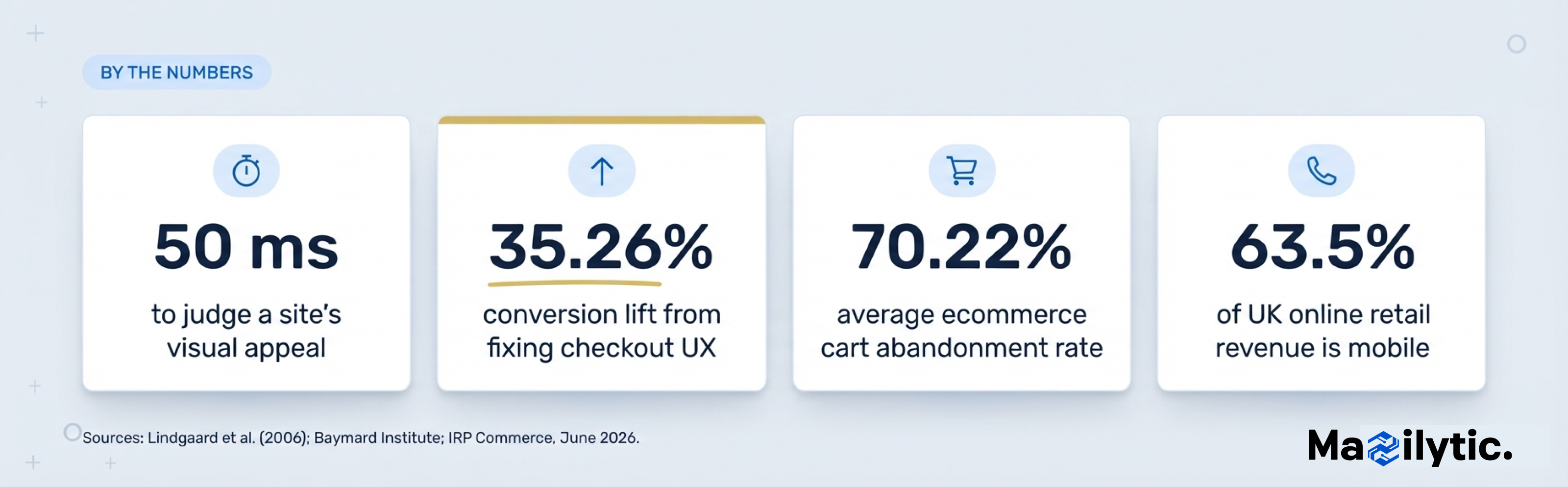
A landmark study by researchers at Carleton University found that people form a lasting judgement about a website's visual appeal within 50 milliseconds of landing on it, long before they've read a headline, scanned an offer, or noticed a review. First impressions of a website are formed almost entirely on design, and once that impression sours, a large share of visitors simply won't come back.
For UK businesses competing in an increasingly crowded digital market, UI/UX design isn't a cosmetic consideration. It's a commercial one. This article breaks down exactly what good design does for your business, what it costs, and how to get it right, whether you're running an ecommerce store, a fintech platform, or a professional services firm.
What Is UI/UX Design and Why Does It Matter for UK Businesses?
UX (User Experience) design is the discipline of understanding how people interact with a digital product: what they're trying to do, where they get stuck, and how to make the path from intention to action as frictionless as possible.
UI (User Interface) design is what that experience looks like on screen: typography, colour, button placement, visual hierarchy, and the small details that make an interface feel intuitive rather than confusing.
Together, they determine whether a visitor becomes a customer. The commercial case is well established even if it doesn't reduce to a single tidy statistic. A 2014 Design Management Institute study, built with Motiv Strategies, found that a portfolio of publicly traded, design‑led companies had outperformed the S&P 500 by 228% over the preceding decade.
For UK businesses weighing whether to invest in UX design services, the question isn't whether it's worth it. It's how long you can afford to wait.
UI vs UX: What Is the Difference?
The simplest way to think about it: UX is the journey, UI is the vehicle.
A UX designer maps the route a user takes through your product, from landing page to checkout, from sign‑up to activation, from search to result. They're working with information architecture, user flows, wireframes, and research findings. Their job is to remove confusion and reduce the number of decisions a user has to make to reach their goal.
A UI designer takes that route and makes it look and feel right on screen. Colour palettes, type scales, icon systems, interactive states, spacing: the details that signal professionalism, build trust, and make interactions satisfying rather than stressful.
On most commercial website UX design projects, these disciplines overlap significantly. That's why the most effective teams treat them as a single, integrated practice rather than two separate handoffs.
How Good UI/UX Design Improves Website Conversion Rates
The data here is worth taking seriously:
Fixing checkout UX alone can deliver a 35.26% conversion lift for large ecommerce sites, based on the Baymard Institute's decade‑long checkout usability research
High‑contrast, well‑designed CTAs consistently outperform generic ones. The strength of the effect varies by site and audience, so it's worth A/B testing on your own traffic rather than assuming a fixed uplift
The average ecommerce cart abandonment rate is 70.22%, based on Baymard's meta‑analysis of 50 separate abandonment studies, and optimised checkout UX can recover much of that
Every one of these improvements comes from the same source: reducing friction. Good website UX design removes the micro‑hesitations (the unclear CTA, the confusing navigation, the slow‑loading image) that collectively erode conversion rates without anyone noticing.
Key UI/UX Design Principles UK Businesses Should Follow
Simple and Intuitive Navigation
Confusing or non‑responsive navigation is one of the most commonly cited causes of poor UX among design practitioners. Users shouldn't have to think about how to find what they need. Navigation should reflect how your customers think about your product, not how your internal team is organised.
Mobile‑First Design
Mobile now accounts for the majority of UK ecommerce activity. IRP Commerce's live UK Ecommerce Market Data put mobile's share of UK online retail revenue at 63.5% in June 2026.
If your mobile experience is an afterthought (slower, harder to navigate, with smaller tap targets), you're degrading the experience for the majority of your customers. Mobile‑first isn't a trend. It's the baseline.
Clear Calls to Action
A CTA isn't just a button. It's the moment where intent meets opportunity. High‑contrast, action‑specific CTAs (not "click here" but "Get my free audit" or "Start your trial") consistently outperform generic alternatives in usability testing. Personalisation matters too: users respond better to language and offers that speak to their specific situation rather than generic messaging.
Fast and Accessible Interfaces
Speed isn't just a user preference. It's a conversion lever. Google's own research with SOASTA, based on nearly 900,000 mobile landing pages, found that as load time increases from one to ten seconds, the probability of a mobile visitor bouncing rises by 123%. Every second of delay has a measurable cost.
Consistent Branding and Design Systems
Inconsistency destroys trust. When fonts, colours, button styles, and tone shift across pages, users sense it even if they can't articulate it. A coherent design system, documented and applied consistently, reinforces professionalism and makes every touchpoint feel intentional.
Why Accessibility Matters in UK Website and App Design
Accessibility isn't a compliance checkbox. It's a commercial opportunity most UK businesses are leaving on the table.
There are 16.7 million disabled people in the UK, roughly a fifth of the population, a figure consistent with the government's own Family Resources Survey data. Research including the long‑running Click‑Away Pound Survey has repeatedly found that UK ecommerce businesses lose substantial, measurable revenue every year when disabled customers hit accessibility barriers and abandon a purchase. Beyond the moral case, accessible website UX design also delivers measurable SEO benefits, since the semantic HTML and clean structure that accessibility requires are also what search engines rely on to understand a page.
The business case for accessibility is simple: you're designing for more people, more use cases, and more devices, which always improves the experience for everyone.
How WCAG 2.2 Accessibility Standards Affect UI/UX Design
WCAG 2.2 (Web Content Accessibility Guidelines) is the current international standard for web accessibility, published as a W3C Recommendation in October 2023. It added nine new success criteria beyond WCAG 2.1, focusing on focus visibility, authentication flows, and drag‑based interactions.
For UK businesses, here's what you need to know:
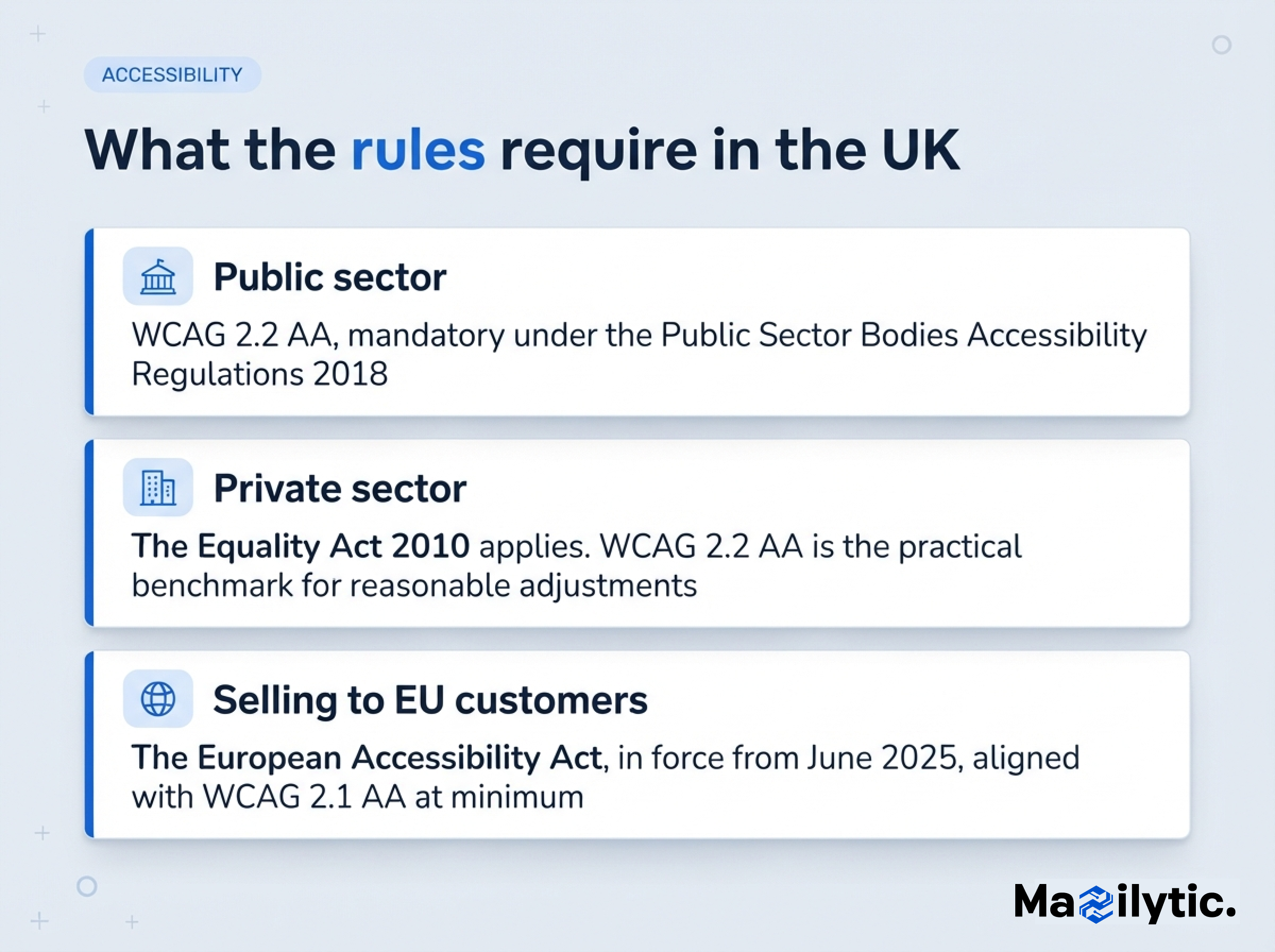
- Public sector: WCAG 2.2 AA, mandatory under the Public Sector Bodies (Websites and Mobile Applications) Accessibility Regulations 2018
- Private sector: The Equality Act 2010 applies. WCAG 2.2 AA is the practical benchmark businesses and courts generally use to assess "reasonable adjustments"
- Selling to EU customers: The European Accessibility Act, enforceable from June 2025, requires accessibility standards aligned with WCAG 2.1 AA at minimum
The WebAIM Million report, an annual audit of the top one million website homepages, consistently finds that the overwhelming majority of sites carry detectable accessibility failures, most commonly low colour contrast, missing image alt text, empty links, and missing form labels. Full, current‑year figures are published annually at webaim.org and are worth checking directly, since they update every year and the specific percentages shift accordingly.
Common UI/UX Mistakes That Cost UK Businesses Customers
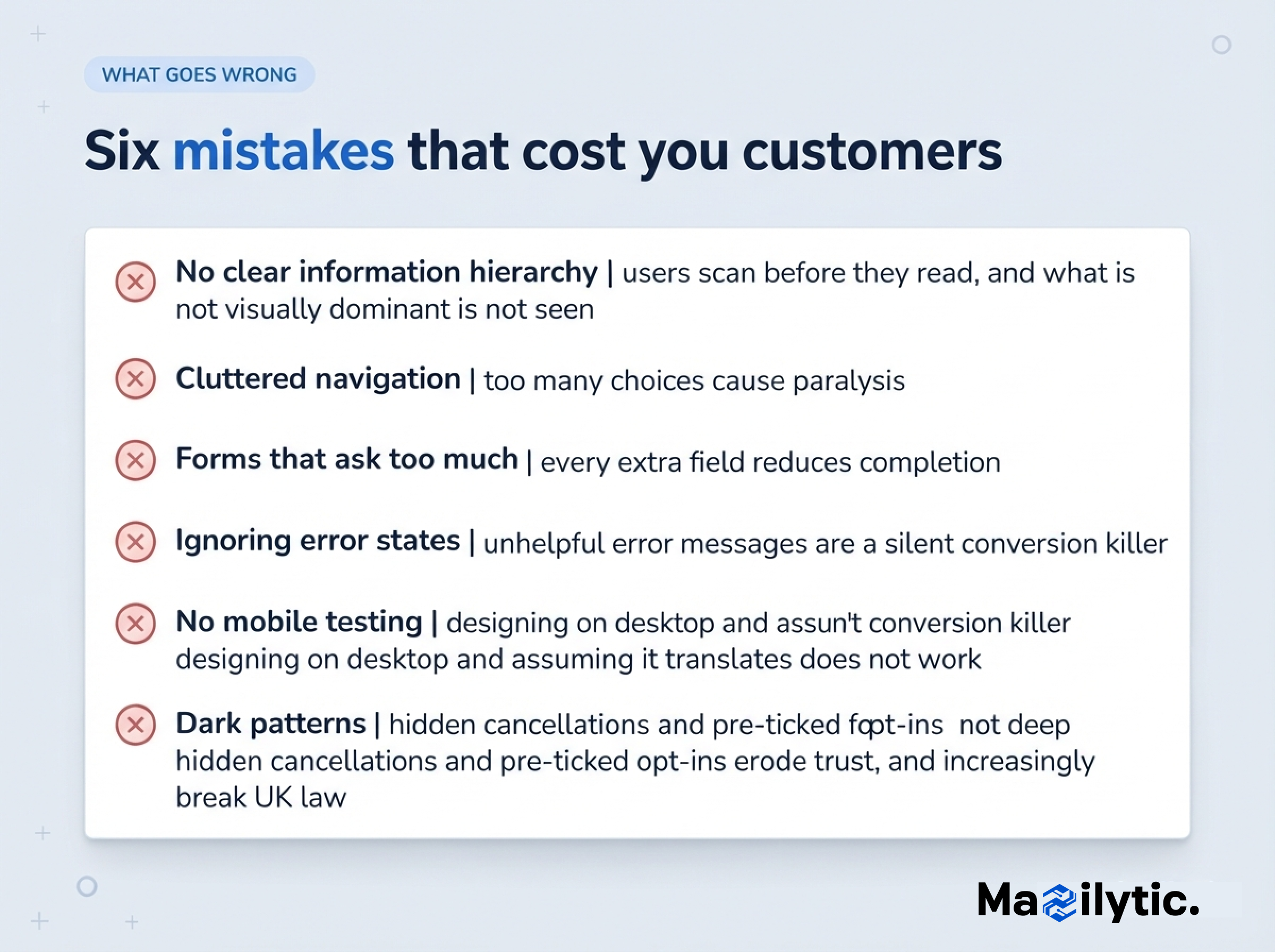
Most UX failures aren't dramatic. They're a series of small frictions that compound until a user leaves and doesn't come back.
- No clear information hierarchy. Users scan before they read. If your most important content isn't visually dominant, it won't be seen.
- Cluttered navigation. Too many choices cause paralysis. Streamline menus to reflect what users are actually looking for, not every service you offer.
- Forms that ask too much. Every additional field reduces completion rates. Ask for what you need at the point you need it.
- Ignoring error states. Broken forms with unhelpful error messages are a silent conversion killer. Design for failure, not just success.
- No mobile testing. Designing on a desktop and assuming it translates doesn't work. Slow‑loading or broken images are a common, easily preventable cause of visitors leaving before they've even seen your content.
- Dark patterns. Pre‑ticked opt‑ins, hidden cancellation paths, and misleading button labels erode trust and, increasingly, run afoul of UK consumer protection law.
UI/UX Design for Different UK Industries
Good UX design for businesses isn't one‑size‑fits‑all. The priorities, constraints, and user expectations vary significantly by sector.
Ecommerce
The priority is conversion. Streamlined product discovery, a frictionless checkout, clear trust signals (reviews, returns policy, security badges), and fast load times are the levers that move revenue. As noted above, Baymard Institute data shows checkout UX fixes alone can increase conversions by 35.26%, a significant return on a relatively focused investment.
Fintech
FCA‑compliant patterns, multi‑factor authentication flows, and clear terms and conditions are non‑negotiable. Fintech UX also demands that every edge case is designed for: failed transactions, authentication errors, and session timeouts, because trust is the product. A confusing or anxiety‑inducing interface doesn't just lose a sale; it loses the customer permanently.
Healthcare
Accessibility, clarity, and emotional sensitivity define healthcare UX. Patients using digital health products are often stressed, in pain, or navigating complex information under pressure. The interface needs to reduce that burden, not add to it. Plain language, logical flows, and accessible design aren't optional. They're the job.
SaaS
Onboarding is everything. The fastest path from sign‑up to "aha moment" (the point where a user understands why your product is valuable) is the most important UX journey you'll ever design. After that, role‑based dashboards, progressive disclosure of features, and low‑friction help systems keep users engaged and reduce churn.
Professional Services
For law firms, consultancies, and agencies, the website is doing sales work. The UX needs to signal expertise, surface proof (case studies, credentials, client names), and make it easy to initiate contact. Friction at the enquiry stage, buried contact forms, unclear next steps, directly costs revenue.
UI/UX Design Trends UK Businesses Should Watch in 2026
- AI‑powered personalisation: Interfaces that adapt to user behaviour, surfacing the right content, product, or CTA at the right moment, are increasingly the competitive standard, as AI tooling for personalisation becomes cheaper and easier to deploy.
- Voice and conversational UI: Voice interaction is emerging as a differentiation lever as users demand more natural, low‑effort interactions, particularly on mobile and smart devices.
- Micro‑interactions: The small animated responses to user actions (a button that confirms a click, a form field that validates in real time) that make an interface feel alive and responsive.
- Brutalist minimalism: Fewer elements, bolder typography, more intentional whitespace. The backlash against visual clutter is shaping a generation of UK sites that trust whitespace to do heavy lifting.
- Accessibility as design standard: With the European Accessibility Act now in force and UK case law evolving, accessibility is being built in from the start rather than retrofitted, and that's producing cleaner, more usable interfaces for everyone.
How to Choose a UI/UX Design Agency in the UK
The right agency isn't the one with the most beautiful portfolio. It's the one that can demonstrate how their work affected business outcomes.
When evaluating a UI UX design agency in the UK, ask:
- Can you show conversion or retention data from past projects?
- What's your process for user research, and do you do it, or skip straight to mockups?
- How do you handle accessibility compliance on new builds?
- Who will we work with day‑to‑day: senior designers or juniors?
- How do you manage feedback and revisions?
Avoid agencies that lead with aesthetics and avoid questions about metrics. Beautiful doesn't mean effective. The best UX agency UK teams are forensic about user behaviour and rigorous about testing.
How Much Does UI/UX Design Cost in the UK?
UI/UX design cost in the UK varies significantly by project scope, complexity, and agency tier. The ranges below are synthesised from current UK agency pricing guides and should be treated as indicative, since no single authoritative industry‑wide guide exists for design pricing:
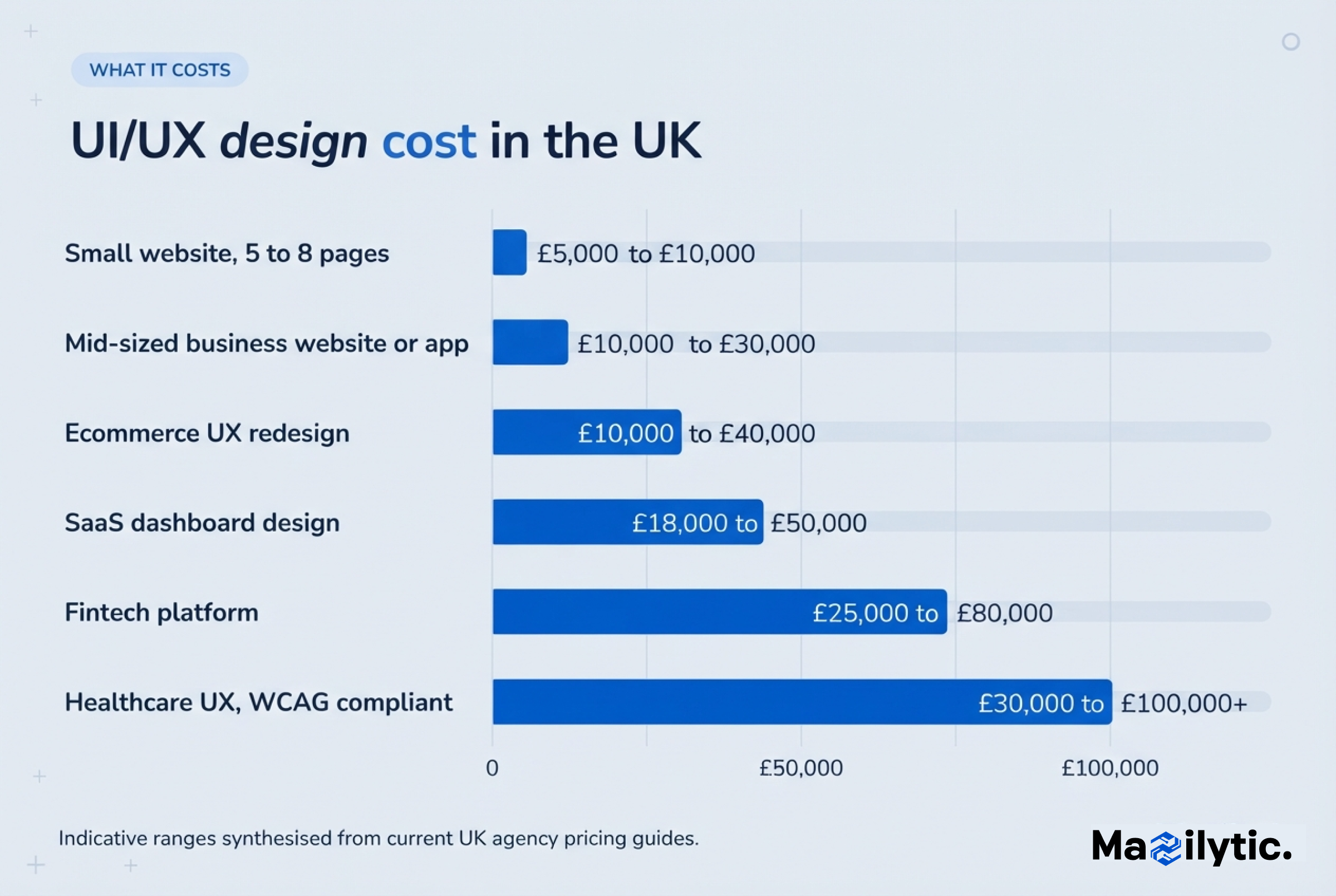
- Small website (5 to 8 pages): £5,000 to £10,000
- Mid‑sized business website or app: £10,000 to £30,000
- Ecommerce UX redesign: £10,000 to £40,000
- SaaS dashboard design: £18,000 to £50,000
- Fintech platform: £25,000 to £80,000
- Healthcare UX (WCAG‑compliant): £30,000 to £100,000+
One caution worth repeating: a low upfront price that skips user research and usability testing often costs more in the long run. When UX issues surface after development, fixing them requires rework at the code level, consistently more expensive than addressing them at the design stage, since the earlier a problem is caught, the fewer downstream systems it affects.
Our UI/UX Design Process at Mazilytic
At Mazilytic, we approach every UI/UX design project as a commercial problem first and a design problem second. Our process follows four phases:
- Discovery: stakeholder interviews, user research, competitive analysis, and defining the metrics that matter
- Architecture: information architecture, user flows, and wireframes that map the journey before we touch visual design
- Design: high‑fidelity UI built to your brand system, with accessibility baked in from the start
- Test and iterate: usability testing, performance benchmarking, and refinement before handoff to development
Our design team works across a range of industries, which means projects benefit from real cross‑sector experience rather than a generic aesthetic applied everywhere.
How to Measure the Success of a UI/UX Redesign
A redesign without measurement is a guess. The metrics that actually matter:
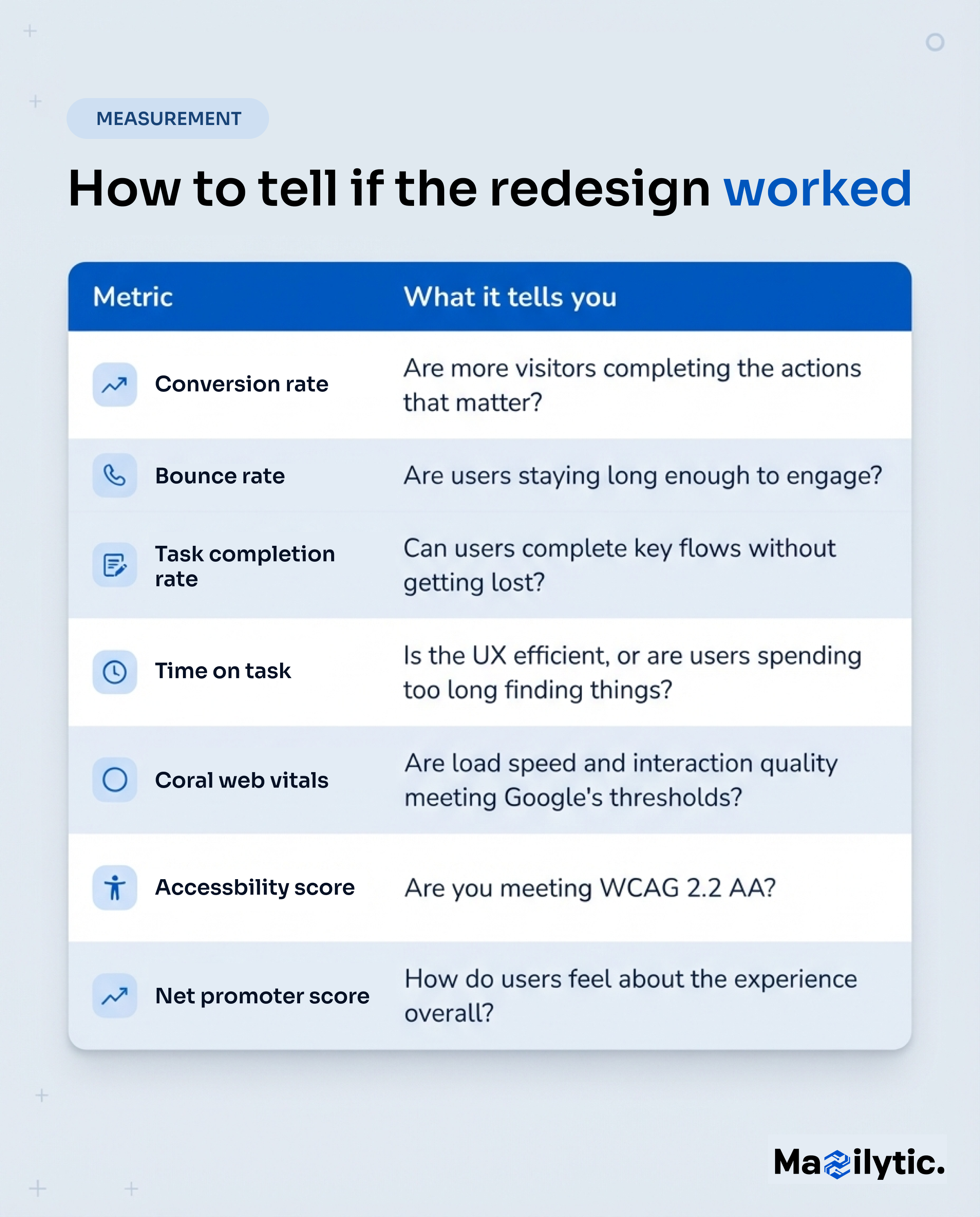
- Conversion rate: Are more visitors completing the actions that matter?
- Bounce rate: Are users staying long enough to engage?
- Task completion rate: Can users complete key flows without getting lost?
- Time on task: Is the UX efficient, or are users spending too long finding things?
- Core Web Vitals: Are load speed and interaction quality meeting Google's thresholds?
- Accessibility score: Are you meeting WCAG 2.2 AA?
- Net Promoter Score: How do users feel about the experience overall?
Track these before and after any redesign. The delta is your proof of value.
Frequently Asked Questions About UI/UX Design
Q1: What does a UI/UX designer do?
A UI/UX designer researches how users interact with a digital product, identifies friction points and opportunities, and creates the interfaces and flows that make the experience intuitive and effective. In practice, this means user research, wireframing, prototyping, high‑fidelity visual design, and usability testing, often in close collaboration with developers and product managers.
Q2: How much does UI/UX design cost in the UK?
Project costs range from around £5,000 for a small website to £100,000+ for complex, regulated platforms in fintech or healthcare. The primary drivers are scope (number of screens and user flows), complexity (number of user roles, compliance requirements), and the level of research and testing included. Skimping on research is a false economy: problems found in design are consistently cheaper to fix than problems found in development.
Q3: Is UI/UX important for SEO?
Yes, directly. Google's Core Web Vitals, which measure load speed, visual stability, and interactivity, are ranking signals. Accessible websites also tend to see stronger organic performance, since the semantic structure required for accessibility is the same structure search engines rely on to understand a page. A well‑structured, fast, accessible website is both better UX and better SEO.
Q4: Should a business redesign its website or improve its existing UX?
A full website redesign in the UK is warranted when the underlying structure, navigation, or information architecture is fundamentally broken, or when the visual design no longer reflects the brand. Incremental UX improvement, fixing specific flows, improving page speed, or addressing accessibility failures, is often the higher‑ROI starting point. A UX audit from a qualified UX agency UK will tell you which situation you're actually in.
Final Thoughts
The businesses that treat UI/UX design as a cost tend to have websites that cost them in lost conversions, high bounce rates, and customers who leave and don't come back. The businesses that treat it as an investment tend to see exactly what the data predicts: more conversions from the same traffic, higher retention, and a digital presence that builds trust rather than quietly undermining it.
If your website isn't performing the way it should, or you're not sure whether it is, the right starting point is an honest audit of what users actually experience when they arrive.
CTA: Talk to Mazilytic's design team about a UX audit